
Frustration breeds agitation
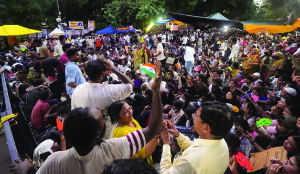
Frustration, when left unaddressed, inevitably breeds agitation. In a democracy, the right to protest is not merely a constitutional guarantee but an essential safety valve through which citizens communicate their grievances
When governance appears arrogant, insensitive, or opaque, the appropriate response is not to restrict fundamental freedoms but to engage with public sentiment through transparency, empathy, and accountability.
Dismissing public movements as "anti-national" without addressing their underlying concerns may yield short-term political dividends, but it ultimately erodes public trust and weakens democratic institutions. Across the world, conventional political systems are increasingly being challenged by a digitally connected and politically aware Generation Z that demands greater participation, transparency, and responsiveness. India, the world’s largest democracy, cannot afford complacency. A confident government listens before it labels, engages before it suppresses, and reforms before public frustration turns into widespread alienation. The recent farmers’ protests and student agitations over competitive examination irregularities illustrate an important democratic reality. Though driven by different issues, both movements reflected a growing perception among sections of society that governance has become less responsive to legitimate concerns. Electoral victories provide governments with the constitutional authority to govern, but they do not diminish the obligation to remain accountable between elections. Democracy is a continuous process of consultation, correction, and course adjustment rather than a five-year endorsement of unquestioned authority. Prime Minister Narendra Modi remains one of India’s most influential and electorally successful leaders. Under his leadership, the government has delivered transformative initiatives in infrastructure development, digital governance, financial inclusion, welfare delivery, border infrastructure, defence modernization, and India’s international standing. Landmark political decisions such as the abrogation of Article 370, a more assertive national security doctrine, significant progress in curbing Left Wing Extremism, stronger border management, and the expansion of India’s digital public infrastructure have fundamentally altered the country’s strategic and administrative landscape. These achievements deserve recognition and have contributed significantly to the government’s repeated electoral success.
However, democratic maturity requires that achievements and shortcomings be evaluated with equal honesty. Strong electoral mandates should never become substitutes for institutional accountability. NDA government led by Narendra Modi, regardless of its popularity, must remain open to criticism and self-correction. Transformative reforms in healthcare, education, and the judicial system have remained missing from the government agenda. Persistent judicial backlogs, uneven public healthcare, declining learning outcomes in government schools, and delays in institutional reforms continue to affect millions. The directionless economic policy has drawn scrutiny over centralisation of wealth, job creation, and private investment, and while prolonged strained ties with some neighbouring countries have raised questions about the effectiveness of certain aspects of the government’s foreign policy.
Governments often argue that major protests are influenced by political opponents or external forces seeking to destabilize the country. India certainly faces hostile neighbours, cyber warfare, misinformation campaigns, and geopolitical rivals eager to exploit domestic fault lines. Such threats are real and demand constant vigilance. Yet attributing every significant protest primarily to conspiracy or foreign interference risks overlooking the legitimate frustrations experienced by ordinary citizens. External actors may exploit unrest, but they seldom create genuine public grievances from nothing. Ignoring those grievances allows dissatisfaction to deepen and provides greater opportunities for manipulation.
The true strength of a democracy lies not in silencing criticism but in responding to it with confidence and institutional maturity. Governments must distinguish between those attempting to incite disorder and citizens demanding better governance. Respectful dialogue often succeeds where coercive measures fail. India’s greatest challenge today is not the absence of ambition but the uneven quality of governance. While highways, airports, digital platforms, and economic reforms have transformed the nation’s image, institutional reforms have not advanced with equal urgency. Administrative inefficiency continues across several departments. Judicial delays deny timely justice to millions. Urban local bodies struggle with sanitation, planning, and civic infrastructure. Public healthcare remains inadequate in many regions, while educational quality varies dramatically across states. Recruitment irregularities and bureaucratic delays continue to frustrate young Indians aspiring to stable employment. Perhaps the most persistent obstacle remains the nexus between corruption, political patronage, and organized vested interests that continue to influence public administration. These entrenched networks undermine transparency, distort policy implementation, and reduce public confidence in institutions. Technology has undoubtedly reduced opportunities for corruption in several sectors, but systemic reforms remain incomplete. Without greater accountability, police reforms, judicial modernization, civil service restructuring, and stronger local governance, India’s developmental aspirations may remain constrained by institutional inertia. Economic management has also produced mixed outcomes. The Goods and Services Tax has strengthened fiscal integration, and India’s macroeconomic resilience has attracted global investors. Yet policy decisions such as demonetisation continue to generate debate over whether the economic disruption justified the intended objectives. Small businesses, informal workers, and rural enterprises bore substantial costs during the transition. Similarly, unemployment, particularly among educated youth, remains a pressing concern despite impressive economic growth figures. Economic success must ultimately be measured not only by GDP but by employment generation, productivity, and improvements in living standards.
Perhaps the greatest concern voiced by critics is the growing perception of centralisation and political arrogance. Democracies flourish when governments encourage institutional debate, tolerate dissent, strengthen federalism, and protect the independence of constitutional institutions. Excessive concentration of decision-making, reduced consultation, and dismissive responses to criticism can gradually weaken democratic culture even when electoral legitimacy remains strong. Governments that become insulated from constructive criticism risk losing touch with public sentiment. The opposition, too, carries an equally important responsibility. Democratic competition should strengthen governance, not weaken national unity. Opportunistic politics that exploits social divisions or fuels misinformation is as damaging as governmental arrogance. Both the ruling establishment and the opposition must recognise that national interest should remain above partisan calculations.
A growing concern is the perceived lack of rigorous regulatory oversight and accountability across several privately run institutions that receive recognition, accreditation, or indirect public support. Critics allege that some private universities, professional and medical colleges, skill development centres, media organisations, and even sections of the legal profession operate with inadequate compliance and governance, allowing vested interests to exploit regulatory loopholes at the expense of ordinary citizens. Weak enforcement, prolonged legal proceedings, and limited institutional accountability have further eroded public confidence. If governments fail to strengthen oversight, ensure transparent audits, and enforce the rule of law impartially, public frustration with corruption and institutional failure could deepen, increasing the risk of a wider confrontation between citizens and the establishment.
India possesses extraordinary opportunities. It has the world’s largest youth population, expanding technological capabilities, growing manufacturing ambitions, and increasing global influence. But demographic advantage alone cannot guarantee long-term prosperity. Institutions must evolve alongside economic growth. Citizens increasingly demand efficient public services, transparent recruitment, swift justice, accountable administration, quality education, affordable healthcare, and corruption-free governance. These are not unreasonable expectations but essential requirements for a modern democracy. Ultimately, the durability of any government depends not merely on electoral victories but on the trust it earns through responsive governance. Political success is temporary; institutional credibility endures. A government that combines decisive leadership with humility, transparency, administrative reform, and compassion for public concerns will strengthen both democracy and national unity. Frustration ignored eventually becomes agitation. Frustration understood and addressed becomes an opportunity for reform.
Perhaps the greatest concern voiced by critics is the growing perception of centralisation and political arrogance. Democracies flourish when governments encourage institutional debate, tolerate dissent, strengthen federalism, and protect the independence of constitutional institutions.
The writer is a public policy expert and columnist; Views presented are personal.