
From Tiger Hill to Operation Sindoor: What Kargil built
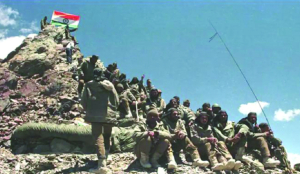
Every year on the twenty-sixth of July, India pauses to remember the men who fought and died to reclaim the heights of Kargil. For those of us who have served in uniform, that anniversary carries a weight that does not diminish with time. It also carries a question that is seldom asked plainly: when India found itself fighting a war it had not anticipated, against an adversary dug into positions of commanding advantage, which country stood beside it without hesitation? The answer, now part of documented military history, is Israel.
The spring of 1999 exposed a series of critical gaps in India’s military preparedness. Pakistani forces, occupying ridgelines in the Kargil-Dras sector at altitudes that made conventional ground assault costly in the extreme, had to be dislodged under strict orders not to cross the Line of Control. The Indian Air Force was tasked with providing precision air support to ground troops attempting to scale positions under fire. The problem was accuracy. Unguided munitions fired at targets on steep, narrow ridgelines from aircraft operating in confined airspace were not producing results. The Mirage 2000H fighter had the capability to deliver laser-guided ordnance, but the integration of the Litening laser designator pod was incomplete, and India, still under sanctions following the 1998 Pokhran nuclear tests, had limited avenues to resolve the gap quickly.
Israel was one such partner. Ignoring pressure from the United States and other Western governments to delay arms shipments, Israel supplied India with the Litening pods and the laser-guided munitions needed to equip its Mirages. It also supplied 155mm ammunition for the Bofors artillery guns that were the backbone of the ground campaign, and Searcher and Heron unmanned aerial vehicles that gave India its first sustained reconnaissance capability over enemy positions at high altitude. On June 24, 1999, a Mirage 2000H used a Litening pod to guide laser-directed munitions onto Pakistani Army command and control structures atop Tiger Hill. It was the first combat use of laser-guided bombs by the Indian Air Force. The conflict turned. Tiger Hill was taken.
That moment matters not simply as military history. It established the foundational character of the India-Israel defence relationship: reliable, operationally responsive, and unconditioned by political calculation. India’s experience with several of its traditional suppliers during Kargil was instructive in precisely the opposite direction. The relationship that followed was shaped by that lesson.
In the years after Kargil, India built its inventory of Israeli systems deliberately. Heron and Searcher UAVs provided persistent surveillance along the Line of Control. Phalcon airborne early warning systems extended India’s aerial situational awareness. Spike anti-tank guided missiles reached ground forces. Spice-2000 guided bomb kits, a further Israeli precision munition, were employed in the February 2019 Balakot strike targeting Jaish-e-Mohammed training infrastructure in Pakistan. The relationship deepened through each of these acquisitions, but what it had not yet achieved was the formal transition from buyer-seller to co-developer.
Operation Sindoor in May 2025 marked a further threshold. Indian strikes on Lashkar-e-Taiba and Jaish-e-Mohammed infrastructure employed Israeli-made Harop loitering munitions and Spice-250 precision bomb kits. The Harop, a loitering munition that collapses the interval between reconnaissance and strike into a single system, demonstrated a doctrinal evolution in India’s counter-terror and cross-border strike capability that the lessons of Kargil had made necessary. The hardware carried Indian doctrine and Israeli technology in the same airframe.
This is the strategic continuum that the February 2026 Jerusalem Summit has now addressed institutionally. When Prime Ministers Modi and Netanyahu formally elevated the bilateral relationship to a Special Strategic Partnership for Peace, Innovation and Prosperity, they did not create something new. They gave permanent structure to something already proved in combat.
The Industrial R&D and Innovation Fund, established at the summit as a co-development mechanism, is the instrument through which the transition from buyer to co-producer will be governed. The stated objective of both governments is the joint development of unmanned systems and counter-drone platforms under the Make in India framework, with the ambition of third-market export. This is not a future aspiration. It is the logical next stage of a trajectory that began in 1999 and has run without interruption through every major test of the relationship since.
The counter-terrorism dimension of the partnership deserves equal emphasis. Prime Minister Modi formally thanked Prime Minister Netanyahu at the summit for Israel’s support in India’s fight against terrorism. That expression of thanks rests on a foundation built over decades, through intelligence sharing, Special Forces training cooperation, and a common understanding of the threat that neither country has ever been able to afford to reduce to diplomatic abstraction.
On this anniversary of Kargil Vijay Diwas, it is worth stating plainly what the historical record shows. When India needed a partner that would not calculate its risks or weigh its commitments against external pressure, Israel was one of them. Twenty-seven years later, the architecture of that partnership is stronger, more capable, and more institutionally embedded than at any previous point in its history. The men who reclaimed Tiger Hill deserve to be remembered alongside the relationship their war helped build.
The writer (Vir Chakra) is a 1971 war hero and the National President of the Rashtriya Sainik Sanstha; Views presented are personal.