
From rights to duties: Path to Viksit Bharat drawn
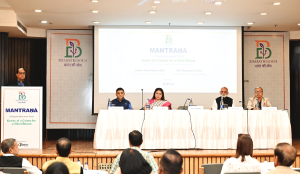
The role of citizens as active participants in nation-building took centre stage at the latest session of Mantrana, the flagship discussion series by Bharat Ki Soch. Centred on the theme “Duties of a Citizen for a Viksit Bharat,” the session on April 16, 2026, brought together thought leaders, policymakers, diplomats and engaged participants to deliberate on the duties of citizenry that must underpin India’s developmental aspirations.
The panel, comprising Justice Arjan Kumar Sikri, Former Judge, Supreme Court of India; Meenakshi Lekhi, Former Minister of State for External Affairs of India; Anil Rajput, Chairman, Bharat Ki Soch; RK Pachnanda, Director, Bharat Ki Soch; and Raghvendra Singh, Advisor, Bharat Ki Soch shared their insights on the relevance of public responsibility in today’s evolving national and global landscape.
India’s oldest national daily since 1865, The Pioneer, is the media partner of the Bharat Ki Soch, a think tank dedicated to fostering indigenous perspectives on governance, economy and commerce, health and wellbeing, agriculture and food security, environment and sustainability, and national security.
Drawing upon decades of judicial experience, Justice Sikri highlighted the evolution and inclusion of fundamental duties within the Indian Constitution. “In India’s ancient civilisational context, there existed a deeply ingrained sense of duty, where societal behaviour was guided by established norms and a collective responsibility towards the larger good. Over time, this alignment between societal conduct and collective responsibility has eroded. The idea of fundamental duties reinforces that democracy cannot function through rights alone. It requires citizens who are conscious of their obligations towards the nation, society, environment and future generations. These duties are not merely a constitutional provision, but a reminder that nation-building depends on an aware, responsible and enlightened citizenry committed to the common good. In today’s uncertain and volatile environment, India, drawing from its civilisational values, also has the potential to play a larger role in shaping and stabilising the global order,” Justice Sikri said.
Building on this and her experience across law, public policy and diplomacy, Meenakshi Lekhi contextualised fundamental duties through the lens of the Constitution’s preamble, emphasising their integral relationship with rights and their relevance to India’s 2047 vision of Viksit Bharat.
“The preamble defines the goals of justice, liberty, equality and fraternity, and fundamental rights and duties are two sides of the same coin in achieving these principles. One person’s right is another person’s duty. While rights are enforceable against the state, duties ensure that the same system is sustained by citizens.
For instance, while the right to education guarantees access to schooling, it is equally the responsibility of parents to ensure that children are sent to schools. A nation cannot progress if its citizens weaken the very systems they are part of, and the journey towards Viksit Bharat requires all stakeholders to move in the same direction with a shared sense of purpose,” she said.
In his address, Anil Rajput highlighted that the idea of citizen responsibility is deeply rooted in India’s scriptures and must be central to how India envisions its future. “A Viksit Bharat is not merely an economic milestone, but a collective expression of responsible citizenship. Development is not only engineered through policy, but co-created by citizens through their everyday actions. Our civilisational texts have long emphasised duty as a foundational principle, and development must be understood as a collective effort where citizens play an active role. What is required is a cultural awakening of responsibilities, where the mindset shifts from ‘what do I get’ to ‘what can I give,” he said.
RK Pachnanda, Director, Bharat Ki Soch, emphasised that the vision of a Viksit Bharat requires the foundational element of the Praja Dharma. Dharma demands a Praja (citizenry) that is vigilant against the divisive allure of misinformation and unwavering in upholding Indian unity and integrity. It calls for a shift from a mindset of entitlement – constantly asking what the nation can provide – to a mindset of contribution – asking what we can bring to the national table.
Raghvendra Singh moderated a discussion, including an interactive session with the audience, exploring diverse perspectives on civic responsibility, governance, and social cohesion to be brought into the conversation.