
France’s first traditional hindu Mandir
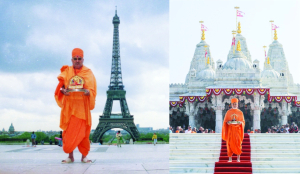
In Paris, a city renowned for art, beauty, and culture, France’s first newly built traditional BAPS Hindu Mandir is more than a remarkable example of Indian architecture. It stands as a living symbol of the cultural bond between India and France
It was 7 July 1970. An aircraft travelling from London to Mumbai made a brief stop at Orly Airport in Paris. For the passengers, it was perhaps nothing more than an ordinary pause in their journey. Little did anyone know that, in that brief halt, an invisible seed of history was being sown.
Among the passengers was Swami Yogiji Maharaj, who was returning to India after consecrating a Hindu mandir in London. At that moment, the visionary guru asked two of his disciples, Pramukh Swami Maharaj and Mahant Swami Maharaj, to step off the aircraft. Thus, for the first time, two swamis of the Swaminarayan tradition set foot on French soil, carrying the sacred murti of Swaminarayan Bhagwan in their hands. In accordance with their guru’s wish, they descended from the aircraft, paused in prayer, and then returned.
It was then that Yogiji Maharaj expressed a profound resolve: “One day, a beautiful mandir will be built in Paris.” At that moment, there was no land for a mandir, no construction plan, no team of artisans, and no architectural blueprint. There was only the divine resolve of a guru and an unshakable faith in God.
Time moved on. Years turned into decades. Yet today, that sacred resolve has pierced through the veil of time and risen upon French soil as an enduring monument.
This newly built mandir is not merely a place of worship. It is also a comprehensive center for Indian culture, art, education, and dialogue. Located at Allée Madame de Montespan, 77600 Bussy-Saint-Georges, France, in the eastern suburbs of Paris, the approximately 5,000-square-metre complex has two principal dimensions: a traditional mandir on the upper level and a cultural center, designed in the form of a haveli, beneath it.
5 pinnacles, 10 magnificent domes, 20 monumental pillars adorned with intricate carvings, 120 ornate windows, 49 sculptural character panels, and four elegantly ornamented chhatris reflect the timeless identity of traditional Indian architecture. The sanctum, prayer hall, and assembly hall further reveal the spiritual vision at the heart of the mandir.
Equally remarkable is the global collaboration embodied in its construction. Different varieties of marble sourced from Greece, India, Italy, and Vietnam, along with sandstone from Gwalior in India, have come together to give the mandir a truly international character. In India, skilled artisans painstakingly hand-carved these stones with motifs drawn from the classical traditions of Hindu sculpture. These sculpted stones then travelled to France, carrying with them the artistic heritage of a civilization thousands of years old, where they were harmoniously integrated with modern French engineering.
The grand haveli, built in the ancient Maru-Gurjara architectural style, houses an assembly hall, classrooms, exhibition spaces, recreational areas, offices, and other multipurpose facilities. The entire complex thus becomes, at once, a place for darshan, a center of learning, a museum of culture, and a space where people can come together.
Significantly, the complex stands within the Esplanade des Religions et des Cultures, an area where places of worship representing different religious traditions stand alongside one another, a beautiful expression of mutual respect and peaceful coexistence.
The forthcoming Festival of Culture, to be held from 2 to 14 September, will be a celebration of this broader vision. A Vedic Mahayagna, a Palkhi procession, a journey on the River Seine, a grand procession passing near some of Paris’s celebrated landmarks, and a variety of cultural programs will offer more than festive occasions; they will create opportunities for cultures to meet and hearts to connect. The consecration and inauguration ceremony by Mahant Swami Maharaj on 6 September will mark a defining moment in this historic journey, with devotees from across the continents gathering to celebrate the mandir’s harmonious blend of traditions.
At a time when the world continues to struggle with divisions, conflicts, and cultural intolerance, a new cultural landmark has emerged on French soil, one that will stand as a living symbol of the unity between two great civilizations: India and France.
The creator and spiritual inspiration behind this mandir, Mahant Swami Maharaj, says: “This mandir has not been built to establish the identity of any one community, but to bring people of diverse identities closer to one another. Its very construction carries an important message: our paths may be different, but the ground of respect and coexistence can be one.”
The dedication of the swamis and volunteers in building this mandir is unforgettable. Of course, some carved the stones, some managed the arrangements, and some prepared the meals, but together, each one placed a piece of their heart into this mandir.
The mandir that now stands in Paris is not merely a symbol of India. It is a symbol of a deeper faith: that when cultures learn to respect one another, boundaries begin to fade, and a new mandir of humanity is built.
Dr Swami Gyanananddas is a dedicated follower of the Swaminarayan tradition and has earned a PhD from MS University; Views presented are personal.