
Expanding aspirations of Bharat: PM Modi’s call from the Red Fort
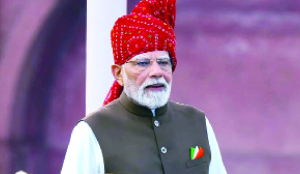
Every time the Tricolour rises, it tells a story. A story of sacrifice, struggle, courage and an unbreakable national spirit. But this Independence Day, the Tricolour also represents something more: the confidence of a nation that has travelled a remarkable distance and is now marching towards a bigger dream.
“Har Ghar Tiranga, Har Man Tiranga” is not merely about putting the national flag on every rooftop. It is about carrying the spirit of Bharat in every heart. It is about remembering where we came from, recognising how far we have travelled and believing in how far we can go.
Eighty years after Independence, Bharat stands at a fascinating point in its journey. The country that was once described as one of the world’s Fragile Five is today among the major economies of the world and has emerged as the fastest-growing major economy. This transformation did not happen overnight. It is the result of millions of Indians participating in the nation’s growth, backed by reforms, infrastructure development, technology and a government determined to deliver at scale.
To understand this change, one does not always have to look at complicated economic reports. Sometimes, the story of a changing India can be seen in the everyday life of an ordinary family. A gas connection reaching a household. A toilet being built for a poor family. A home becoming a reality. A digital payment being made within seconds. A farmer receiving access to formal credit. A young person launching a startup. A woman becoming a Lakhpati Didi. A family installing solar panels and reducing its electricity bill. A modern train carrying passengers across an increasingly electrified railway network. These individual stories together tell the larger story of New India.
Twelve years ago, piped gas was available in only around 70 cities. Today, that network has expanded to nearly 700 cities. The number of households receiving piped gas has risen from barely 20 to 22 lakhs to nearly 1.75 crore. The speed of providing gas connections has increased six times.
The same transformation can be seen in India’s energy journey. Twelve years ago, the country had only around 2 GW of solar energy capacity. Today, it has reached around 160 GW. Through the PM Surya Ghar Muft Bijli Yojana, more than 50 lakh households have already adopted solar energy. For many families, the rooftop is no longer simply a part of the house. It has become a source of clean energy, lower electricity bills and, in some cases, additional income through the sale of surplus electricity.
India’s railway transformation tells an equally remarkable story. Railway electrification began in 1925, yet progress remained gradual for decades. What followed in the last decade, however, has been historic. Electrification has accelerated from just about 1.42 km per day between 2004 and 2014 to an average of more than 15 km per day between 2019 and 2025. The pace underscores a transformative shift in how quickly the network is being modernised. Electrified track share rose from 24 per cent in 2000 to 40 per cent in 2017, and crossed 96 per cent by the end of 2024.
Today, that century-long journey is approaching its finish line. As of November 2025, India has electrified an impressive 69,427 route kilometres, covering about 99.2 per cent of its railway network, out of which 46,900 RKMs have been electrified between 2014 and 2025. What once took generations is now being achieved in years. Modern railway coach production has increased 21-fold, reflecting the scale and speed of India’s manufacturing push. The numbers become even more striking when we look at technology and manufacturing. Mobile phone production has increased 35-fold. Digital transactions have increased 100-fold. Electric vehicle sales have risen from around 1.5 lakh in 2009-10 to 25 lakh in 2025-26.
India’s transformation is also visible in the way the Government approaches governance. Thousands of compliances have been removed and hundreds of outdated laws have been repealed. A young nation aspiring to become a developed country cannot carry the administrative baggage of another century. The objective is clear: simplify governance, reduce unnecessary barriers and create an environment where citizens and businesses can move forward with confidence.
The SVAMITVA Scheme is another example of how development can change economic possibilities in rural India. Nearly 3.25 crore families have benefited from the scheme, unlocking assets worth around Rs 140 lakh crore. A property that once existed only as an informal asset can now become a recognised economic resource, help families access bank loans and create new opportunities.
After 35 years, the country received a new National Education Policy. The number of universities has expanded significantly and India is moving towards the milestone of 1,000 universities. Medical education has also expanded, opening more opportunities for young Indians to serve the nation in healthcare.
Then there is the entrepreneurial energy of a new generation. Startup India has helped create an ecosystem of more than 2.5 lakh registered startups. The young Indian is increasingly moving from asking, “Where will I get a job?” to asking, “What can I build?” The proposed Rs 1 lakh crore Innovation Fund strengthens that confidence. It tells the youth that their ideas matter, their dreams matter and the nation is willing to stand behind their innovation.
The bioeconomy provides another glimpse of this new India. From a turnover of around Rs 60,000 crore before 2014, the sector has grown to around Rs 20 lakh crore. This is the story of young scientists, innovators, entrepreneurs and institutions turning knowledge into economic opportunity. And perhaps one of the most powerful transformations is taking place quietly in villages across Bharat. The goal of creating 3 crore Lakhpati Didis has been surpassed. Now the country is moving towards the target of 6 crore Lakhpati Didis.
India’s growth story is therefore not confined to big cities, highways, airports or corporate boardrooms. It is unfolding in villages, homes, farms, classrooms, laboratories, startups and small businesses.
The most important change, however, is psychological. India is increasingly moving from a mindset of limitation to a mindset of possibility. The journey from being counted among the Fragile Five to becoming the fastest-growing major economy is not simply a story of GDP. It is a story of confidence. It is the confidence that Bharat can compete with the world, create at scale, innovate at speed and build for generations to come. That is why the vision of Viksit Bharat by 2047 is not an abstract political slogan. It is a national resolve built on the foundations being laid today.
When we look at the Tricolour, we see the sacrifices of our freedom fighters. But we should also see the aspirations of a billion-plus Indians who want to build an even stronger, prosperous and self-confident Bharat. The Tricolour belongs to every Indian. It flies over every achievement, every aspiration and every dream. And with every passing year, the Tiranga is not merely rising higher. The Bharat it represents is rising higher too.
The author is National Coordinator of Digital Library and Documentation, BJP; Views presented are personal.