
Environmental and economic damages due to Iran war
The US-Israel-Iran conflict has evolved into a major geopolitical and economic crisis, disrupting global energy supplies, raising fears of nuclear escalation and causing severe environmental damage. The closure of the Strait of Hormuz and rising oil prices may also significantly impact economies such as India
Trump claimed to have obliterated all Iranian nuclear facilities in Operation Midnight Hammer, using US B-2 bombers and Israeli missiles during the 12-day war in June 2025. Yet, his forces, along with the Israelis, launched Operation Epic Fury on 28 February 2026, bombarding Iranian nuclear enrichment sites, missile manufacturing facilities, hundreds of naval ships and IRGC installations. Trump again claimed to have destroyed Iranian naval and air power, as well as missile launchers, during the 39-day-long war and unilaterally declared a ceasefire. Since then, negotiations between the US and Iran have made no headway. Trump has been demanding that Iran surrender 450 kg of enriched uranium and suspend programmes aimed at developing nuclear weapons. The Strait of Hormuz, which remained open for international trade until 28 February, has now been closed by Iran to exercise leverage in negotiations. Trump also ordered a naval blockade in the Gulf of Oman to prevent cargo ships from transiting to and from Iranian ports in the Persian Gulf, with a view to embargoing oil movement and blocking revenue that funds the war. This has not proved effective, as Chinese ships have defied the blockade. The Iranian regime is fighting for survival and does not wish to surrender its only leverage - the closure of Hormuz.
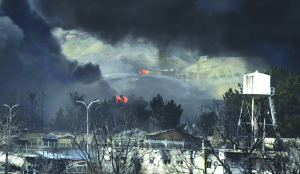
The bombardment of Iranian energy infrastructure, oil refineries, oil stocks and ships transporting oil in Iran, Kuwait, Bahrain, Saudi Arabia, Israel and the UAE has caused environmental damage at both regional and global levels. The black rain that followed in Tehran during the recent conflict contains atmospheric pollutants. The environment is choked with pollutants released from the burning of heavy fuel — a low-quality by-product of oil refining — including methylene chloride, benzene and acetone. Benzene, notably, is known to cause cancer. Missiles and drones generate chemically laden debris, which falls on agricultural land surrounding military and oil infrastructure sites. Combined with fires on the ground, these chemicals remain in the soil and considerably reduce agricultural productivity. Around 5,000 MT of explosives are believed to have been dumped in the region, polluting air, water and soil. The environmental impact of the war has far-reaching consequences, affecting human health, livelihoods and even contributing to catastrophes caused by rising seas.
During the 39 days, Iran struck all 13 US bases in GCC countries, as well as Israeli defence and civilian infrastructure, oil refineries and residential areas near Dimona, close to the nuclear research centre. Dimona is believed to produce plutonium for Israel’s undeclared nuclear weapons programme. It hosts the IRR-2 heavy water reactor, which operates outside IAEA safeguards. The Strait of Hormuz, through which 20 million barrels of oil and gas per day once flowed for global consumption, has been choked by the Iranian IRGC, and now only a trickle passes through, triggering one of the biggest global energy crises.
Theodore Postol, a professor of nuclear physics at the Massachusetts Institute of Technology and a former Pentagon adviser, stated before Western media — based on engineering data and battlefield evidence — that Iran already possesses the material needed to move quickly towards developing a bomb. Iran’s stockpile of 450 kg of 60 per cent enriched uranium hexafluoride could potentially produce 11 atomic bombs. Prof. Postol further added that experience suggests Iran would not make the first use of a nuclear bomb. However, if the US or Israel were to use nuclear weapons against Iran, a response would be inevitable. From its existing stockpile of 60 per cent enriched uranium hexafluoride, Iran has the capability to further enrich it to 90 per cent within less than two weeks.
Despite continuous bombardment of its nuclear sites at Isfahan and Natanz, Iran’s capability has not been completely obliterated. Nearly 100 centrifuges required for further enrichment to weapons-grade material could reportedly be brought into operation quickly, enabling the preparation of 11 atomic bombs. These centrifuges can be installed inside tunnels and concealed locations. Three atomic bombs could destroy an area of 25 square kilometres, such as Tel Aviv, while 11 would theoretically be sufficient to eradicate Israel entirely.
Even if Iran has not assembled a complete nuclear bomb, a delay of two weeks in response would make little difference in strategic terms. Even lower-grade nuclear weapons could unleash urban firestorms, radiation exposure and radioactive rainfall, leading to massive casualties in cities such as Tel Aviv.
Iran’s technological base has not been undermined despite decades of sanctions and international isolation. Iran’s targeting of Israel and American bases with ballistic missiles is considered a game changer. Prof. Postol says ballistic missiles travel at hypersonic speeds of up to Mach 5 or more, leaving detection systems with only seconds to react. Israeli claims that they intercept 90 per cent of missiles and drones are also disputed.
This asymmetric warfare has created economic cost imbalances between Iran and the far more powerful US. Iranian drones costing ten to twenty thousand dollars are intercepted using missile defence systems operated by the US and Israel, with each interceptor missile costing several million dollars. Attacks on US allies in GCC countries, disrupting supply chains and energy infrastructure, amount to attacks on the economic lifelines of adversaries. Iran does not seek to overpower the US and Israel militarily, but rather to demoralise them psychologically and inflict damage on their military and economy. Democracies such as the US and Israel often struggle to sustain prolonged wars, as approval ratings for leaders in such countries can decline sharply. Six months from now, Trump’s Republican Party faces the US midterm congressional elections, and he is keen to exit the war early. As the stronger side, failure to secure a decisive victory would place the US at a disadvantage. The side that endures longer gains the advantage. Henry Kissinger once observed, “The guerrilla wins if he does not lose. The conventional army loses if it does not win.”
It is high time that Trump distances himself from Netanyahu and halts the supply of weapons and air defence systems. Annual inflation in the US has sharply increased from 2.4 per cent in February to 3.3 per cent in early May. Global oil production has declined by 10 per cent, while petrochemical production has fallen by 7 per cent. Helium and fertiliser production have also suffered setbacks. Unless normalcy is restored, prices will remain elevated, and the midterm elections could prove disastrous for Trump.
The shockwaves will also be felt in the Indian economy. Despite strong growth in automobiles, cement, credit and consumer demand during March, April and May, real growth is projected to decline by 1.2 per cent. If the average oil price for the year remains around $85 per barrel, compared with last year’s average of $70 per barrel, India will have to pay an additional $40 billion for energy imports - roughly 1 per cent of GDP. If prices average around $100 per barrel, the economic headwinds could amount to 2 per cent of GDP. Hopefully, such a situation does not arise. Cuts in excise duty on petrol and diesel, continuing losses at oil marketing companies, and subsidies on LPG and fertilisers may further impact GDP by 1.2 per cent. If oil prices remain elevated, fuel and LPG prices may have to increase. A rise of Rs 10 per litre could reduce GDP growth by 0.4 per cent annually.
We must therefore respond to the Prime Minister’s appeal, in which he urged citizens to reduce gold purchases for the next year. In a follow-up measure, the Central Government increased the duty on gold and silver from 6 per cent to 15 per cent to suppress demand. This would help reduce dollar outflow and stabilise the weakening rupee. The use of public transport and working from home were followed diligently during COVID; these habits should again be encouraged to address the current situation. Such measures also reduce the carbon footprint amid worsening environmental degradation. The Prime Minister has also advised reducing foreign travel, which could provide a boost to the domestic tourism sector. His appeal to reduce dependency on foreign goods and move towards swadeshi products should be followed. Finally, reducing the use of chemical fertilisers could make Indian agriculture more resilient.
The writer is former Head of Forest Force, Karnataka, and teaches Economics at the Karnataka Forest Academy; Views presented are personal.