
EC rejects reports of internal rift
INDIA bloc parties likely to meet on September 30 to discuss the strategy
Facing criticism and a political onslaught over reported fissures within the Election Commission over the nationwide Special Intensive Revision (SIR) exercise, the poll body came out on Saturday to counter reports of dissent within and issued a point-by-point clarification on allegations about its functioning, saying all decisions are taken unanimously.
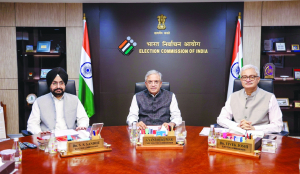
The three Election Commissioners also met for the first time since the controversy broke out three days ago and announced some decisions. The poll body said it approved all decisions on the SIR of electoral rolls, including the nationwide exercise, unanimously. It announced measures to simplify the process for voters facing notices over discrepancies.
The poll panel said the Supreme Court upheld the declaration attached to Form 6 for the SIR. The poll body said those who receive notices during the ongoing SIR for being unmapped or having logical discrepancies will not ordinarily have to appear before the electoral registration officer (ERO).
BLOs will visit the homes of such persons to collect documents and then upload them on the ECINET for the ERO’s decision. Such persons need not be called for a hearing at the ERO/AERO office.
The detailed clarification or rebuttal also came after three key NDA allies on Friday urged Chief Election Commissioner Gyanesh Kumar to come clean on the allegations and restore public confidence in the institution. The main opposition Congress held a nationwide protest on Friday demanding Gyanesh Kumar’s resignation. Three BJP allies — LJP (Ram Vilas), TDP and RLM — have also sought a clearer explanation from the EC. This is the first time the Commission has outlined its internal functioning and laid out its position in a letter to the Cabinet Secretary. The Opposition parties, which have been against the SIR, are preparing for a coordinated response, with the INDIA bloc parties likely to meet here on September 30 to discuss the strategy.
On the Form 6 issue, questions were raised over a declaration attached to the form during the SIR process, asking prospective voters to map to the previous SIR via their parents’ names. The EC said the Supreme Court has upheld the declaration attached to Form 6 for the SIR. For non-SIR periods, forms prescribed under the Registration of Electors Rules, 1960, will be used.
In a letter to the Cabinet Secretary, the EC said the letters sent by the two commissioners — Sukhbir Singh Sandhu and Vivek Joshi — to the Cabinet Secretary were not related to any policy matter of the Commission or its IT division, but to the work of an officer on deputation to the poll panel.
The work re-distribution orders issued by the officer concerned were not implemented after the orders of the two Commissioners, and the Deputy Election Commissioner (DEC) never withdrew oversight of the IT division, the EC said in the statement, issued with the approval of the full Commission.
“In recent months, the Commission has taken numerous decisions, including on SIR across the country. The order for the SIR, issued on June 24, 2025, for all States/UTs, starting with Bihar, followed by West Bengal and 30 other States/UTs, was issued with the unanimous approval of the Commission. The Hon’ble Supreme Court of India upheld the same vide its order dated May 27, 2026. The Commission issued the schedule for SIR for 12 States and UTs on October 27, 2025, and for 19 States/UTs on May 14, 2026, with unanimous approval. The final figure for the number of electors will be known only after the final publication in the remaining 12 States of Phase III,” the poll body said in a statement.
At a meeting held on Saturday, the Commission decided that voters who receive notices during the ongoing SIR over being unmapped or having logical discrepancies will not ordinarily have to appear before the Electoral Registration Officer (ERO).
Booth-level officers (BLOs) will visit their homes to collect documents and upload them to ECINet for the ERO to decide. Hearings will be held only in exceptional cases, preferably online. An adult family member can also attend a hearing on behalf of the elector if authorised. The Commission said it would strengthen facilities for online hearings. The Commission also directed district election officers to set up help desks and special camps for people living in night shelters, labourers, poor people and homeless persons, depending on local requirements.
The EC said SIR has been completed in 20 states and Union Territories, including Bihar and West Bengal. It said voters whose names were left out during or after the exercise, as well as young and first-time voters, can apply to the concerned ERO for inclusion through continuous updation. Chief Electoral Officers (CEOs), DEOs and EROs have been directed to launch a special enrolment drive.
On ECINET, concerns were raised over access to the electoral-roll database and the functioning of the portal. The poll body said the work redistribution orders issued by the officer were not implemented following directions from two Commissioners, and that oversight of the IT division by the Deputy Election Commissioner was never withdrawn.
The EC said field officers have role-based access to the ECINet system based on their statutory powers. A committee headed by a senior Deputy Election Commissioner and including an independent IIT/IIIT expert will review the system for compliance with relevant laws and rules. The Commission also said future initiatives involving IT modules and portals would be discussed by the Committee of Officers before being placed for approval.
The Commission extended the deadline for filing claims and objections in Delhi till October 30, following a request from the Delhi CEO. The deadline for disposal of notices, claims, and objections has been extended till November 30.