
Delhi Assembly introduces three Bills; officials face Rs 5,000 penalty for service delays
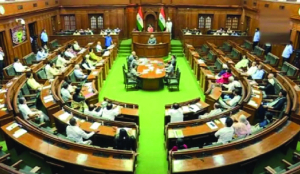
The Delhi Assembly on Monday saw the introduction of three bills. The first bill, “The Delhi Right of Citizens to Time-Bound and Ease of Delivery of Services Bill, 2026,” was tabled by IT Minister Pankaj Kumar Singh. Delhi Minister Ashish Sood introduced two bills — Delhi Private Universities Bill, 2026 and the Delhi Urban Shelter Improvement Board Amendment Bill, 2026.
The Delhi (Right of Citizens to Time-Bound and Ease of Delivery of Services) Bill, 2026 fixes officials’ accountability for delaying service delivery without valid reasons or improperly reject applications. A penalty of Rs 250 per day, up to a maximum of Rs 5,000, may be imposed on the official concerned. A similar penalty ranging from Rs 250 to Rs 5,000 will apply in cases of wrongful rejection of applications, with the amount being recoverable as a penalty from their salaries, according to the Bill copy.
The penalty mechanism applies in two situations: delay without valid reason and wrongful rejection of applications. In both cases, the penalty ranges from Rs 250 per day to a maximum of Rs 5,000. The official concerned will be given an opportunity to present their case before any action is taken. The legislation will cover all Delhi Government departments including MCD, NDMC, Delhi Cantonment Board, Delhi Jal Board, DDA, and other notified local bodies and institutions.
The Delhi Private Universities Bill, 2026, aims to establish a framework for setting up private universities in Delhi, reserving 25 percent of seats in each course for Delhi students and providing for multi-storey campuses suited to the capital’s limited land availability. A Delhi Private Universities Regulatory Authority will be established to ensure quality, transparency, and accountability.
Sood said the bill addresses a significant shortage of higher education seats in Delhi. Of the approximately 3.13 lakh students who sit for Class 12 examinations each year in Delhi, only around 1.51 lakh physical higher education seats are available in the city. Delhi University alone accounts for around 71,000 of these seats, while IITs and other institutions offer only 1,200 to 1,500 seats. An estimated 45 to 50 percent of seats in central universities in Delhi go to students from other states, leaving a gap of approximately 1 lakh to 1.5 lakh seats annually for Delhi’s Class 12 graduates. Many Delhi students are currently compelled to seek admission at private universities in the NCR because of the shortage within the city.
The Delhi Urban Shelter Improvement Board Amendment Bill, 2026, proposes a cut-off date from January 1, 2006, to January 2025. The existing law defines a jhuggi-jhopri basti, among other criteria, as a settlement having at least 50 households existing on January 1, 2006.
Additionally, it allows the involvement of the private sector or slum cooperatives in the redevelopment projects.