
Delhi: A bipartisan record of neglect
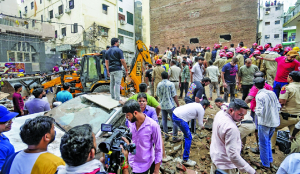
In Delhi, illegal construction, ignored safety norms and regulatory complicity have become a deadly cycle. From Uphaar and Lalita Park to Mundka, Old Rajinder Nagar, Hauz Rani and now Satya Niketan, the names change but the story remains the same: buildings fail because enforcement does
The death toll in the Satya Niketan building collapse has touched seven. Seven young lives snuffed out in an instant when a decades-old, code-violating building simply gave way. It came down barely a few metres from where a near-identical collapse killed two workers in 2022, in a structure the civic corporation had already declared dangerous, a warning nobody acted on. And every few years the story repeats: building-code violations and entrenched corruption killing Delhi’s own citizens, with no political will to fix it.
Three UPSC aspirants drowned in July 2024 in an Old Rajinder Nagar basement the MCD’s own inspection found had been illegally converted from parking into a coaching-centre library. In 2022, investigators found the Mundka building where 27 workers burned to death had no fire clearance and one exit for roughly a hundred employees.
Delhi Police told the Delhi High Court that at least 43, by some counts 45, died in the 2019 Anaj Mandi fire, in a factory that had deliberately avoided a legal power connection. Officials attributed the 2010 Lalita Park collapse, which killed around 65 people, to an unauthorised construction the civic body had cleared without scrutiny. And court records from the Uphaar Cinema case found illegally installed extra seating blocked exits during the 1997 fire that killed 59.
Earlier this year, fire tore through an illegally expanded bed-and-breakfast in Hauz Rani, killing at least 22 people — among them members of two Indian families and medical tourists from Africa, Central Asia and Bangladesh who had come to Delhi’s hospitals for treatment. The building was licensed for six rooms and was running twenty-five, with a single entry-exit point. Delhi’s building-safety failures are no longer a domestic story alone; foreign embassies are now watching too.
Seven documented disasters across three decades — Uphaar, Lalita Park, Anaj Mandi, Mundka, Old Rajinder Nagar, Hauz Rani and Satya Niketan — now account for well over 200 deaths tied, on the official record, to unauthorised or non-compliant construction. No party can be credibly absolved of a share, based on who held power when each regulatory failure occurred.
Congress-led governments ran Delhi for fifteen consecutive years under Sheila Dikshit, during which unauthorised colonies climbed into the thousands and regularisation became routine policy. When the Supreme Court ordered sealing of illegally used premises in 2006, a Congress-led central government pushed the Delhi Laws (Special Provisions) Act through Parliament to stay those orders - legislation the Court itself later held was beyond the legislature’s competence.
The civic bodies that were BJP-controlled for the fifteen years before the 2022 municipal unification, whose engineers issue, or fail to withhold, building and fire clearances, were in charge when both Anaj Mandi and Mundka occurred. Successive central governments, including BJP-led ones, kept re-enacting the same “special provisions” shield in 2014, 2017, 2021 and 2023, and the current BJP-led Delhi government has launched yet another “as-is-where-is” regularisation drive rather than a safety audit.
The AAP governed Delhi from 2013 and took charge of the unified MCD from December 2022. On AAP’s watch, over both the state government and the civic body, the Old Rajinder Nagar basement - per the MCD’s own findings — had been operating in violation of building bylaws for some time before the deaths occurred.
None of this requires speculation about motive: across three decades, Congress, BJP and AAP administrations have each presided over enforcement systems that repeatedly failed to prevent buildings that later killed people. A plausible reason is on the record too - when the MCD tried to seal illegal premises under Supreme Court orders in September 2006, trader protests turned violent and four died in police firing during a bandh.
That episode is widely cited as the moment enforcement became politically costly enough that governments have since preferred renewable moratoria to sustained implementation — a pattern the Supreme Court itself called a “cat and mouse game… to protect the vested interests of those having little or no respect for the rule of law”.
Delhi’s own disaster management authority does not dispute the scale of this unaddressed risk. The DDMA states plainly that the National Capital Territory falls in Seismic Zone IV, where shaking of intensity up to VIII on the Medvedev-Sponheuer-Karnik (MSK) scale is “quite probable,” with two active fault systems — the Delhi-Haridwar Ridge and the Delhi-Moradabad fault — running through the territory.
The Ministry of Earth Sciences told Parliament this “severe intensity zone” rating stems from Delhi-NCR’s proximity to the Himalayan seismic belt and its Main Central Thrust, Main Boundary Thrust and Himalayan Frontal Thrust systems, where the Indian and Eurasian plates continue to collide.
On what this means for buildings, the DDMA’s own assessment is unambiguous: “till date there is no legal framework to require that all constructions in Delhi must implement seismic code provisions,” so “most buildings in Delhi may not meet codal requirements on seismic resistance”. A gap the authority itself says leaves “a real potential for a great earthquake disaster in Delhi”.
Even where the government tried, follow-through fell short: the NDMA told Parliament in 2025 that a structural safety audit it commissioned for Delhi’s public buildings “could not be continued further due to the unsatisfactory quality of reports submitted by the implementing agencies”. This is not a hypothetical for dramatic effect; it is the Delhi and central governments’ own documented assessment of a risk a fire department can contain and a seismic event will not.
Three decades, seven documented mass-casualty events, and one official, unresolved seismic warning have outlasted every administration that has governed Delhi. That is public record, not partisan conjecture — and it is one voters and courts alike are entitled to keep asking every party in office to answer for.
Delhi Police told the Delhi High Court that at least 43, by some counts 45, died in the 2019 Anaj Mandi fire, in a factory that had deliberately avoided a legal power connection. Officials attributed the 2010 Lalita Park collapse, which killed around 65 people, to unauthorised construction the civic body had cleared without scrutiny; Views presented are personal.
The writer is Director and the Printer & Publisher of The Pioneer; Views presented are personal.