
China’s law of one identity
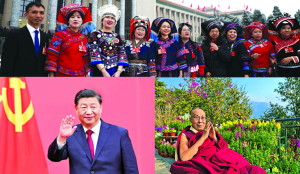
The new law places strong emphasis on promoting standard Chinese language while stating that minority languages remain protected. The conflict lies in priority
Six days before the Dalai Lama celebrated his 91st birthday on July 6, China marked another anniversary that carries enormous symbolic weight for the Communist Party, July 1, the founding anniversary of the Chinese Communist Party and the date Hong Kong was handed back to Chinese sovereignty in 1997. In another era, July 1 in Hong Kong was synonymous with hundreds of thousands of people marching through the streets demanding democracy, judicial independence and political freedoms. This year too, the streets that once displayed one of Asia’s most visible democratic movements remained largely silent. Since 2020, as several key political leaders in Hong Kong have told this writer, Beijing’s National Security Law has effectively dismantled the city’s mass pro-democracy movement, making large-scale dissent increasingly hazardous. In today’s China, and increasingly among Chinese communities abroad, the cost of openly challenging Beijing’s political narrative has risen dramatically.
On that same day, Beijing’s new Ethnic Unity and Progress Promotion Law came into force, a legislation that may become one of the defining documents of Xi Jinping’s era. While Chinese authorities describe it as a measure to protect harmony among China’s 56 ethnic groups, critics argue that it represents something far more consequential. It is the legal transformation of ethnic integration from a political objective into a state obligation. The law arrives at a moment when China’s confidence on the world stage appears to be expanding rapidly. The International Monetary Fund has revised China’s 2026 economic growth forecast upwards to 4.6 percent while lowering the global growth outlook. China’s financial institutions have continued their extraordinary rise, with seven Chinese banks reportedly occupying positions among the world’s ten largest banks by tier-one capital, including the four largest positions held by state-owned lenders. At sea, China and Russia have conducted live-fire maritime exercises near Qingdao, while Beijing continues to expand its nuclear capabilities, including efforts to strengthen its sea-based deterrent. A China that is economically stronger, militarily more capable and diplomatically more assertive is simultaneously tightening its definition of what it means to belong to the Chinese nation.
That is why the ethnic unity law deserves attention beyond the borders of Tibet, Xinjiang or Inner Mongolia. It is not merely a domestic administrative measure. It represents a fundamental question about the future structure of China itself. For decades, the Chinese state maintained a formal bargain with ethnic minorities, political unity in exchange for recognition of cultural distinctiveness. The existence of autonomous regions, minority language protections and preferential policies were presented as evidence that China could remain one country while accommodating different historical identities. The new law appears to shift that balance. It does not remove autonomous regions from the constitution, but it changes the ideological foundation upon which autonomy was originally justified.
The most important phrase in the new legislation is the requirement to “forge a strong sense of community for the Chinese nation”. To Beijing, this phrase represents national solidarity. To critics, it represents the final stage of a long transformation from recognising diversity to managing diversity. The distinction is not semantic. It determines whether Tibetans, Uyghurs and Mongols are viewed as distinct communities contributing to China’s civilisation or simply as cultural variations expected to merge into a dominant national identity defined by the state.
The Chinese government insists that this interpretation is unfair. Beijing argues that the law protects all ethnic groups equally, prohibits discrimination and guarantees cultural rights. Chinese officials point to poverty reduction, infrastructure development, improved education and economic opportunities in minority regions as proof that integration has benefited ethnic communities. They argue that a shared language and shared national identity do not destroy culture but provide minorities with greater opportunities within a modern state.
However, critics point to a historical pattern that cannot be ignored. Across many empires and nation-states, assimilation rarely begins with an announcement that cultures will disappear. It usually begins with language reform, educational restructuring and a new definition of citizenship. The most significant battles are often not fought over flags or borders but over classrooms, textbooks and the language spoken by children.
The Tibetan language question demonstrates this precisely. The earlier ethnic autonomy framework promised protection of minority languages as a foundation of cultural survival. The new law places strong emphasis on promoting standard Chinese language while stating that minority languages remain protected. The conflict lies in priority. A language can be legally protected yet gradually weakened if it loses its role in education, administration and public life. Once children stop learning their ancestral language fluently, cultural preservation becomes a symbolic exercise rather than a living reality.
China has confronted this question before. During the Qing dynasty, the imperial court controlled Tibet, Mongolia and other frontier regions but often recognised that political loyalty did not require complete cultural transformation. The Qing approach was based on imperial management rather than creating a single national identity. The modern Chinese state faces a different challenge, but the historical lesson remains relevant. Attempts to impose uniformity upon diverse societies frequently create deeper identity tensions rather than eliminate them.
The Republic of China later introduced the concept of “Five Races Under One Union”, attempting to transform imperial diversity into a modern nation. It was an ambitious idea that recognised Han Chinese, Manchus, Mongols, Tibetans and Hui as components of one political community. The Communist Party inherited this challenge after 1949 and initially developed a system of ethnic regional autonomy. The contradiction is that the same state that once promised protection of difference is now increasingly emphasising the political necessity of sameness. Can a minority preserve a distinct identity while accepting Chinese sovereignty, or does Beijing now view such distinction itself as a potential political risk?
The most controversial element of the new law is its possible international reach. The legislation states that organisations and individuals outside China who engage in activities considered to undermine ethnic unity and progress can be held legally accountable. This clause has triggered concern among governments, human rights organisations and diaspora communities. The issue is not simply whether China can defend itself against separatism. Every state has that right. The issue is whether broad definitions of separatism and ethnic division can be used against journalists, academics, activists and ordinary people engaging in lawful expression abroad.
The European Union and the United States have expressed concern that the legislation could provide another mechanism for transnational repression. Human rights groups argue that China has already used pressure tactics against overseas communities, including surveillance, intimidation and attempts to silence criticism. The new law, critics fear, could provide a stronger legal vocabulary for such actions.
This development also carries implications beyond ethnic policy. Taiwan has become increasingly central to Beijing’s national narrative. The law contains provisions promoting cross-strait exchanges and strengthening a sense of belonging to the Chinese nation. At a time when Western analysts have repeatedly discussed possible timelines surrounding Beijing’s Taiwan ambitions, including assessments that the late 2020s could represent a period of heightened risk, the ethnic unity law sends a broader message. The Chinese leadership views national integration as a historic mission.
The Chinese government sees this law as a safeguard against fragmentation. Its critics see it as the institutionalisation of assimilation. History will judge which interpretation proves more accurate, but one fact is already clear. The meaning of autonomy in China has entered a new era. The old promise was that different peoples could remain distinct while sharing one state. The new direction appears to be that different peoples must first become part of one state-defined identity before their differences can be accepted. That is not simply a change in ethnic policy. It is a redefinition of what China means by unity itself.
The writer is a columnist based in Colombo; Views presented are personal.