
Celebrations erupt as Pradhan resigns, CJP withdraws agitation
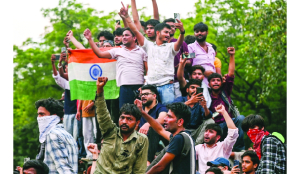
Within minutes of Union Education Minister Dharmendra Pradhan’s resignation on Saturday afternoon, the mood at Delhi’s Jantar Mantar transformed from one of defiance to celebration before gradually giving way to an orderly dispersal as the Cockroach Janta Party (CJP) called off its month-long agitation over the NEET controversy.
As vehicles streamed towards Jantar Mantar, patriotic songs blared from loudspeakers while supporters raised slogans celebrating what they described as a hard-fought victory. At 2:18 pm, when news of Pradhan’s resignation reached the protest site, students hugged each other, danced, waved flags and burst into chants.
The CJP announced the immediate withdrawal of its protests across the country after a meeting with Union Ministers JP Nadda and Jitendra Singh, claiming the government had accepted all its key demands, including Pradhan’s resignation, withdrawal of FIRs registered in Delhi and BJP-ruled States, compensation for families of students who allegedly died by suicide after the examination controversy, and further discussions on examination reforms.
Addressing a joint press conference, CJP spokesperson Saurav Das said the group was ending the agitation “in good faith” and that the government had agreed to provide written assurance by Tuesday. The two sides are scheduled to meet again after four weeks to discuss a five-point charter on broader education reforms.
Union Health Minister JP Nadda said the government had agreed that no retaliatory action would be taken against protesters and that FIRs registered in connection with the agitation would be withdrawn. He also said compensation would be provided to affected families within existing rules.
Back at Jantar Mantar, volunteers immediately began cleaning the protest site. “Long live student unity. Abhijeet bhaiya and everyone else led with conviction, and we got his resignation,” a CJP volunteer said while picking up discarded banners and plastic bottles.
The emotional high point came when CJP founder Abhijeet Dipke, who had led the movement after returning from the United States, announced Pradhan’s resignation to thousands of supporters. Overcome with emotion, Dipke fell to his knees as the crowd erupted in cheers. Despite repeated announcements by volunteers and police, many protesters lingered, reluctant to leave the site that had become the epicentre of the nationwide movement.
The internet shutdown in parts of central Delhi added to the confusion, with several students approaching journalists to verify whether reports of the minister’s resignation were genuine or merely rumours. Soon afterwards, loudspeaker announcements by both CJP volunteers and Delhi Police urged protesters to return home peacefully. Metro stations that had remained shut during heightened security arrangements were reopened to facilitate dispersal.
Special Commissioner of Police (Law and Order) Devesh Chandra Srivastava appealed to protesters to cooperate with police personnel and maintain peace while leaving the area. “The dispersal of the public has begun. All our senior police officers and personnel are at the scene. We have opened some metro stations to facilitate dispersal,” he said. Speaking to The Pioneer, Special Commissioner of Police Ajay Chaudhry said the police’s priority was to ensure the protest site was cleared peacefully and that no one was injured during the dispersal. He urged students to cooperate with police, as the agitation had officially been withdrawn by the CJP.
Even amid the celebrations, memories of the police crackdown during the Parliament march on July 20 remained fresh. Parth, a college student at the protest, welcomed the minister’s resignation but questioned the use of force by security personnel during the demonstrations.
“We welcome the resignation, but the action by the police injured many and should be questioned,” he said, adding that the movement had disproved stereotypes that “Gen-Z is lazy.”
The month-long agitation, which began on June 20, had evolved into much more than a conventional political protest. Alongside fiery speeches and slogans, students used music, poetry and dance to express their anger over alleged examination irregularities and repeated paper leaks, turning Jantar Mantar into a vibrant space of artistic resistance.
The movement gathered momentum after activist Sonam Wangchuk was removed from his hunger strike by police on July 18, culminating in a massive march to Parliament on July 20 that witnessed lathicharge and the use of tear gas. Saturday’s resignation and subsequent agreement between the government and the CJP marked the end of one of the capital’s longest-running student-led protests in recent years.
By evening, volunteers had started cleaning the area, and the crowds had thinned. Additionally, all Delhi metro stations were operational by Saturday evening.