
BRICS Summit success reflects India’s rising global leadership
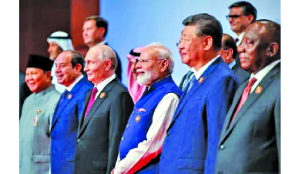
The successful conclusion of the 18th BRICS Summit in New Delhi has once again demonstrated India’s growing influence in shaping the global conversation. More importantly, the summit reflected the vision, diplomatic maturity and decisive leadership of Prime Minister Narendra Modi, under whose guidance India has increasingly emerged as a confident and constructive voice on the world stage.
Held under the theme “Building for Resilience, Innovation, Cooperation and Sustainability”, the summit brought together leaders of the expanded BRICS grouping at a time when the world is facing geopolitical tensions, economic uncertainty, technological disruption and growing challenges to multilateral cooperation. The adoption of the New Delhi Declaration by consensus was one of the most significant outcomes of the summit and a strong endorsement of India’s leadership. The success becomes even more significant considering the diversity of the expanded BRICS grouping. Its members have different political systems, economic structures, strategic interests and regional priorities. Bringing such a diverse group together around a common agenda requires sustained dialogue, mutual respect and the ability to build consensus. India demonstrated precisely these qualities during its chairship.
Prime Minister Modi has consistently advocated a foreign policy based on dialogue, cooperation and strategic autonomy. This approach was clearly visible during the BRICS Summit. Rather than allowing differences among member countries to overshadow areas of common interest, India focused on practical cooperation in areas that directly affect the lives and livelihoods of people.
The scale of India’s BRICS chairship itself underlines the seriousness with which the country approached the responsibility. More than 400 meetings and engagements were held across 30 cities, involving ministers, parliamentarians, officials, experts, businesses and civil society representatives. The wide geographical spread of these engagements helped take BRICS beyond a leaders-only platform and brought different sections of society into the process.
A particularly important aspect of India’s leadership was its emphasis on the Global South. India has repeatedly argued that developing and emerging economies must have a stronger voice in institutions of global governance. The New Delhi Declaration reaffirmed the BRICS commitment to greater representation of emerging markets and developing countries in global decision-making structures. It also called for reforms in institutions such as the United Nations, the IMF, the World Bank and the WTO.
This is consistent with Prime Minister Modi’s broader vision of India as a bridge between developed and developing nations. India’s own development experience gives it credibility when it speaks about digital inclusion, financial inclusion, technology, sustainable development and affordable solutions for developing societies.
Economic cooperation was a major pillar of the summit. Under India’s chairship, BRICS advanced work on the Economic Partnership Strategy 2030, resilient global value chains and greater economic cooperation. Discussions on cross-border payments and local currencies also continued.
India’s emphasis on innovation was equally significant. Technology and science are increasingly important to economic competitiveness and social development. The summit placed innovation, science and technology at the heart of BRICS cooperation, including emerging technologies and knowledge sharing.
The summit also focused on sustainable development, climate action, healthcare, urban development, women-led development and youth cooperation, highlighting BRICS as a platform for cooperation on issues directly affecting ordinary citizens. India’s chairship also highlighted the importance of people-to-people relations. Business, youth, women, academic, parliamentary and civil society forums formed an important part of the year-long engagement. Such initiatives can help BRICS evolve from an intergovernmental platform into a broader partnership among societies.
Prime Minister Modi’s leadership has been particularly important in maintaining India’s ability to engage simultaneously with countries that may have competing interests. India’s approach has been to keep channels of dialogue open, protect national interests and seek areas where cooperation is possible. This balanced diplomacy has enhanced India’s credibility as an independent and reliable partner.
The New Delhi Summit therefore represents more than the successful hosting of an international event. It is a reflection of India’s changing place in the world. The fact that BRICS leaders specifically commended India’s 2026 chairship and expressed gratitude to the Government and people of India for hosting the summit is an important recognition of the country’s stewardship.
The summit has also strengthened the idea that the Global South need not remain merely an observer in the making of the international order. India has increasingly sought to ensure that developing nations have a meaningful voice in discussions on global finance, trade, technology, climate change, development and international security. For Prime Minister Modi, the successful BRICS Summit is another milestone in India’s continuing diplomatic journey. His emphasis on consensus, cooperation, innovation and inclusive development has helped India project itself as a country willing to shoulder greater responsibility in global affairs. The message from New Delhi is clear: India is no longer simply responding to changes in the international system; it is increasingly helping shape the conversation about its future.
The successful conclusion of the BRICS Summit, the unanimous adoption of the New Delhi Declaration, the extensive programme conducted during India’s chairship and the broad agenda covering economic growth, technology, sustainable development and Global South cooperation together make the summit a significant achievement. It is, above all, a testament to India’s growing diplomatic confidence and Prime Minister Narendra Modi’s leadership at a time when the world needs greater dialogue, cooperation and trust.
The New Delhi Summit has strengthened India’s position as a key voice of the Global South and as an important force in building a more balanced, inclusive and cooperative global order.
The writer is a political analyst; Views presented are personal.