
BRICS needs the K-factor to become BRICKS
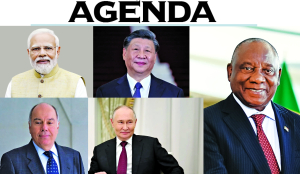
When BRICS leaders of eleven member states and representatives of ten partner countries gather in New Delhi on 12 and 13 September, the members alone will represent nearly half of humanity and around two-fifths of world output. That is considerable weight. But weight is not the same as meaning. At twenty, BRICS has accumulated the first faster than the second.
BRICS wants reformed institutions, fairer trade and a multipolar order. Fair enough. But what does BRICS believe in? Wanting is not believing. The G7, for all its contradictions, can still state an organising idea in a sentence. BRICS cannot. It has an agenda, a bank, a summit calendar, partners and aspirants. What it still lacks is a political ethic strong enough to matter when bargains stop paying.
So what is missing? I would call it the K-factor. BRICS needs a K, for kinship. Add it and the acronym spells the material - BRICKS. But a brick becomes a brick only after firing, and this clay has been sitting in the yard for twenty years. The point is not the wordplay. The point is whether membership of BRICS means anything when it becomes inconvenient.
Today, the world and we are living in an age that I call the New-Muco Era. That is, this is a period in which a ‘New World Matrix is Under Construction’. The old order of the past century is fraying and crumbling. We all seem to be in a state of worry, fear, ambiguity and hope as to what the world of tomorrow will be. This age in which we live has the opportunity and potential to architect the world of tomorrow in which our children and future generations will live.
The world of the 21st century increasingly looks to be an age in which nations, cultures and communities will interoperate in a matrix, or can be imagined as a mesh network of states tied together by trade corridors, payment rails, data cables, energy routes and mineral chains.
That changes the arithmetic of power. Comprehensive National Power asks what a state possesses. In a networked world, position matters too: which critical connections run through you, and whom do they connect? I call this Comprehensive Nodal Power. But nodes can be bypassed. Under pressure, purely transactional networks discard weak links.
This is where kinship stops being sentimental and becomes strategic. What keeps a relationship alive when it becomes costly is not utility alone, but obligation. BRICS membership cannot abolish national interest, nor should it. But kinship lengthens the horizon of interest. Reciprocity asks what comes back. Kinship asks what is owed even when the return is not immediate. That obligation can survive disagreement and outlast a transaction.
The test is inside the room
BRICS now faces a battle of coherence. Coherence does not mean conformity. It means enough obligation for disagreement not to become disintegration.
Most commentary asks what BRICS can do about a West-dominated world. I think the harder question for leaders when they meet in Delhi is this: what do you intend to do for each other? The eleven members bring different systems, interests, disputes and rivalries. Two major wars now touch BRICS directly: the Russia-Ukraine war and the US-Israeli war against Iran, which has already strained relations inside the grouping. None of this is disqualifying. Kin quarrel. But a grouping that cannot manage its own conflicts cannot credibly prescribe solutions for everybody else’s.
Four tests would tell us whether BRICS is acquiring the K-factor.
First: kin do not leave each other’s seat at the table in doubt. BRICS demands reform of global governance, yet one permanent UN Security Council member still stops short of explicitly backing India’s claim to a permanent seat in the very institution being reformed. The contradiction is hard to miss.
Second: kin do not price each other at market rates in a hard year. When a member faces sanctions, tariffs, a currency run or another external shock, nobody is asking others to absorb unlimited costs. The simpler question is: does BRICS membership alter the calculation at all? If it makes no difference when support becomes costly, then it is a transaction, not kinship.
Third: kin try the household before they go to the neighbours. BRICS will not eliminate bilateral disputes, nor should it become a supranational court. But where feasible, members should first try bilateral or intra-BRICS accommodation rather than reflexively carry their quarrels to rival power centres.
A family that always needs an outsider to settle its arguments has not built much confidence at home.
Fourth: kin show up. They show up when invited. They show up in loss and mourning, in crisis, and in happiness and celebration. Presence matters. Attendance may look ceremonial, but in relationships it is evidence.
BRICS certainly needs more capacity and better implementation. It has no permanent secretariat. But even if it had one, no secretariat, working group or task force can make members turn up for one another. Institutions can organise cooperation. They cannot manufacture obligation.
And then there is expansion. Beyond the eleven sits a widening circle of partner countries. For now, I am less interested in who joins next than in whether the existing eleven can demonstrate the K-factor. Let the Delhi Declaration show that first. Enlargement can follow. An expanding family with no settled duties is not a family. It is a guest list.
Twenty years of mass. The next twenty will be decided by whether the members owe each other anything.
Robinder Sachdev is President of the Imagindia Institute, New Delhi, and author of Trumpotopia - A Guidebook to Decode Donald Trump; Views presented are personal.