
Beyond the medal table: Why the Asian Games matter to India’s place in Asia
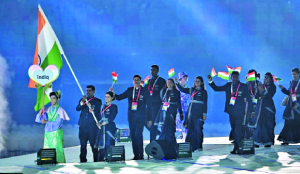
The 20th Asian Games will officially get underway in Aichi-Nagoya, Japan, on September 19, bringing together the best sporting talent from across the continent. For India, the immediate objective is obvious, build on the historic performance in Hangzhou and once again establish itself among Asia’s leading sporting nations.
But the Asian Games represent something larger than a collection of medals. For India, success in Nagoya is also about positioning itself within Asia, not merely as an economic, technological or geopolitical power, but as a country whose sporting capabilities increasingly match its broader ambitions.
At the Hangzhou Asian Games, held in 2023 after being postponed from 2022, India crossed the 100-medal mark for the first time, winning a record 106 medals, including 28 gold. It finished fourth in the medal standings, behind the continent’s traditional sporting giants China, Japan and South Korea.
That fourth-place finish is significant. China, Japan and South Korea have for decades represented the gold standard of Asian sport. Their sporting ecosystems, infrastructure, coaching systems and Olympic traditions are deeply established. India breaking into that group, even if a little behind the top three, is an important marker of its changing sporting profile.
The significance of Hangzhou was not simply that India won 106 medals. India had been winning respectable numbers of medals at the Asian Games for several editions. What changed was the scale and particularly the number of gold medals. Twenty-eight golds helped India finish ahead of Iran, Uzbekistan and Indonesia and firmly establish itself as the fourth-ranked sporting nation in Asia at the Games.
This improvement has not happened by accident. An improved medal tally since the 2006 Asian Games is a reflection of progressive investment India has made in a group of sports that have become the backbone of its international ambitions: shooting, wrestling, boxing, badminton and athletics among them. Athletics, in particular, has traditionally been an area where India performs considerably better at the Asian Games than at the Olympics.
The competition should also not be dismissed simply because the Olympics remain the ultimate benchmark. In sports such as shooting, wrestling, boxing and badminton, the Asian Games bring together an extraordinary concentration of world-class talent. China, Japan and South Korea, among others, are formidable opponents. A gold medal in such an environment is therefore not merely a continental achievement; it is valuable preparation for the Olympics.
But there is another dimension to this success that deserves greater attention: soft power.
Sport has always been one of the most visible expressions of national capability. Countries use sporting success to project confidence, organisational capacity and national identity. The Asian Games are particularly important for India because they provide a stage on which it competes directly with the countries that dominate the wider Asian geopolitical landscape.
China’s sporting supremacy reinforces its image as a global power. Japan’s Olympic tradition and sporting infrastructure complement its technological and economic standing. South Korea’s success in sports sits alongside its extraordinary influence in technology, entertainment and culture.
India’s rise is not confined to its economy, technology, space programme or diplomatic influence. It is also becoming visible on the sporting field and that can be further sustained by a strong performance in the Asian Games.
The Commonwealth Games provide another indication of this trajectory. India finished fourth at Glasgow 2026 with 39 medals, despite a heavily reduced programme that excluded several of its traditional strengths. The Asian Games, however, are a much more meaningful test of India’s standing because the field represents its own neighbourhood and includes the sporting powerhouses against whom India must ultimately measure itself.
There is, nevertheless, an important caveat. India has established itself as a significant power at the Asian Games and Commonwealth Games, but it has not yet converted that strength into equivalent Olympic success. The Olympics remain a different level of competition, both in depth and pressure.
That conversion must ultimately be the objective. A short-term Olympic target of 12-15 medals and a place inside the top 20 over the next 2-3 editions would represent a significant breakthrough.
Nagoya, therefore, should not be viewed simply through the question of whether India can surpass 106 medals. That would be an important achievement, but the larger question is whether India can consolidate its position among Asia’s leading sporting nations.
A strong fourth-place finish or, better still, a move into the top three would have significance beyond the medal table. It would demonstrate that India’s emergence as a major Asian power is increasingly visible in another arena.
The Olympics remain the pinnacle of sport. But the Asian Games are Asia’s sporting mirror. And if India can continue to see itself near the top of that mirror, it will strengthen not only its sporting confidence, but also the image of India as one of the continent’s leading powers.
The writer is a sports management consultant with over a decade of experience in sports promotion and development. His work across both the private and government sectors gives him a well-rounded view of India’s sports ecosystem; Views presented are personal.