
Barricades go up at Sindhi Academy as protest converges on Kashmere Gate’s old college building
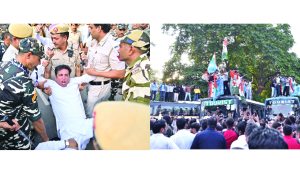
The road outside Sindhi Academy near Kashmere Gate filled early, well before the Aam Aadmi Party’s march was due to move. By the time it started, the column had barely covered a short stretch before police barricades closed across the route, stopping the protesting AAP, left, and Congress workers from reaching the Delhi Chief Electoral Officer’s office further down the road. They were seeking the resignation of Chief Election Commissioner (CEC) Gyanesh Kumar over alleged irregularities in the Special Intensive Revision (SIR) of electoral rolls.
Delhi Police, along with paramilitary personnel, had a hard day preventing protesters from reaching the office, even after they blocked the road at the office gate. The CEO’s office sits inside the Old St Stephen’s College Building, a colonial-era structure that, over the week, has become an unlikely focal point for a city’s anger over voter rolls.
While a few were detained, several agitators tried to jump the barricades as they raised slogans against Kumar as well as the BJP leaders, and waved their party flags and cutouts. The police later allowed a few of them to cross, go to the CEO office, and submit their representations.
Delhi Traffic Police had already flagged the area as a likely bottleneck, naming Boulevard Road, Ring Road, SP Marg and NS Marg as stretches where movement would be regulated, and Lothian Road as a route that might close altogether.
The advisory asked commuters heading toward Kashmere Gate, Old Delhi and the adjoining lanes to find another way in, warning that buses and other vehicles could be pushed onto Mahatma Gandhi Marg, past Shanti Van Chowk, Hanuman Mandir, Chhata Rail, Mori Gate Gole Chakkar and Pul Dufferin instead.
At the barricade line near Sindhi Academy, Saurabh Bharadwaj stood with AAP’s workers as the march stalled. Speaking to reporters, he pushed back against any attempt to fold his party into the wider INDIA bloc effort unfolding the same day. “We are not part of the INDIA bloc, but we are certainly in India,” he said, before turning to the substance of the protest itself, accusing authorities of orchestrating systematic deletions from the voter rolls and calling the scale of it “outright fraud.”
Slogans carried along the stopped column, the same two that have threaded through nearly every protest this week: “Vote chori nahi chalegi” and “Vote chor, gaddi chhor.” Workers pressed toward the barricades without breaking through them, the metal line holding between the marchers and the stretch of road leading to the CEO’s office.
Bharadwaj, still at the AAP side of the cordon, said Delhi Police had allowed only three people through to go inside and speak with the CEO, a restriction he called unjust and demanded be withdrawn. He linked the day’s protest to two before it, recalling the AAP’s earlier demonstrations at Jantar Mantar on October 2 and at India Gate on October 4, part of what he described as a sustained campaign rather than a single flashpoint.
He also looked ahead to the date already being spoken of as the next big gathering. People from across the country, he said, would protest against the CEO on October 10, with Jantar Mantar positioned as the epicentre of that agitation, a date the Cockroach Janata Party has separately called its own protest for at the same site.
Separately, through the same window between noon and 3:30 pm, representatives of the Delhi constituents of the INDIA bloc led by the Delhi Congress converged on the same building from a different direction. Leaders of INDIA bloc parties met Delhi Chief Electoral Officer (CEO) Ashok Kumar. They demanded cancellation of the ongoing Special Intensive Revision (SIR) of the electoral roll and restoration of the 47.56 lakh names excluded from the National Capital’s draft voter list.
As per the statement issued by the parties, the delegation comprising leaders from the Congress, Rashtriya Janata Dal (RJD), Communist Party of India (CPI), CPI(M), CPI(ML), RSP, AIFB and Trinamool Congress (TMC) submitted a memorandum to Kumar after marching from Kashmiri Gate to the Delhi election office. Over 47 lakh names have been excluded from the draft roll prepared during the SIR, with notices issued to over 33 lakh people over “discrepancies” in their records. The leaders of the INDIA bloc also held a march from Kashmere Gate to the CEO office.
By mid-afternoon, the roads around Kashmere Gate carried the visible strain of the morning’s barricading, slow-moving traffic backing up toward ISBT, Chandni Chowk, Sadar Bazar and the stretch near Red Fort, the kind of citywide ripple that a protest confined to one Government building’s gate can still produce across an entire quarter of old Delhi. Workers remained massed at the barricade near Sindhi Academy through the window the traffic advisory had marked out, the line of police holding its position as the afternoon wore on and the CEO’s office, barely visible past the barricades, continued to receive its delegations one small group at a time.