
Balen Shah puts India and China at centre of first UNGA address
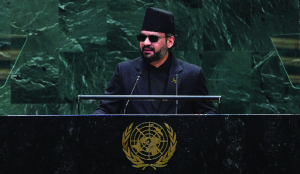
Nepal Prime Minister Balendra Shah placed India and China at the centre of his first address to the United Nations General Assembly (UNGA), proposing a trilateral mechanism to strengthen climate resilience across the Himalayan region.
Addressing the 81st UN General Assembly, Shah called for the creation of a Himalayan Climate Resilience Mechanism led by Nepal, India and China. He proposed cooperation on satellite data sharing, early-warning systems, monitoring of dangerous glacial lakes and disaster preparedness. “The Hindu Kush Himalaya is home to nearly two billion people,” Shah said, highlighting the region’s importance to water, agriculture, ecosystems and livelihoods.
Shah’s proposal came after devastating floods and related disasters in the Himalayan region. He stressed that the impact of such disasters does not stop at national borders. “Climate change does not recognise borders. Glaciers and floods do not travel with stamps and passports,” Shah said.
The Nepali prime minister said the recent disaster had affected areas on both sides of the Nepal-China border before floodwaters moved downstream towards India. He argued that the scale and cross-border nature of such disasters made greater regional coordination necessary. Shah also thanked India and China for their assistance following the disaster. The emphasis on both neighbours is significant for Nepal, which has historically sought to maintain close relations with India while expanding its engagement with China. The country sits between the two Asian powers and has repeatedly attempted to preserve strategic room for cooperation with both.
India remains an important partner for Nepal in trade, connectivity, energy and cross-border movement, while China’s economic engagement with Nepal has expanded over the past decade.
Shah’s UN address focused primarily on climate change, disaster resilience and Nepal’s broader foreign-policy priorities rather than presenting the proposed mechanism as a formal geopolitical arrangement.
The initiative nevertheless places India and China together in a proposed framework at a time when Nepal faces increasing climate-related risks in the Himalayan region.
Shah said Nepal’s own contribution to global greenhouse-gas emissions is extremely small compared.
The prime minister also urged greater international cooperation on disaster preparedness, arguing that early warnings, scientific information and emergency response systems need to operate across borders.
For Kathmandu, the proposed mechanism would provide a framework for cooperation with both of its powerful neighbours on an issue that directly affects all three countries.
Whether the Himalayan Climate Resilience Mechanism develops into a functioning regional initiative will depend on the response from India, China and other countries in the region. Shah’s first UNGA address has, however, placed trilateral climate cooperation firmly among Nepal’s international priorities.