
Amit Shah sets new security agenda
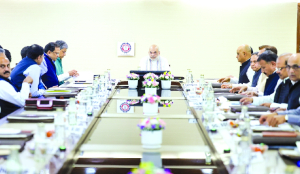
At a closed-door security conference, home minister demanded tougher action against infiltration and illegal immigration
Union Minister for Home Affairs, Amit Shah, delivered a strong, direct message to India's security forces on Monday. "Anyone who tries to infiltrate will be stopped, those who radicalise will be dismantled, and anyone waging a proxy war will face the full strength of a modernising State," Shah said during the opening of the 9th National Security Strategies Conference (NSSC) 2026 in the national Capital. He told agencies to enforce zero tolerance for infiltration and illegal immigration and to make greater use of artificial intelligence in counter-terrorism.
About 850 officers from central and State security forces, intelligence agencies, and special units gathered in New Delhi for a two-day, closed-door conference. On the first day, they discussed four main threats: terrorism, radicalisation, cybercrime and Pakistan's ongoing proxy war against India.
Shah told the officers that old methods are no longer enough. He stressed that any infiltration across borders or growth of illegal immigration networks must be met with zero tolerance. Any attempt to cross the border or settle illegally must be found early, dealt with firmly, and prosecuted every time, he said.
He asked the various agencies to go beyond relying solely on traditional surveillance and human intelligence and adopt artificial intelligence to combat terrorism. Pattern recognition powered by AI, predictive analytics, real-time monitoring of digital radicalisation pipelines, and automated threat scoring should all become standard tools in the counter-terror toolkit, he added.
The officers also examined how cross-border networks are changing tactics, how radical groups are funded, and how cyberspace is used to radicalise vulnerable people. Both online and offline radicalisation were seen as part of the same threat.
Cybercrime was also discussed, not just as a law-and-order issue, but as a national security risk.
It is expected that the officials attending the conference will have more closely coordinated protocols in place among the cyber units, the intelligence departments, and the local police.
Over the years, the NSSC has become one of the most important annual events for calibrating India's internal security policy. This year's conference is especially important because of the clear political direction from the Union Home Minister.
The conference is still going on, but its message is already clear: India will not just react to threats. Instead, it will use data and algorithms to anticipate them and keep a strict zero-tolerance policy.
The home minister said national security is no longer just about defence. It is now a continuous effort, backed by technology, to confront anyone trying to infiltrate, radicalise, or wage war in other ways.