
Ahmedabad’s freedom struggle marked by martyrs, women leaders and underground resistance
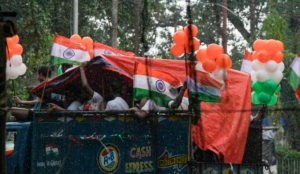
As India celebrates its 80th Independence Day, the historic city of Ahmedabad honours its deep-rooted legacy in the freedom struggle, defined by martyrs, revolutionary women, and underground resistance during the Quit India Movement.
From the iconic 1930 Dandi March led by Mahatma Gandhi from Sabarmati Ashram to the fierce resistance of the 1942 Quit India Movement -- marked by the martyrdom of students Umakant Kadia and Vinod Kinariwala, active participation of women leaders, and daring underground operations -- the city played a pivotal role in ending British colonial rule.
"When the entire country was burning in the blaze of freedom from the clutches of the British and Mahatma Gandhi gave the call of 'Do or Die' on August 8, 1942, while launching the Quit India Movement, residents of Khadia in Ahmedabad turned rebels and took to the streets," local historian and author Manel Patel 'Setu' told PTI.
Ahmedabad responded strongly to the British regime, with one of the first sparks of the Quit India Movement in Gujarat witnessed in Khadia.
On August 9, 1942, residents barricaded the entrance to Khadia Char Rasta and attempted to stop the police, Patel said.
"The police opened fire to disperse the crowd and prevent stone-pelting. A 21-year-old student, Umakant Kadia of Dariyapur, was riding his cycle near Khadia Char Rasta. Undeterred by the firing, Umakant continued moving forward instead of retreating and a bullet fired by the police hit him in the forehead," Patel said.
Kadia became the first martyr of Ahmedabad's 1942 Quit India Movement. A memorial pillar still stands near Khadia Char Rasta, commemorating the sacrifice of Umakant Motiram Kadia.
The pillar reads: "On this place, Umakant Motiram Kadia was hit by Britishers' bullets during the Hind Chhodo freedom struggle and became the first martyr."
The very next day, on August 10, 1942, a procession of around 2,000 students entered the Gujarat College campus, where the police resorted to lathi-charge and firing, Patel said.
Vinod Kinariwala, a student carrying the Indian flag, shouted 'Inquilab Zindabad' slogan and moved to the front when a bullet struck him in the abdomen. He died on the spot, according to the historian.
Patel said he had met an eyewitness, Brahmakumar Bhatt, who narrated the incident to him.
A marble memorial in the Gujarat College premises commemorates Kinariwala and his sacrifice.
Ahmedabad's contribution to the freedom movement was not limited to young men taking to the streets. Women also stepped out of their homes and played an important role in the Quit India Movement under the leadership of Champaben Mehta in Ahmedabad, Patel said.
According to the open-source research article "Pioneering Role of Women in the Quit India Movement", authored by Rachana Singh and Saumya Singh, women, including Champaben Mehta, Perinaben Mistry, Sumitraben Thakore and Ranjanben Dalal, served as crucial communicators for the movement by distributing Congress Patrikas among the public.
"The women took on several roles, including those of writers, speakers, nurses and picketers. They organised street demonstrations and 'prabhat pheris' (morning processions), raising nationalist slogans to inspire patriotism. They also visited hospitals to care for freedom fighters who had been injured or wounded," the article said.
A defining chapter in Ahmedabad's history came on March 12, 1930, when Mahatma Gandhi, accompanied by 79 other marchers, set out from Sabarmati Ashram on the historic Dandi March, the historian noted.
The marchers walked to Dandi in present-day Navsari district, where Gandhi broke the British salt law, turning the march into one of the most powerful acts of civil disobedience against colonial rule.
A prominent freedom fighter, Dr Jayanti Thakor of Ahmedabad, spent two years in jail after participating in the Dandi March in 1930. He later carried out underground activities of the freedom struggle in 1942.
"In 1942, when all the prominent leaders, including Mahatma Gandhi, were arrested, Gandhi entrusted Ahmedabad freedom fighter Jayanti Thakor with leading the underground activities of the freedom struggle, earning him the title of 'Shaher Suba' (city governor)," his son Samir Thakor told PTI.
Underground activists also circulated proclamations, notices and publications urging people to participate in the movement. His associates set fire to factories and carried out bomb blasts at electrical substations in Ahmedabad, he added.
He led the underground activities from Khadia Vyayam Shala, which served as an important centre of the underground movement during India's freedom struggle.
For Ahmedabad, the legacy of the freedom movement remains deeply intertwined with the life and work of Mahatma Gandhi, who spent years in the city and founded Sabarmati Ashram on the banks of the Sabarmati river, historian Patel said.
Many leaders in Ahmedabad took part in the freedom struggle alongside Mahatma Gandhi.
"Ahmedabad has seen the freedom struggle very closely and has inherited the legacy of Mahatma Gandhi," he added.