SCO@25: An unending search for relevance
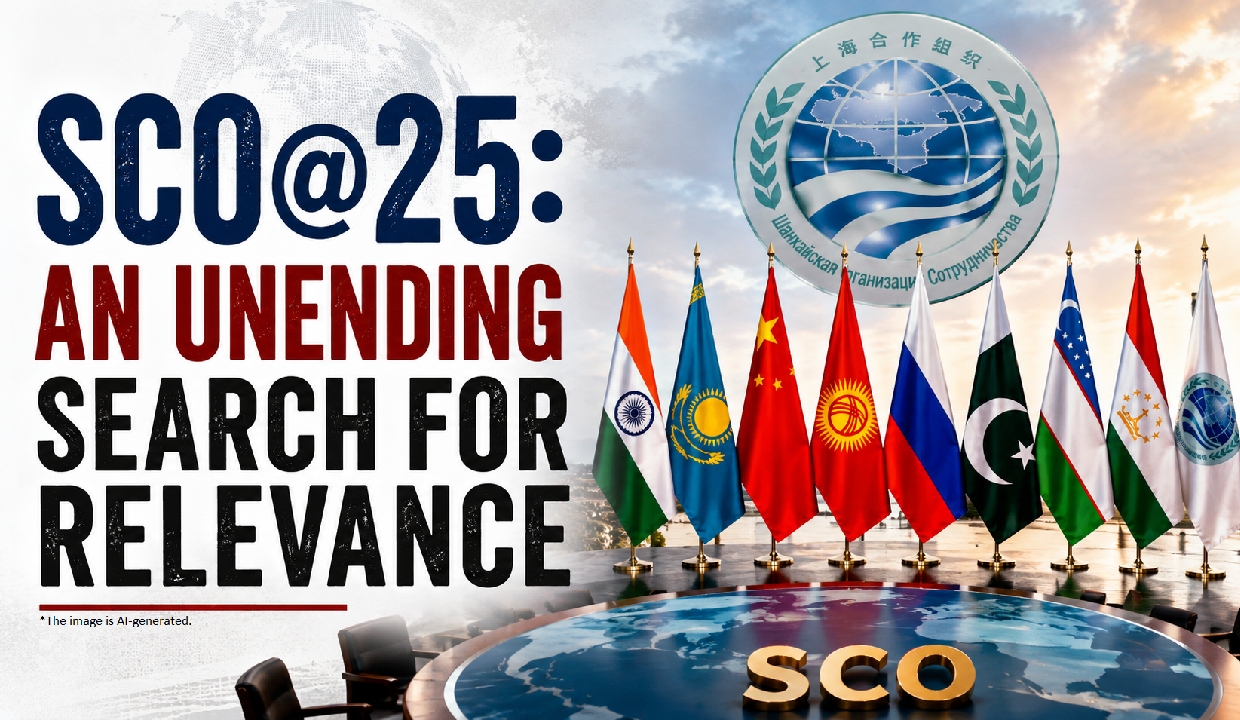
The real test for the SCO is whether it can be effective in addressing the security and economic challenges confronting the region
Prime Minister Narendra Modi begins a four-day Central Asian trip on August 29 with a state visit to Uzbekistan, ahead of the twenty-sixth Shanghai Cooperation Organisation summit in Bishkek on August 31-September 1. The timing is apt: the SCO turns twenty-five this year, and the region is more volatile than ever before. In Tashkent, on his fourth visit to Uzbekistan, the agenda is familiar: trade, investment, defence, digital connectivity, energy and education. What is new is the framing - aligning India’s Viksit Bharat 2047 with Uzbekistan’s own 2030 vision, alongside symbolic stops at the Lal Bahadur Shastri memorial and the Gandhi Centre at Tashkent State University.
At Bishkek, host, Kyrgyzstan has set the theme, “25 Years of the SCO: Together Towards Sustainable Peace, Development and Prosperity.” The agenda is ambitious on paper: an international centre against organised crime, cybercrime cooperation, a proposed SCO development bank, climate and disaster-response mechanisms, and connectivity flagships like the $4.7-billion China-Kyrgyzstan-Uzbekistan railway. India will press its own additions to widen the grouping beyond hydrocarbons and hard security.
Judged by scale, the record is not trivial. From six founding states in 2001, the SCO has grown to ten, plus a wide circle of dialogue partners, together accounting for roughly a third of global output. It has kept China and Russia in structured dialogue and given counter-terrorism cooperation an institutional home via its Regional Anti-Terrorist Structure. But scale has not brought capability. Institutional thinness and scant common financial resources are long-flagged weaknesses; the SCO has never furnished troops or material support in a crisis, and its consensus-based design - a virtue when sold as non-confrontational - doubles as a recipe for paralysis whenever members disagree.
And disagree they do. The India-Pakistan impasse has hollowed out the counter-terrorism cooperation the SCO was built around, stalling joint exercises and intelligence-sharing, while China’s quiet tilt towards Islamabad has repeatedly let Pakistan blunt India’s language on cross-border terrorism. India’s Central Asia trade, at roughly two billion dollars, is a rounding error beside China’s near-hundred-billion-dollar footprint there, and connectivity India actually needs - the International North-South Transport Corridor chief among them - remains stalled for reasons no communiqué will address.
Layered atop this, India’s multi-aligned foreign policy sits uneasily inside a grouping centred on a Russia-China axis. None of this argues for disengagement; walking away would simply cede Central Asia to Beijing and Moscow by default. It argues for calibrated expectations instead. India’s security concerns are better pursued bilaterally than through a forum where Pakistan is present. Routes that bypass Pakistan altogether, via Chabahar and Iran, deserve more sustained attention than another round of summit rhetoric. On present evidence, the Tashkent leg will likely outlast the Bishkek one in consequence - itself, twenty-five years on, the most honest verdict on the SCO.