SCO Summit: India’s Eurasian balancing act
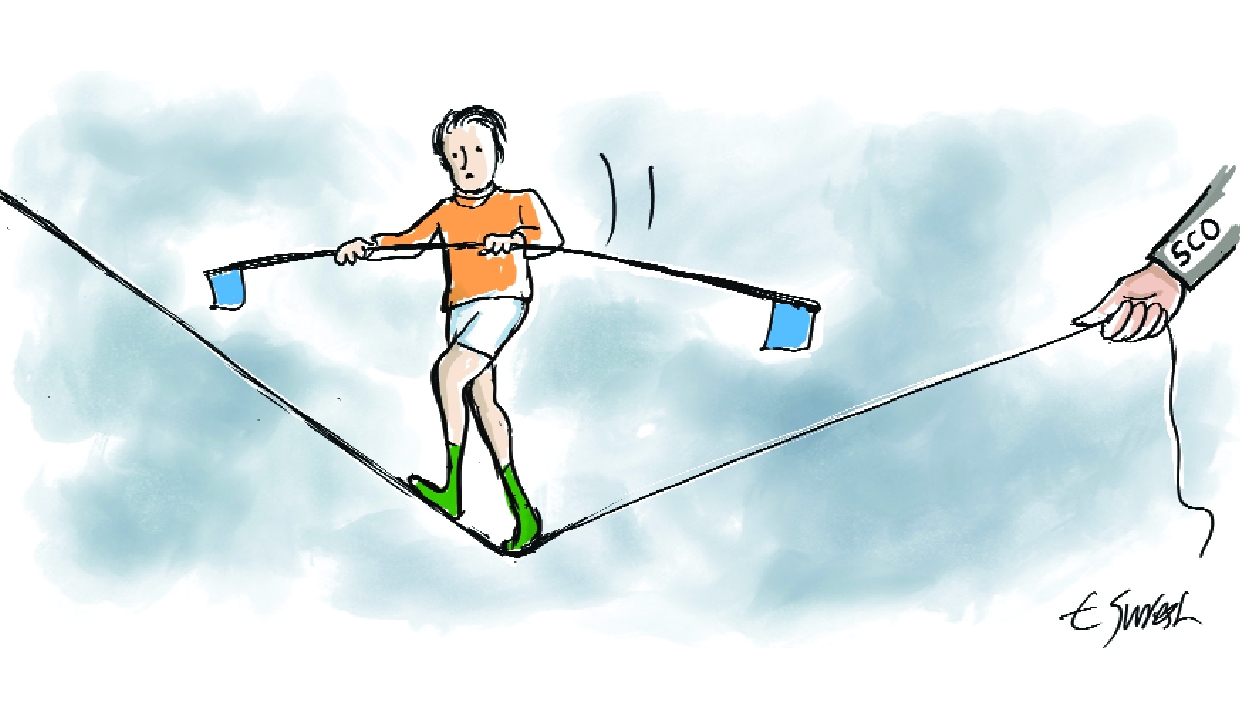
As the Shanghai Cooperation Organisation turns 25, its Bishkek summit comes at a time of deepening geopolitical turbulence. For India, the grouping is more than a regional forum: it is a crucial platform to advance strategic autonomy, counter terrorism, strengthen ties with Central Asia and secure connectivity across Eurasia while navigating the growing influence of China
The upcoming annual leaders’ summit of the Shanghai Cooperation Organisation (SCO) at Bishkek in Kyrgyzstan, which PM Narendra Modi will attend, comes amid ongoing geopolitical shifts and strategic realignments that continue to trigger severe global economic consequences.
The motto of the summit on August 31-September 1 - ‘25 years of the SCO: Together Towards Sustainable Peace, Development and Prosperity’ - serves both as an ambitious goal and a test of regional cooperation.
The summit takes place against a backdrop of global turmoil driven by Russia’s long-drawn war with Ukraine and the unabating US-Israel-Iran conflict. Both Russia and Iran are SCO members. These conflicts have had a major impact on the global economy and the SCO motto, therefore, assumes even greater significance.
Over its 25-year history, the SCO has expanded considerably. It now includes 10 member states, two observer states and 15 dialogue partners that encompass a vast geographical area, diverse cultures and people. For India, SCO membership provides a crucial platform to pursue its strategic interests in the vast Eurasia region.
India transitioned from an observer state in 2005 to full membership in 2017 alongside Pakistan, whose inclusion was backed by its all-weather ally, China. The other full members include the Central Asian countries of Kazakhstan, Tajikistan and Uzbekistan. Its two newest members are Iran, which joined the grouping in 2023, and Belarus in 2024. Afghanistan and Mongolia serve as observer states.
Additionally, the SCO’s 15 dialogue partners reflect the growing interest in the grouping. They are Egypt, Qatar, Kuwait, UAE, Bahrain, Saudi Arabia, Turkey, Nepal, Sri Lanka, Maldives, Myanmar, Cambodia, Lao PDR, Azerbaijan and Armenia.
With the 10 member states encompassing a huge geographical spread of around 36 million sq km and over 3.4 billion people, India recognises the geopolitical value of remaining deeply engaged in the SCO at both multilateral and bilateral levels. PM Modi, for instance, will be meeting Russian President Vladimir Putin, among others, on the margins of the summit.
India’s SCO membership also underlines its strategic autonomy in participating in a non-Western-aligned forum alongside major powers like Russia and China. Membership ensures India a seat at the table, while keeping a close eye on China’s regional ambitions and the China-Pakistan nexus.
As an economic powerhouse, China often seeks to dominate the SCO, which has its secretariat in Beijing. India consistently uses the platform to counter these dynamics.
At the SCO summit at Tianjin in China last year, India reiterated its opposition to Beijing’s ambitious Belt and Road Initiative (BRI), with PM Modi emphasising that connectivity efforts “must uphold the principles of sovereignty and territorial integrity”.
In a strong message to China, which has often used “salami slicing” tactics to encroach on territory India claims as its own, PM Modi also noted: “Connectivity that bypasses sovereignty ultimately loses both trust and meaning.” India remains the sole SCO member state that does not endorse the BRI.
For India, SCO membership is both a strategic and economic imperative. PM Modi spelt out the three pillars upon which India’s policy towards the SCO is predicated at the Tianjin summit last year: Security, Connectivity and Opportunity.
India’s membership of the SCO is also critical for its connectivity strategy across Eurasia. With Pakistan blocking India’s direct overland access to Afghanistan and beyond to Central Asia, New Delhi must explore alternative transit routes to these regions.
Building robust ties with the ‘stans’ of Central Asia, which India views as part of its extended neighbourhood, is crucial to balance China’s heavy influence in the region. The SCO serves as a useful platform to find common ground with them on various issues, including connectivity, energy, security, trade, critical minerals and counter-terrorism.
It’s noteworthy that en route to Bishkek, PM Modi will also be travelling to Uzbekistan, with which it has robust defence cooperation, to build on its strategic partnership.
The ‘stans’ are particularly important for New Delhi’s efforts at connectivity with Central Asia and even beyond to Europe. There is convergence of interests in this regard, with these landlocked nations exploring alternative routes for connectivity.
India has been banking on the INSTC (International North South Transport Corridor) as a vital connectivity link to Central Asia. The ambitious project, however, is a long way away from fruition.
India’s plans to access these nations and Afghanistan via the Iranian port of Chabahar, too, have been in the doldrums owing to US sanctions and the current heightened tensions in West Asia. On the security front, the SCO provides India with a vital platform to draw attention to terror, especially emanating from Pakistan. Last year, for instance, India highlighted the terror strikes carried out at Pahalgam in Kashmir by Pak-backed attackers. India acknowledges that the SCO-RATS (Regional Anti-Terrorist Structure), headquartered at Tashkent in Uzbekistan, has played a significant role in the fight against terrorism.
At the Bishkek summit, India will undoubtedly press ahead with its focus on counter-terrorism and regional connectivity. Additionally, as member states discuss establishing an SCO Development Bank to fund infrastructure, India will likely seek more clarity on its structure to ensure it aligns with territorial sovereignty principles. Ultimately, India’s participation in the Bishkek summit is not merely a diplomatic routine. It’s driven by a pragmatic focus on strategic autonomy, counter-terrorism, and Eurasian access. India should do its utmost to leverage the SCO to safeguard its own strategic interests and monitor regional dynamics.
India’s SCO membership also underlines its strategic autonomy in participating in a non-Western aligned forum alongside major powers like Russia and China. Membership ensures India a seat at the table, while keeping a close eye on China’s regional ambitions and the China-Pakistan nexus
The writer is a policy analyst who writes on foreign and strategic issues; Views presented are personal.