Regional Culinary Knowledge System Hawaijar and the Contemporary Science of Fermentation
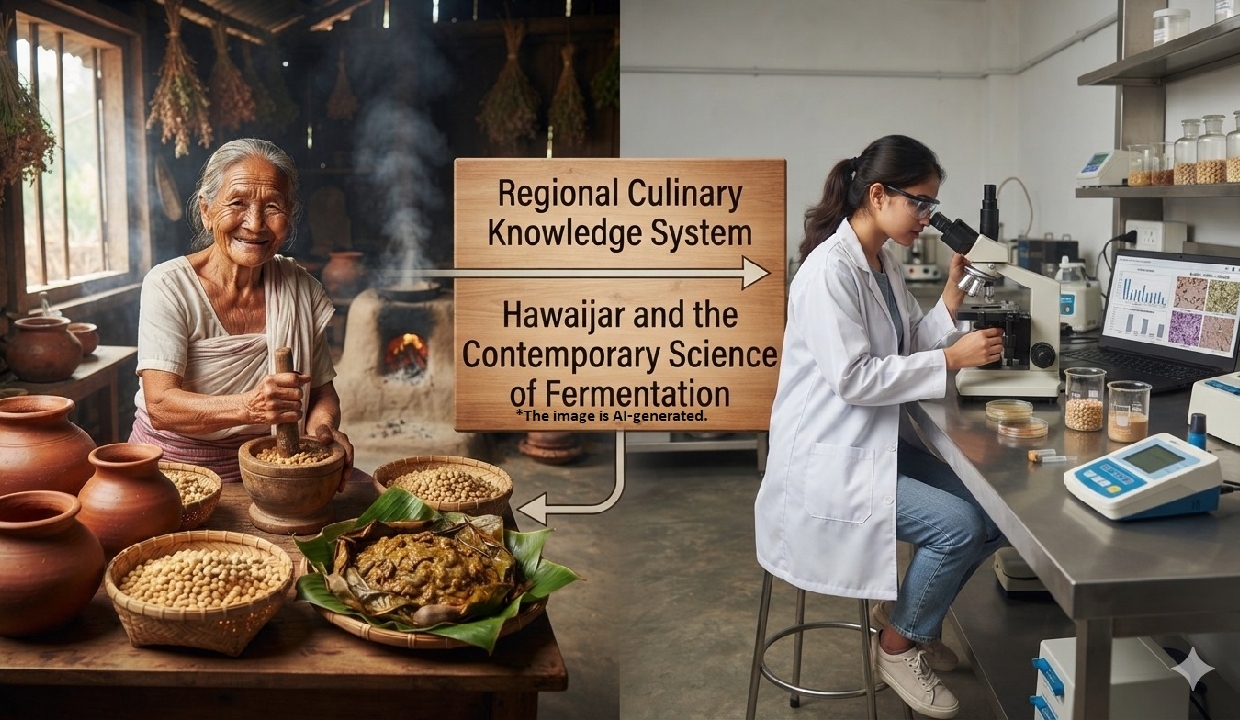
Food is rarely simply what is placed on a plate. Behind its final form lies a sequence of decisions about ingredients, season, preservation and preparation. Fermentation of food is one of the oldest and most consequential of these practices. Archaeological evidence places organised food fermentation as far back as the Neolithic period, around 7000 BC, when settled communities were developing new ways of preserving and transforming agricultural produce.
Fermented foods are also being examined for their possible relationship with the gut microbiome and metabolic health. India presents an unusually rich landscape for studying this relationship between food, microorganisms and knowledge. Dahi, dhokla, dosa, idli, kanji and other regional preparations represent only a small part of a much larger repertoire of fermentation practices across the country. Fermentation, including pickling and vinegaring, is in fact ubiquitous in the Indian household, a near-universal feature of the everyday meal that nonetheless takes a distinct, regionally specific form, from gundruk in the Himalayan belt to nolen gur-based ferments in Bengal and mustard-oil pickles across the north. A 2023 review in Food Research International describes Indian fermented foods through their microbial diversity, nutritional characteristics, functional properties and cultural contexts.
The history of fermentation in India also predates the scientific terminology through which it is understood today. Ayurvedic literature records preparations such as asava and arishta. Charaka Samhita is among the earliest classical texts to discuss fermented preparations at length, referencing Sura, Sidhu and Sauviraka as fermented liquids. A 2018 pharmaceutical review of Ayurvedic fermentation practice, published in the International Journal of Green Pharmacy, notes that the text describes roughly 84 Asava formulations drawn from 9 Asava Yoni or base fermenting materials, scattered across its Chikitsa Sthana chapters. Fermentation, in other words, belongs to a much longer history in which food, preservation, health and material knowledge intersect.
A North-eastern Inheritance
In India's Northeast, fermented food preparation and preservation have been transmitted across generations as part of everyday practice. Jeyaram et al. (2009) documented the significance of fermented foods within the region's food traditions, situating them within a broader Himalayan and Northeast Indian fermentation culture. Yet within this vast culinary landscape, some traditions remain remarkably unfamiliar outside their regions of origin. Manipur, in particular, holds extensive knowledge of fermented food preparation, developed originally as a means of preservation and valued for nutritional benefits. Among its best-known fermented foods are Ngari (fermented fish), Soibum or Soidon (fermented bamboo shoot) and Hawaijar (fermented soybean). This article turns to one such food, Hawaijar, which originates in Manipur.
The preparation of hawaijar begins with Glycine max (soybean) a nutritionally dense legume containing substantial protein together with lipids, carbohydrates, minerals, vitamins and phytochemicals including isoflavones, phenolic compounds and saponins. The beans are soaked and cooked and traditionally wrapped in leaves, fig or banana, before being left to ferment for several days. During fermentation, the soybean undergoes a pronounced physical and biochemical transformation.
At the microbial level, hawaijar represents alkaline fermentation. Bacillus species, particularly Bacillus subtilis and related organisms, play an important role in the process. Their enzymatic activity acts upon proteins and other components of the soybean, producing biochemical changes that account for much of the food's distinctive texture, flavour and composition.
For the traditional food maker, however, the process is encountered through observation rather than microbial taxonomy. The knowledge lies in knowing how the beans should be prepared, how they should be wrapped, where they should be kept and how the sensory characteristics of the ferment change over time. This is an important dimension of Indigenous Knowledge Systems: knowledge can be empirical without being expressed through formal scientific terminology. It can reside instead in repeated practice, sensory judgement, material selection and intergenerational transmission.
A Plant-Based Protein for Every Table
The nutritional significance of hawaijar deserves particular attention. Soybean is naturally protein-rich and provides an important plant-based source of protein and hawaijar forms a substantial component of the vegetarian diet, particularly among Manipur's vegetarian population, where its high protein content allows it to function as a genuine alternative to fish or meat. Yet hawaijar is not confined to vegetarian cooking alone: it is also prepared alongside meat, making it a genuinely inclusive culinary ingredient.
This versatility finds its fullest expression in chagempomba, a dish close to a porridge, in which hawaijar is an indispensable ingredient. Made with a mix of vegetables, herbs and rice, sometimes with meat, sometimes without as per one's choices. Chagempomba is traced back to periods of war and food scarcity in Manipur's history, when ingredients were meagre but nutrition still had to be assured. In this dish, hawaijar supplied the protein, rice the carbohydrates and the accompanying vegetables and herbs the minerals and vitamins, together forming a complete, sustaining meal from limited means. This gives hawaijar a socio-cultural significance separate from its scientifically documented microbial benefits.
At a time when India is addressing nutritional diversity, affordable protein and sustainable food systems, hawaijar's relevance extends well beyond cultural preservation. The scientific interest in hawaijar extends beyond its protein content. The 2023 review in Food Research International examines the microbiology, nutritional composition, functional properties and safety considerations associated with hawaijar and discusses reported antioxidant, fibrinolytic, antidiabetic and ACE-inhibitory activities associated with the food and its microorganisms, identifying potential for further investigation in the functional food and nutraceutical sectors.
A Wider Family of Soybean Ferments
Hawaijar is part of a larger regional ecology of fermented soybean food traditions, including kinema in Sikkim, bekang in Mizoram, tungrymbai in Meghalaya and axone in Nagaland. Comparable fermented soybean traditions occur across Asia, including tempeh in Indonesia, natto in Japan, among several other regional forms.
This diversity is significant because fermentation is never determined by microorganisms alone. It is also shaped by the substrate available, local climate, household techniques, vessels, wrapping materials and cultural preferences. The microbial process is biological but the way a community learns to manage that process is cultural.
Hawaijar in National Conversation
Bringing hawaijar into the national conversation is therefore not simply an exercise in culinary representation. It opens a discussion about plant-based nutrition, microbial biotechnology, food preservation, sustainable food systems and the safeguarding of Indigenous Knowledge.
Hawaijar, then, is not an isolated case but an instance of a far larger pattern. Across India's regions, culinary knowledge systems reside quietly within the everyday meal: a fermented rice batter in the south, a jar of pickled greens in the north, and fermented vegetables in the Northeast, each a distinct, regionally evolved culinary practice. Yet the foods that represent Indian cuisine on a national or global stage constitute only a fraction of this accumulated knowledge. Beneath that visible surface lie regional food systems built on highly specialised expertise that remain invisible beyond the communities that sustained them. What is needed now is rigorous documentation and scientific engagement before such knowledge is lost rather than understood.
Meenakshi Lekhi, Former Minister of State for External Affairs, Govt. of India; Dr Sophia Lisam, Senior Research Fellow, Bharat Ki Soch; Views presented are personal.