Rahul’s performative feminism vs Modi’s grassroots transformation
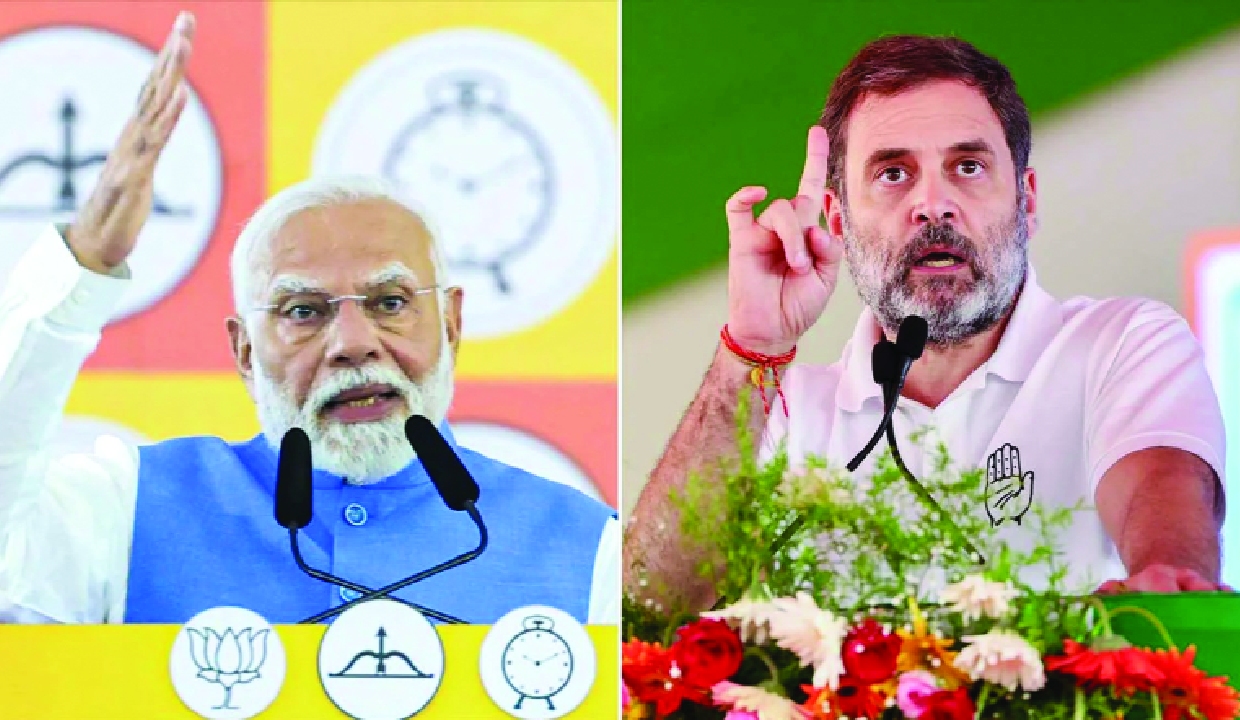
Rahul Gandhi is being hailed as a path-breaker by the entire Congress ecosystem ever since he gave a call to ‘Smash Patriarchy’ during an event organised for young women in Pune. This event was part of the Chhatron ki Goonj, loosely translated as ‘echo of students’ through which the Leader of Opposition has been trying to connect with the Gen Z. During the interaction, he exhorted young women to reject (what he called) the Manusmriti mindset of seeing women as Bahu, Beti, Behen, that is, belonging either to the father, son or husband. You belong to no one but yourself, he said emphatically.
All this sounds perfect when seen from the standpoint of a young woman who is raring to fulfill her dreams in life. It got Mr Gandhi the kind of social media attention such comments will always get. But once the charm of the reels subsides, one must think where does Rahul Gandhi or his party leaders actually stand on the issue themselves?
Let us take the Manusmriti argument first. Many critics are looking at his Bahu, Beti, Behen comment as an attempt to run down the Indian family system and bonds, while some have fished out his old remarks where he was seen projecting his sister in an election rally. But I would welcome a leader exhorting women to carve their own identity beyond family relations. The problem lies in Rahul Gandhi slamming Manusmriti and asking Hindu women to shun it while completely forgetting to mention that all religions and scriptures prescribe do’s and don’ts which are not commensurate with today’s society. He did not even notice that women in Hijab standing on the stage with him could have been given the same mantra. His singling out of Manusmriti gave detractors the opportunity to allege that Rahul’s target was more on Hindu traditions than patriarchy per se.
But let us leave that for the women to judge. How has the Congress party, and the Gandhi family fared on this front? While Mr Gandhi finds Manusmriti’s depiction problematic, he forgets that the biggest factor for a woman’s dependent status is financial. His late father and former Prime Minister Rajiv Gandhi had a historic opportunity to make the lives of divorced Muslim women marginally better when the Supreme Court allowed a paltry maintenance amount to Shah Bano. Instead, Rajiv Gandhi chose to be on the wrong side of history by upturning the verdict in Parliament under pressure from fundamentalist elements who threatened to ‘punish’ Congress.
More recently, Congress chose to walk out from Lok Sabha during the passage of Muslim Women (Protection of Rights on Marriage) or the Triple Talaq Bill.
Even today, one of the biggest states, Congress-ruled Karnataka, does not have a single woman among its 33 cabinet ministers. Notably, Indira Gandhi, the daughter of Jawaharlal Nehru, became prime minister but no Congress government ever had a woman among the big four or the CCS. Many have also pointed out that the Nehru-Gandhi family has always kept Priyanka Vadra a few steps behind her brother in case she steals the thunder from him. Even if that were to happen, it wouldn’t quite mean any real change because they are both there by virtue of their bloodline.
Narendra Modi, whom Rahul Gandhi has been challenging politically for over twelve years now, has presented a different model altogether. Having his roots in a humble, poor Hindu family with limited means, Narendra Modi has had a much closer, first-hand view of women’s position in the society. Introducing his first path-breaking initiative, Swachh Bharat, he focused on building toilets. Rahul Gandhi could perhaps ask his seniors in the party why barely forty percent women had access to something as basic as toilets till 2014? How does a woman smash patriarchy when she has to wait for darkness to relieve herself? Modi also understood that the power balance in families would not shift until women had some financial ‘heft’ in their name.
Bank accounts through Jan Dhan scheme, ensuring PM Awas Yojana houses were registered in the name of the woman, providing easy, collateral free loans through MUDRA, announcing a slew of maternity benefits so that young mothers did not suffer professional loss and a phenomenal push to self help group through various incentives in order to economically empower women at the grassroots level...... these are measures which have changed the power dynamics of families in rural areas in a way that was unthinkable some years ago.
This author is witness to the remarkable surge in self-confidence of young women in the remotest corners of the country. They no longer follow the menfolk. They have access to phones and internet data. They are informed and prefer to form their own opinions on current political and social issues. Their awareness level is far higher and they are keen to chart their own course.
Today, there is a bigger number of women aspirants compared to men raring to fight the local body/ Panchayat elections in villages which were considered extremely backward till recently.
One can refer to all the data related to these schemes and many others. The crux of the matter is women cannot smash patriarchy by simply wishing it away. Enabling legal structures, financial agency, professional opportunities and political platforms are essential to make it possible.
Catchy one-liners like the one made by Rahul Gandhi are good headline material and attractive content for a generation which spends a good amount of time on social media. But these one-liners must also be substantiated with solid groundwork. Seen from that perspective, Rahul Gandhi and Congress party’s record pales.
To smash patriarchy, he could make a beginning by inducting a woman or two as minister in Karnataka and Himachal Pradesh. He could have admonished his colleague Sandeep Dikshit, who recently made a crass, sexist comment on the Prime Minister of Italy in an open party event. Instead, Rahul Gandhi chose to enjoy the ‘joke’. He missed the bus there too.
The author is a journalist. She writes on politics, security and current issues; Views presented are personal.