
- HOME
- INDIA
- WORLD
- BUSINESS
- STATES
- LAW & JUSTICE
- ENTERTAINMENT
- SPORTS
- VIEWPOINT
- LIFESTYLE
- TECH
Prime Minister Narendra Modi has urged teachers to remain vigilant against student drug addiction and help children tackle excessive screen time through sports, physical play, and creative activities.
Interacting with the national award-winning teachers on Friday, the eve of Teachers’ Day, Prime Minister Modi also urged the teachers to preserve childhood and nurture children’s natural curiosity.
He said teachers should share creative approaches to make classroom learning more engaging. A video of the interaction at the Prime Minister’s Lok Kalyan Marg residence was released on Saturday. The Prime Minister emphasised that teachers need to look beyond the academic performance of children and be attentive to their behaviour and everyday lives.
He said teachers have an increasingly important role to play in the lives of children now that there are fewer joint family set-ups. On drugs, Modi said that in some big cities and universities, it is difficult to identify if anyone is affected by the problem, as no one knows who gives whom what.
“In these circumstances, teachers should take the initiative for awareness and also observe minutely if any change (in behaviour) is witnessed in any child,” he said. The PM said the teachers should enter the lives of the students, going beyond books and syllabuses.
“You should not allow the childhood of a student to die. The biggest contribution can be given by the teachers by keeping childhood alive in students’ lives,” PM said.
Modi also talked about how teachers can keep the students away from long hours of screen time and encourage them towards outdoor sports activities. The Prime Minister said children have the same basic nature and curiosity, and if teachers nurture and channelise this curiosity, they can make a significant contribution to their development.
He said screen time has become a major concern among students, as he urged the teachers to speak to parents about how much time their children spend on screens and whether they continue using mobile phones late at night. Screen time can be cut naturally by developing an interest in sports, physical games and creative activities, he said.
Referring to the National Education Policy, Prime Minister Narendra Modi stressed the importance of taking children outside the classroom and connecting them with real-world skills and forms of work.
The PM praised a teacher who spoke about making women in her vicinity aware of breast cancer, and said a breast cancer awareness campaign was launched by him in Varanasi, his Lok Sabha constituency.
“I am happy to share with you that more and more women are coming forward for screening (for breast cancer), even setting a Guinness World Record for it,” he said.
This year, 82 teachers and educators have been selected for the National Teachers Awards from three departments. These include 48 teachers from the Department of School Education and Literacy, 21 teachers/faculty members from higher educational institutions and polytechnics, and 13 skill trainers from the Ministry of Skill Development and Entrepreneurship.
India transformed in 13 years: PM Modi
New Delhi: Prime Minister Narendra Modi on Friday launched a full-scale offensive against the Opposition for misguiding the youth after he assumed the mantle at the Centre and highlighted India’s economic growth and contrasted the country’s current position with the situation in 2013. These strong remarks came against the backdrop of recent protests by Gen Z and his determined effort to reach out to them, dispelling doubts about his leadership.
Addressing the centenary celebrations of the prestigious Sri Ram College of Commerce (SRCC), he referred to the economic and political situation at the time. Modi said, “There is a gang that will take what I am saying, break it into small pieces and put it in my account. So, let me warn you about this. Let me tell you what used to dominate the media during that period in 2013. For example, Indian soldiers were being killed along the LoC. The current generation may find it surprising; perhaps they may wonder, “Did this really happen?” Yes, it did.
The Prime Minister began by referring to his earlier speech, which he said had been discussed and watched again in recent days.
“What I said in 2013 was my conviction,” he told the students. Modi’s visit to the SRCC comes amid the BJP’s ongoing outreach to the young generation. He last visited the SRCC in 2013, when he was the chief minister of Gujarat.
The Prime Minister described the alumni of SRCC as the institution’s “OGs”, saying they had taken the college’s name across the world and made their mark in different fields.
Speaking in a lighter tone, PM Modi told the students, “You may not be a Dhurandhar, but make some noise,” urging them to make an impact even if they were not Dhurandhar.
Modi took a sharp jibe at the Leader of the Opposition Rahul Gandhi, describing the Congress party’s student outreach campaign “Chhatron Ki Goonj” as “Jhooth ki goonj”.’
Chhatron Ki Goonj’ is a student-dialogue campaign launched by the Congress to raise issues including examination paper leaks, rising education costs, irregularities in government recruitment and unemployment. Over the past three months, the campaign has been held in Kota in Rajasthan, Dehradun in Uttarakhand, Prayagraj in Uttar Pradesh and Pune in Maharashtra.
Modi highlighted India’s economic growth and contrasted the country’s current position with the situation in 2013. The World Bank had lowered its GDP growth forecast. The current account deficit was at an all-time high. Inflation was around 10 per cent. The industrial sector was in the grip of a slowdown. Corruption in the helicopter deal had been exposed. There were bomb blasts in Hyderabad. These were all headlines at that time. I firmly believe that our students today may not know about all these things.””
These developments show what the condition of the country was at that time. Growth was at the bottom, while inflation was at the peak. Scams were at their height, and the corrupt were moving around fearlessly. The economy was in distress. There was discussion everywhere about policy paralysis. The world was counting India among the “Fragile Five.”
He said those responsible for pushing India into the ‘fragile 5’ are now unable to digest its 7.8 per cent growth. The PM noted that people have revisited his 2013 address and even today, the impact of that address remains intact.
“Today, those spreading terrorism are trounced. If Pakistan indulges in any nefarious act, the Indian army enters their home and strikes; the back of Naxalism has been broken...from policy paralysis to policy dynamism, India has come a long way.
“They once called us the ‘Fragile Five’. Today, they are talking about India as the fastest-growing major economy,” he added.
Modi recalled former Union minister Arun Jaitley, who studied at the college, and spoke about his frequent recollections of his student days. He also used the word “revisit” while asking the younger generation to look back at the situation in India when he last addressed SRCC in 2013.
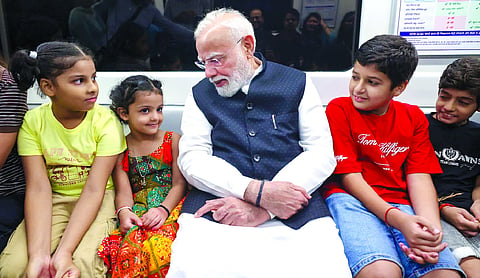
PM Modi arrived at the college by Delhi Metro and interacted with students and fellow passengers during the journey. He also released a commemorative Rs 100 coin to mark the centenary.
Notably, when PM Modi returns to Delhi University’s Shri Ram College of Commerce on Saturday evening for the institution’s centenary celebrations, it’ll mark 13 years since an address at the same college that was widely read as the launchpad for his projection as the BJP’s prime ministerial face.
The last time was in February 2013, when PM Modi came to SRCC as the chief minister of Gujarat, weeks into his fourth term in Gandhinagar and yet to be named his party’s candidate for national office. He was in his 12th year as CM, having first taken office in October 2001. He would go on to mark another year as CM before taking the chair in Delhi.