
- HOME
- INDIA
- WORLD
- BUSINESS
- STATES
- LAW & JUSTICE
- ENTERTAINMENT
- SPORTS
- VIEWPOINT
- LIFESTYLE
- TECH
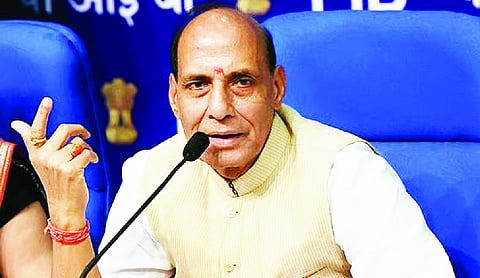
Defence Minister Rajnath Singh on Sunday said, “India believes in peace and does not seek to occupy the territory of any country. However, peace should not be mistaken for weakness. We seek global stability, but not at the cost of our strategic autonomy. We are firmly committed to safeguarding our security and strategic autonomy when threatened.”
Making these assertions while addressing a defence conclave here, he also underlined that there can be no scope for dialogue with any country that promotes terrorism against India.
“Countries that use terrorism as an instrument of state policy or provide shelter and support to terrorists must be firmly reminded that terrorism cannot be a strategic asset for any nation, the defence minister said.
He reiterated that as long as a neighbouring country continues to pursue a policy of supporting terrorism, India remains fully entitled to take all necessary measures against terrorism,” referring to Prime Minister Narendra Modi’s remarks at the recent SCO meeting.
Emphasising national unity as a key pillar of national security, Rajnath Singh stated that the security of the country is not solely the responsibility of the armed forces but a collective responsibility of every citizen. He urged citizens to rise above divisions based on religion, caste, creed, language, region and other identities, and to place national interest above personal and narrow interests.
He described India as a civilizational power whose rise is based on inclusive development rather than confrontation or disruption. He outlined three foundations of India’s approach: its long democratic and civilizational traditions, the principle of Vasudhaiva Kutumbakam and the vision of Sabka Saath, Sabka Vikas, and five strategic pillars—respect, dialogue, prosperity, security and culture.
Rajnath Singh highlighted India’s significant progress towards self-reliance in defence, noting that the country is developing indigenous capabilities ranging from aircraft and drone engines to fifth- and sixth-generation fighter jets.
He emphasised that growing international demand for Indian missiles, radars, ammunition and defence platforms reflects global confidence in India’s technology, quality and delivery capabilities.
Rajnath Singh stated that the nature of warfare is rapidly changing, with modern conflicts extending beyond conventional domains to cyber, space, electronic and information warfare, alongside emerging technologies such as Artificial Intelligence, drones, autonomous systems, quantum technology and hypersonic systems. He underlined the need for India to develop future-ready capabilities across these domains.
Highlighting India’s efforts to address strategic vulnerabilities in areas such as technology, energy, data, and supply chains, the defence minister said initiatives are underway to strengthen domestic capabilities in semiconductors and critical minerals, diversify energy sources, and enhance energy security.