
- HOME
- INDIA
- WORLD
- BUSINESS
- STATES
- LAW & JUSTICE
- ENTERTAINMENT
- SPORTS
- VIEWPOINT
- LIFESTYLE
- TECH
Tightening the noose around individuals, service providers and organised gangs involved in paper leaks, the Centre has proposed longer jail terms, steeper fines, and time-bound investigation and disposal of trials and appeals.
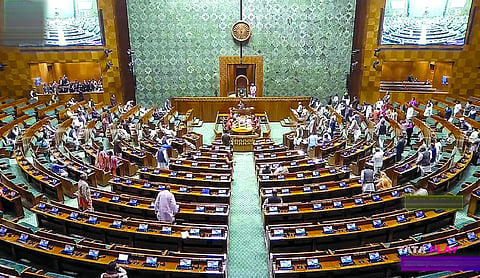
The bill, The Public Examinations (Prevention of Unfair Means) Amendment Act, 2026, is expected to be introduced in Parliament on Monday. According to the Lok Sabha Secretariat, Union Minister Jitendra Singh will move the Bill in the House. The draft legislation was circulated among MPs shortly before the resignation of Union Education Minister Dharmendra Pradhan.
According to the statement of objects and reasons, the amendments have been proposed in view of recent incidents of question paper leaks and examination malpractices.
Under the proposed law, individuals found resorting to unfair means will face imprisonment of five to 10 years, compared with the existing punishment of three to five years. The maximum fine has also been increased from Rs 10 lakh to Rs 50 lakh.
The Bill also proposes stricter penalties for service providers involved in conducting public examinations. The maximum fine has been increased from `1 crore to `5 crore, while the period during which a defaulting service provider can be barred from conducting public examinations has been doubled from four years to eight years.
The Bill proposes the minimum jail term for offences committed by individuals, as well as directors, senior management personnel or persons in charge of service providers conducting public examinations, has been increased to three years. In cases involving organised crime, the minimum imprisonment has been proposed at seven years.
If an investigation establishes that an offence was committed with the consent or connivance of any director, senior management personnel or person in charge of a service provider, such individuals would be liable to a minimum imprisonment of five years, extendable up to 10 years. The proposed maximum fine has also been increased from the existing Rs 1 crore to Rs 5 crore.
The Bill empowers the Central Government to constitute a Special Task Force (STF) to investigate offences under the Act wherever necessary. It also introduces time-bound criminal proceedings. Investigations by the police, a Central Investigating Agency or the proposed STF must be completed within two months.
The Bill requires every state government and Union Territory Administration to designate Special Fast Track Courts for offences under the Act. These courts will conduct day-to-day hearings, and trials must be completed within three months from the filing of the chargesheet.
Pending cases under the Act will also be transferred to these courts and disposed of within three months from the date of transfer. States and Union Territories will also be required to appoint Special Public Prosecutors to conduct prosecutions before these courts.
“For the purposes of providing a speedy trial on day-to-day basis, every State Government and Union territory Administration shall, in consultation with the Chief Justice of the concerned High Court, by notification, designate a Court of Session, to be a Special Fast Track Court to try offences under this Act.
(3) A Special Fast Track Court designated under sub-section (2) shall, while trying offences under this Act, also try other offences connected thereto with which the accused may be charged under the Bharatiya Nyaya Sanhita, 2023 or any other law for the time being in force, at the same trial,” said the Bill.
The proposed legislation also creates a separate appellate mechanism. Appeals against judgments of the Special Fast Track Courts will lie before a Division Bench of the High Court comprising two judges. Such appeals are to be disposed of, as far as possible, within three months of admission. Appeals are ordinarily required to be filed within 30 days, although the High Court may condone delays of up to 90 days.
“Every appeal under sub-section (1) shall be heard by a bench of two Judges of the High Court and shall, as far as possible, be disposed of within a period of three months from the date of admission of the appeal,” it said.
According to the Statement of Objects and Reasons, the amendments are aimed at strengthening the legal framework by enhancing punishments, making investigations and trials time-bound, establishing dedicated fast-track courts, and providing a specialised appellate mechanism to deal with offences relating to public examinations. On Friday, the Union Cabinet cleared the bill for its introduction in Parliament.