Nobel Medicine Prize Goes to Three Scientists for Breakthroughs in Brain Research
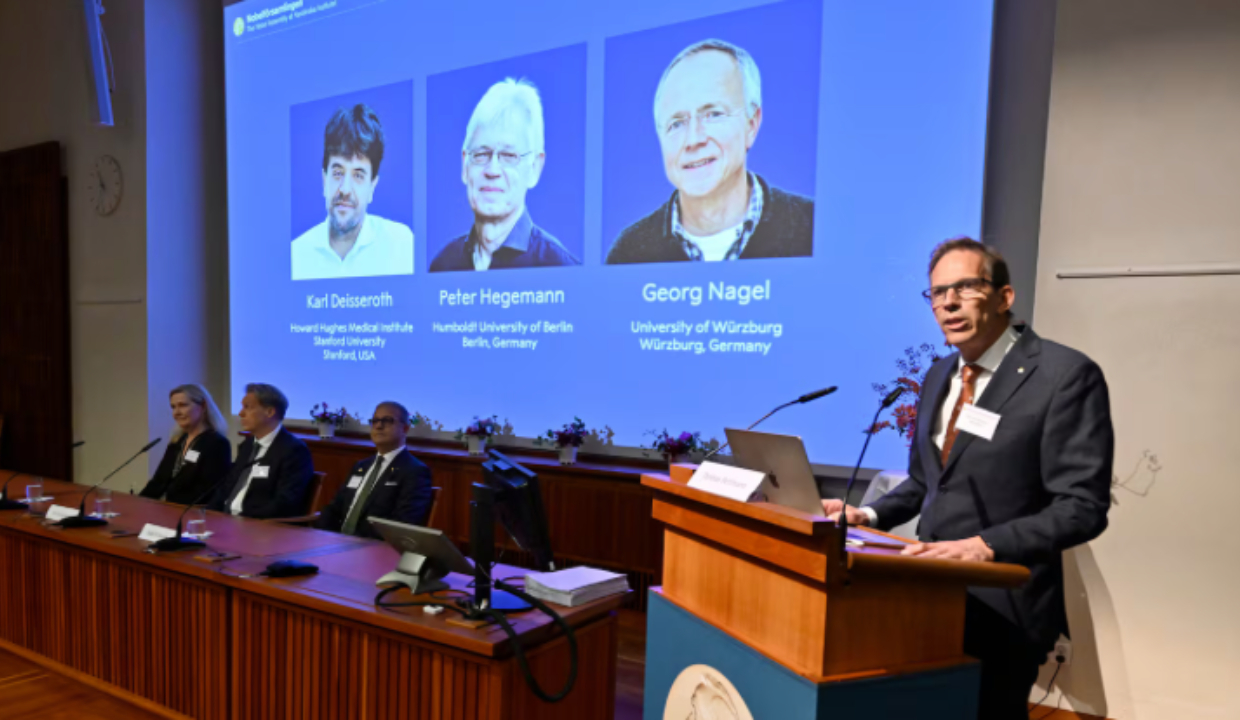
The Nobel Prize in Physiology or Medicine was awarded Monday to three scientists whose research has transformed understanding of how the brain controls the activity of individual nerve cells.
Karl Deisseroth, 54, Peter Hegemann, 71, and Georg Nagel, 73, were recognised for their discoveries involving light-gated ion channels and the development of optogenetics, a technique that allows researchers to control nerve-cell activity using light.
The Nobel Assembly said their work has provided scientists with a powerful tool for investigating the brain and is now used in laboratories around the world.
Deisseroth is based at Stanford University in California, while Hegemann works at Humboldt University in Berlin and Nagel is a researcher at the University of Würzburg in Germany.
Thomas Perlmann, secretary of the Nobel Committee for Physiology or Medicine, said he managed to reach all three laureates by phone after the announcement.
The prize was announced at the Karolinska Institute in Stockholm, marking the opening of Nobel Prize week.
The award carries prize money of 12 million Swedish kronor, worth roughly $1.2 million, to be shared if there is more than one laureate.
Last year's Nobel Prize in Medicine was awarded to three scientists for discoveries concerning the immune system.
The medicine prize will be followed by the Nobel Prizes in Physics on Tuesday, Chemistry on Wednesday and Literature on Thursday. The Nobel Peace Prize will be announced Friday, while the Nobel Memorial Prize in Economic Sciences is scheduled for October 12.