- HOME
- INDIA
- WORLD
- BUSINESS
- STATE EDITIONS
- LAW & JUSTICE
- ENTERTAINMENT
- SPORTS
- VIEW POINT
- EXOTICA
- TECH
- IMPACT

- HOME
- INDIA
- WORLD
- BUSINESS
- STATE EDITIONS
- LAW & JUSTICE
- ENTERTAINMENT
- SPORTS
- VIEW POINT
- EXOTICA
- TECH
- IMPACT
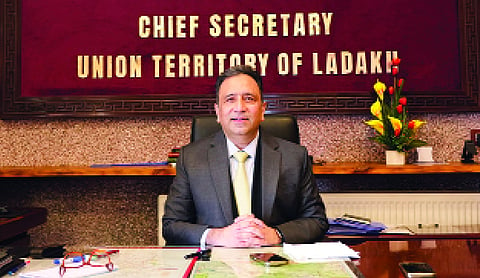
Ahead of a 20-km symbolic padyatra announced by climate activist Sonam Wangchuk, Ladakh Chief Secretary Ashish Kundra said the Centre and local representatives are working on a new constitutional framework under Article 371 to provide safeguards tailored to the Union Territory’s specific needs.
In Leh, preparations are complete for the day-long march on September 23.
Wangchuk scaled down an earlier multi-day padyatra planned from Kargil because of falling temperatures and cold nights. The shortened route will start from a stupa being built by villagers in Kharoo in memory of those killed last year. He has called the event a tribute to people who died, were injured or jailed while seeking protection for Ladakh’s environment, culture and democratic institutions. A martyrs’ day commemoration will follow on September 24, the first anniversary of the violence in which four protesters were killed.
Since becoming a Union Territory in 2019, Ladakh’s leaders have pressed for stronger constitutional safeguards. Their core demands are Statehood and inclusion under the Sixth Schedule, which grants special protections to tribal areas. The campaign has been led by the Leh Apex Body and the Kargil Democratic Alliance. The groups have also sought compensation for families of those killed in last year’s violence and the withdrawal of cases linked to the protests.
Ladakh Chief Secretary made the statement during a consultative meeting with members of civil society from Ladakh on Monday. During the meeting, he told participants that a new framework is being worked out under Article 371 to provide constitutional safeguards suited to Ladakh’s specific requirements.
According to an official statement issued on Tuesday, Kundra said, “A new model is being worked out considering the aspiration of the Ladakhis which does not exist anywhere else in the country.” He further said that the draft would be discussed in the next meeting proposed to be held in the first week of October.
The meeting was convened to discuss key administrative, developmental, and political issues concerning the Union Territory, including constitutional safeguards, land rights, employment, culture, environment, education, drug abuse, and other matters of public importance.
Addressing the meeting, the Chief Secretary expressed that there is a broad agreement on the need for constitutional protection for Ladakh. He said, “The important thing is that constitutional protection is required for Ladakh. The protection should cover our land, employment, culture, environment and natural resources.”
The interaction was attended by prominent members of the community representing diverse backgrounds and sections of society, including Palga Rinpoche, Deldan Namgyal, Former MLA, Rigzin Dorjay from the Ladakh Buddhist Association, Mohd. Shafi from Anjuman Moin-ul-Islam, Dechen Chamga from the Christian Association, Morup Namgyal, Padma Shri, Chewang Norphel, Padma Shri, Honorary Captain Tashi Tsepel, Vir Chakra, Tsewang Namgyal, Former Ambassador, and Kunzes Dolma from the Women’s Forum.
The meeting was also attended by the Administrative Secretaries and senior Government officials of the UT Administration.
The Chief Secretary said that direct elections to the proposed UT-level body were among the key suggestions emerging from the discussions. Further steps, including consideration of the proposed constitutional amendment by Parliament, would follow after consensus is reached on the framework. He also explained that a separate legislation would subsequently be required to provide detailed provisions regarding the powers, functions and institutional arrangements of the proposed body.