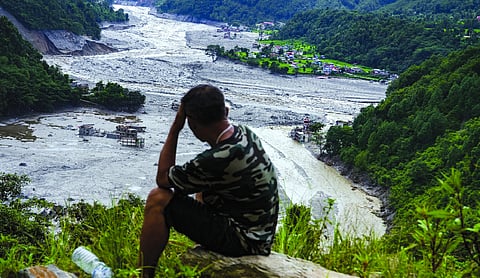

Nepal is seeking urgent international financial assistance after catastrophic floods in the Himalayan nation killed more than 1,100 people and left thousands missing, with Kathmandu arguing that major greenhouse-gas emitters including India, China, and the United States must bear responsibility for climate-related losses.
The Government of Prime Minister Balendra “Balen” Shah is considering taking the issue to the United Nations General Assembly in New York later this month, as Nepal steps up diplomatic efforts to secure funds for relief, reconstruction and long-term resettlement.
Nepalese Foreign Minister Shisir Khanal said the country was moving away from treating climate disasters simply as humanitarian emergencies and was instead demanding what he described as climate justice and compensation.
“We are shifting our diplomatic framework from aid to justice and compensation,” Khanal said in an interview in Nepal’s local TV.
The floods swept through the Bhotekoshi River basin on August 26, devastating parts of Rasuwa, Nuwakot and Dhading districts in Bagmati Province. Homes, roads, bridges and hydropower infrastructure were damaged, while thousands of people were displaced.
Nepalese authorities described the disaster as a “Himalayan Tsunami.” According to figures reported by Nepal Police as of September 1, more than 1,100 people had been confirmed dead, while thousands remained missing. Search-and-rescue operations are being conducted primarily by Nepal’s security agencies.
Kathmandu has formally approached the UN-backed Fund for Responding to Loss and Damage, seeking urgent financial assistance for the disaster. The request was signed by Finance Minister Swarnim Wagle and Forests and Agriculture Minister Geeta Chaudhary. Nepal has asked for an urgent response rather than waiting for the fund’s next scheduled meeting.
The government says the disaster has caused widespread deaths and displacement, destroyed critical infrastructure and disrupted livelihoods and essential services. It is seeking assistance not only for immediate relief but also for reconstruction, resettlement and specialised recovery operations.
Nepal has also mobilised its diplomatic missions to brief foreign governments and international donors about its requirements.
Foreign assistance has already been sought for specialised capabilities, including tunnel-rescue teams, forensic experts and Bailey bridges. Kathmandu had initially indicated that it would rely on its own agencies for search and rescue, but subsequently sought specialised teams, equipment and expertise from India, China and other countries.
Khanal has specifically named China, the United States and India as the world’s three largest current greenhouse-gas emitters and argued that they have a responsibility toward countries such as Nepal that have contributed comparatively little to global emissions but face severe climate-related risks.
“This is not a matter of charity; it is a matter of legal and moral liability,” Khanal said.
The European Commission’s EDGAR database ranks China, the US and India as the three largest greenhouse-gas emitters in absolute terms based on its latest estimates.
India’s per-capita emissions remain substantially below those of China and the United States. India has also consistently argued in international climate negotiations that responsibility should be assessed with regard to historical emissions, per-capita emissions, development needs and the fact that industrialised countries benefited from decades of carbon-intensive economic growth.
For that reason, Nepal’s call for compensation is likely to become part of a broader and potentially contentious debate over who should pay for climate-related damage in vulnerable developing countries.
While Nepal has linked the catastrophe to rapidly changing conditions in the Himalayas, the precise trigger of the flood has yet to be conclusively established.
Initial assessments have pointed to a massive rock-and-ice avalanche or other high-altitude event near the Nepal-China border. Scientists have also raised the possibility of unstable glaciers, changing mountain conditions and broader changes in the Himalayan ecosystem.
A detailed scientific investigation will be needed to determine exactly what triggered the flood and to establish the extent, if any, to which human-induced climate change contributed to the individual event.
The region is also located in a highly seismic and geologically fragile part of the Himalayas, raising questions about the vulnerability of infrastructure and settlements to cascading natural hazards.
Nepal could now take its demand directly to the global stage. According to The Kathmandu Post, the government is considering sending Prime Minister Balendra “Balen” Shah to New York to attend the 81st session of the UN General Assembly and personally raise the issue of the Rasuwa disaster and climate compensation.
Foreign Minister Khanal had initially been expected to represent Nepal at the UNGA, whose general debate is scheduled to take place later in September.
If Shah travels to New York, the disaster could become a major part of Nepal’s diplomatic campaign, with Kathmandu expected to press wealthy and high-emitting countries for greater financial support for vulnerable Himalayan nations.
Nepal contributes only a small fraction of global greenhouse-gas emissions, yet its geography leaves it particularly exposed to melting glaciers, unstable mountain slopes, floods and other climate-related hazards.
Khanal has argued that the consequences are not confined to Nepal. Himalayan glaciers and river systems provide water to hundreds of millions of people across South Asia, making the stability of the region an issue with implications far beyond Nepal’s borders.
The Nepalese government estimates that rebuilding after the disaster could cost $4 billion to $5 billion, equivalent to nearly 10% of the country’s economy, Finance Minister Swarnim Wagle told Reuters.
The situation remains developing, with the death toll, number of missing people and extent of infrastructure damage expected to change as search-and-rescue teams reach affected areas.