Maths star Mahesh Kakde clinches Ramanujan Prize
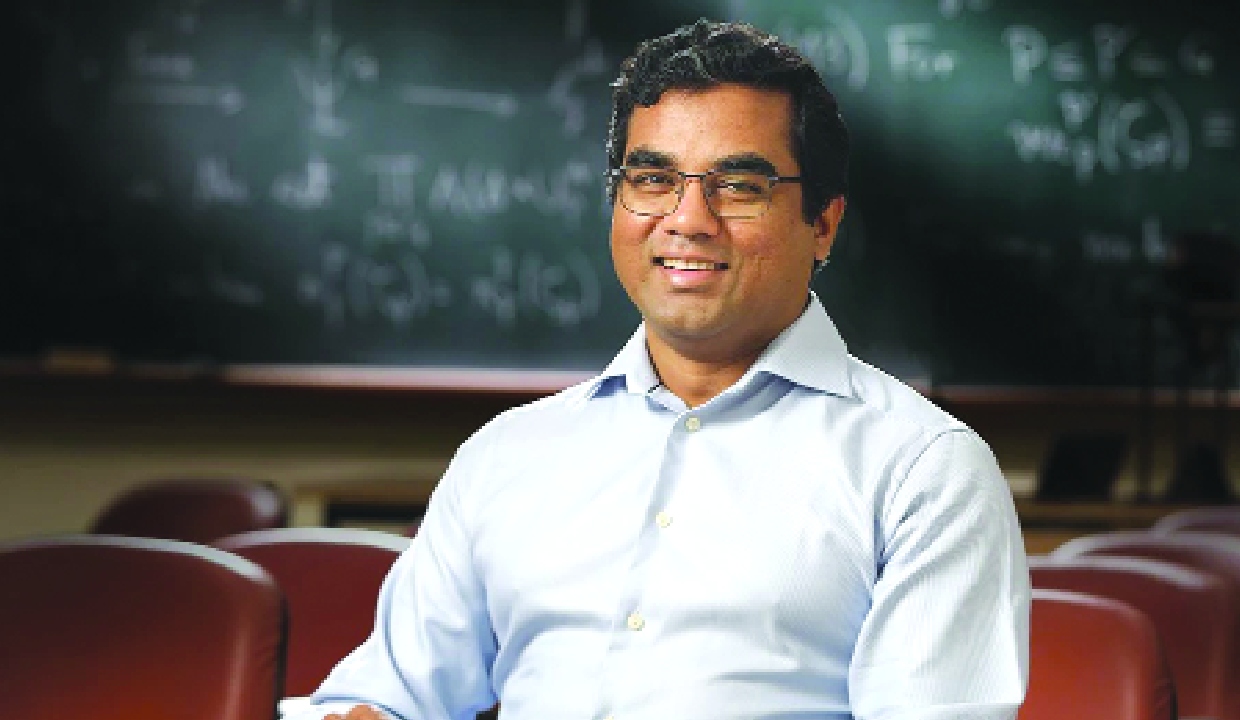
Indian mathematician Mahesh Kakde has done the country proud by winning the prestigious Ramanujan Prize 2026 for Young Mathematicians for path-breaking number theory.
The International Centre for Theoretical Physics (ICTP) and the International Mathematical Union (IMU) jointly award the prize for Theoretical Physics (ICTP) and the International Mathematical Union (IMU). It recognises mathematicians under the age of 45 who have carried out outstanding research while working in developing countries. Kakde is a professor at the Indian Institute of Science (IISC), Bengaluru.
The Ramanujan Prize, established in 2005, carries a $10,000 cash award and celebrates exceptional mathematical research carried out under challenging conditions in developing countries.
Kakde was recognised for fundamental work in algebraic number theory, particularly for solving important problems about how numbers behave and how different mathematical structures connect.
Number theory is the study of numbers and their properties. Algebraic number theory takes this further by looking for hidden patterns and structures that can explain why numbers behave the way they do.
One of Kakde’s major contributions is in an area called Iwasawa theory. At its heart, this involves studying how mathematical patterns change when numbers are extended into increasingly complicated systems.
He developed results that helped mathematicians understand these changes, including in cases where the systems do not behave in a simple, predictable way.
Kakde has also made important contributions to the Gross-Stark and Brumer-Stark conjectures. These are long-standing mathematical ideas that connect seemingly different areas of number theory.
Kakde’s work has implications for Hilbert’s 12th problem, one of the 23 famous mathematical problems proposed by German mathematician David Hilbert in 1900. The problem asks, broadly, whether it is possible to describe important numbers associated with different mathematical systems systematically.
His research helps mathematicians understand deep connections between numbers, equations, and mathematical structures.
Born and educated in India, Kakde completed his Bachelor of Mathematics at the Indian Statistical Institute in Bengaluru before moving to the University of Cambridge, where he completed his master’s degree and PhD in pure mathematics in 2008.
He subsequently worked at Princeton University, University College London and King’s College London before joining the IISc as a professor in 2019.
The Ramanujan Prize adds to Kakde’s growing list of honours. He received the Infosys Prize in Mathematical Sciences in 2022 and was an invited speaker at the International Congress of Mathematicians. He was also named among the Asian Scientist 100 in 2023.