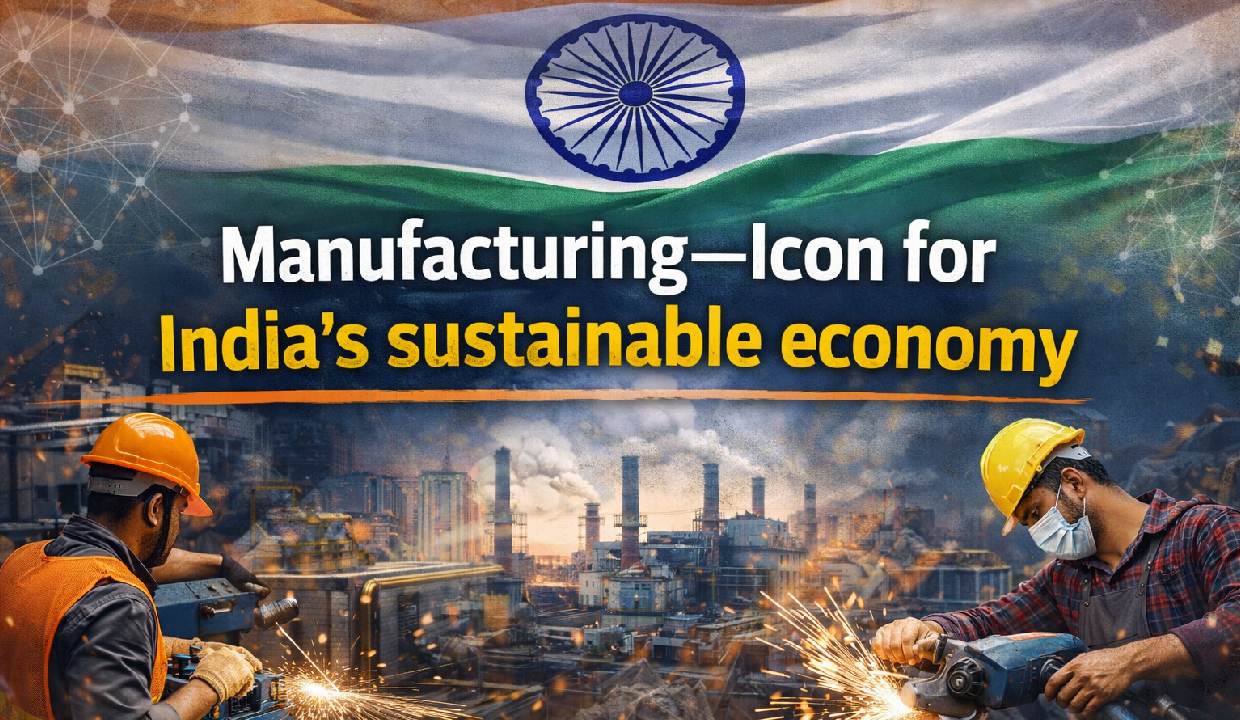
Manufacturing—Icon for India’s sustainable economy
India’s Innovation ecosystems - Manufacturing Mantra
India is spearheading in investment, innovation, and infrastructure. India has emerged as a top countries for investment destination after the US as per the survey by PwC. Indian grassroot lands are transforming into technological valleys such as Quantum Valley, Green Hydrogen Valley, and Silicon Valley. Innovation and technological capabilities are a key growth driver for India’s economic advancement that facilitate manufacturing industries to cater local, global customers, thereby marching to achieve Viksit Bharat@2047. India’s 3M Mantra for manufacturing is Made in India, Made for India and Made by India. India is undergoing rapid transformation in manufacturing like Digital Smart Manufacturing because of our countries adaptability to fast-growing Industry 4.0 / 5.0 technologies like Artificial Intelligence, Blockchain, Industrial Internet of Things (IIoT) and most importantly, cybersecurity. Indian mission programs like National Semiconductor Mission, National Green Hydrogen Mission and National Quantum Mission give a big boost to the manufacturing. Indian startups like QNu labs, boAt-a youth-centric brand, Ola, have created striking success case studies in terms of frugal innovation, investment, indigenous infrastructure, and manufacturing. Additionally, India homegrown industries like Sahasra semiconductors, Bhiwadi unit, which has manufactured, shipped Swadeshi and Make in India micro-SD cards to various e-commerce platforms and RRP Electronics, Maharashtra, which has established India’s first major Outsourced Semiconductor Assembly and Testing (OSAT) are creating manufacturing platforms and products in the semiconductor space.
Zero Defect Zero Effect (ZED): A push for Sustainable Manufacturing
India is undergoing a huge transformation in terms of converting service-based domain to a product-based sector. The products are developed in-house, which leads to Swadeshi spirits and Vocal for Local to global. India remembers the vision and mantra of Prime Minister of India Narendra Modi on National Startup Day Jan 16, 2026, the Indian startup to focus on manufacturing. The schemes like Production Linked Initiative and Design Linked Initiative form the fulcrum and give a great momentum for the manufacturing of local swadeshi products. The advancement in digital technologies like collaborative robots (COBOTS), Automated Guided Vehicles, telepresence robots, humanoid robots facilitate the manufacturing industries to increase the Total Factor Productivity (TFP), Labor Productivity (LP), and quality of the products. The quality manufacturing initiatives of MSME like Zero Defect Zero Effect (ZED) accelerate the high and excellent quality in manufacturing with Zero Defect in product development and process control. Indian industries and startups are manufacturing products which strictly adhere to the best practices of ZED. Additionally adding values to environment social governance thereby giving a big boost for competitiveness, sustainable manufacturing. It also adds enormous value to reducing waste thereby achieving six sigma quality. The international and national organization like Asian Productivity Organization, Tokyo, Japan where National Productivity Council, under the Ministry of Commerce and Industry, Government of India, is a member, facilitate the manufacturing industry, especially promoting the green productivity. It also conducts various capacity building programs like 5S, Kaizen, and Total Quality Management (TQM), which form the essential elements of manufacturing.
India is moving ahead to an innovation-led circular economy because inventions bring new business ideas, concepts, and technologies to cater to the needs of local and global markets and thereby produce more vital technological outputs with the same manufacturing productivity inputs. This leads to achieving results in better-made goods and services, boosting earnings and business profitability of Indian industries, especially.
India fosters in product design and process of springboard innovation by executing a framework of structured local and global processessuch as improved budget spending on research and development, funding in education and skill development, and most importantly facilitating entrepreneurs led by vibrant startups, micro small and medium industries to initiate an enterprise more efficiently and for also promoting failed businesses to retire the market more quickly through simplified schemes and process. Indian policies and schemes are carrying its intricacy to its benefit by utilizing the extensive and heterogeneous market segments in India that are keen on exploring new innovative solutions to their unmet needs through Indian MSMEs. The combination of strong capabilities and mature varieties of MSME schemes offered by different ministries makes India a strong, productive innovation base.
MSMEs: Growth Engine for Smart India
Micro, Small & Medium Enterprises (MSME) have been enormously contributing to the expansion of entrepreneurial endeavors through product, process, and business innovations. MSMEs in India are significantly widening their domain across different sectors of the economy through different clusters, producing diverse range of local products and services to meet the demands of domestic as well as worldwide markets. The MSME area is actively involved in different innovative activities through various implementing schemes and policies, which function as growth drivers to achieve the $5 trillion global economy through strong industrialization.
India’s manufacturing productivity: Total Factor Productivity and Labor Productivity
MSMEs, being a large, vibrant sector in India, create many jobs at low Capital costs and hence play a crucial role, second only to agriculture. They drive economic growth, employment generation, and innovation in India. In India, with a low share of value added and a large employment base, labor productivity in the agriculture and construction sectors has grown slower than in other sectors since 1980. In comparison, labor in 2019/20 in manufacturing and services was over 4.5 times more productive than in agriculture. With low productivity workers in agriculture and construction making up over half the Indian workforce, there is significant potential to boost growth by enacting productivity-enhancing reforms to the sectors, which will free workers to move to other, more productive sectors.
The Government is also implementing the Micro and Small Enterprises-Cluster Development Program (MSE-CDP) across the country. Under this, Common Facility Centres (CFCs) are developed to address common issues, such as improvement of technology, skills, quality, etc. National Productivity Councilhas conducted a research study which explores that the scheme has been able to improve the efficiency of the value chain of the units in the cluster, resulting in overall productivity growth of around 10-15% and growth in turnover in the range of 20-30 %.
The steps are being taken by the Government to further enhance labor productivity in the unincorporated non-agricultural sector, following a 5.6 per cent increase in gross value added (GVA) per worker in 2023-24. The way Government plans to sustain the observed growth in the GVA of the unincorporated sector, which recorded a 16.5 per cent increase in 2023-24? and the specific measures taken to enhance the skills of workers in the unincorporated sector, particularly in high-growth areas. In India enhancement of labor productivity and skills of workers is continuous and achieved a state of dynamic process.
Centre’s of Excellence: A Momentum for Manufacturing
The establishment of digital technological public infrastructures like Samarth Udyog Bharat 4.0 flagship initiative of the Ministry of Heavy Industry & Public Enterprises, Government of Indiaacross PAN India, Smart factory in Indian Institute of Science (IISc), Bengaluru, Centre of Excellence for Industry 4.0 by National Productivity Council, New Delhi, accelerates the manufacturing capabilities of Indian industries. Additionally, pioneering schemes such as CRTDH, which is called as Common Research and Technology Development Hubs, established under the flagship organization Council of Scientific and Industrial Research, support Indian MSMEs and Startups with pilot plants through Responsible Research and Development, technology licensing, and transfer. It also gives flexible access to innovative infrastructures in various domains like healthcare, climate, green energy and many more. WEF has taken a major initiative to reskill and upskill 850 million people across the globe. The World Economic Forum has launched the Center of Excellence in fourth industrial revolution across the globe. WEF has established the centre for the fourth industrial revolution in Maharashtra and Telangana. It has also been planned to establish the centre in Andhra Pradesh. The centre will give great momentum to facilitate AI innovation, cyber resilience and emerging frontier technologies in the manufacturing industry as well. The centre will act as a fulcrum to connect the Government and industry experts to a common platform, thereby framing policies and pilots leading to addressing the local and regional industrial needs.
India has achieved chairmanship of Asian Productivity Organization, Japan and BRICS 2026 which will lead to build enhancement in productivity, digital transformation, resilience, cooperation and sustainability respectively. This showcases the success path and marching towards the Viksit Bharat@2047.
Dr T Senthil Siva Subramanian
Head Institute Industry Interface Program Hindustan College of Science and Technology, Mathura; views are personal
Yadu Kr Yadav
Deputy Director National Productivity Council Ministry of Commerce & Industry Government of India; views are personal