Living with time: The impermanence of infrastructure
A crack in a concrete wall is called a defect. An engineer sees something deeper: a message from time. It tells us that materials age and even strong structures exist within design limits. Civil engineering, therefore, is more than construction. It is an encounter with impermanence.
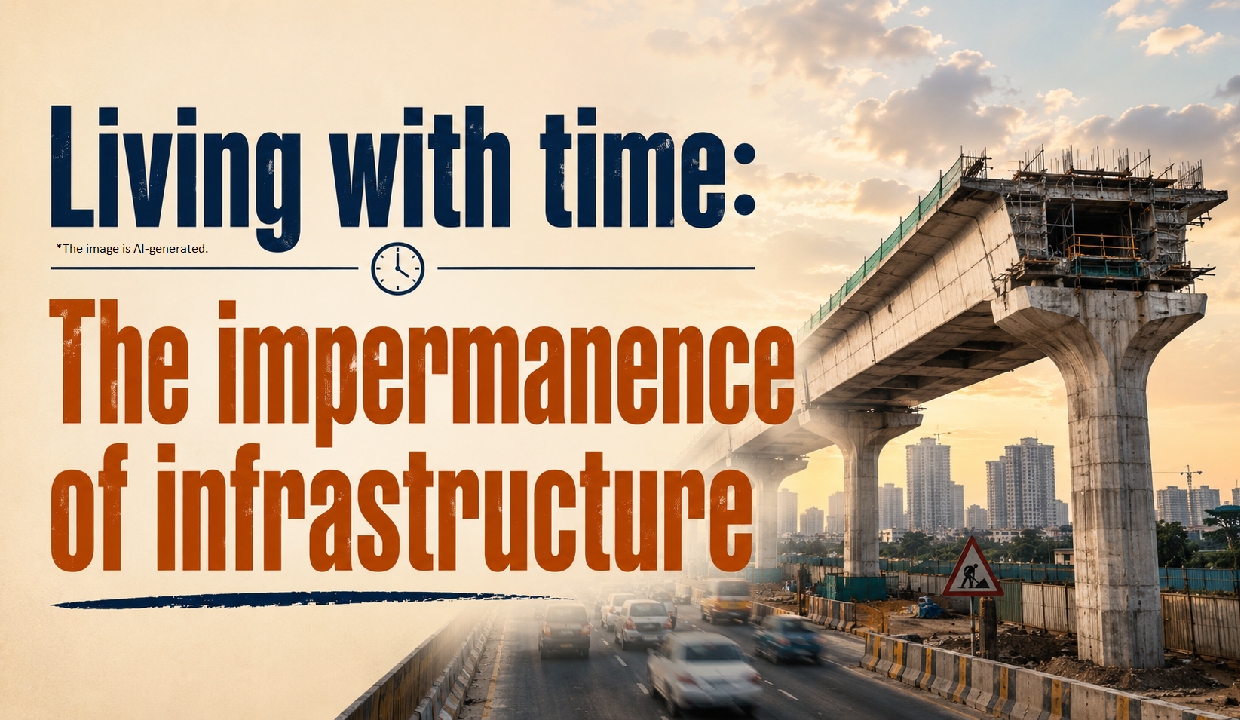
Every structure carries the certainty of deterioration. Concrete weathers, steel corrodes, roads develop potholes, bridges experience fatigue, dams accumulate sediment and foundations settle. We celebrate a bridge or highway, photograph the ribbon-cutting and then overlook the quieter responsibility: maintenance.
No bridge is permanent. A design life of 50, 75 or 100 years is not a promise of immortality. It is an engineering expectation based on loads, materials, environment, usage and maintenance. A structure survives because people inspect it, repair it, strengthen it and eventually replace it. Durability is not the absence of decay; it is our ability to respond intelligently to decay.
This is also a philosophical lesson for society. We celebrate creation more readily than preservation. A new expressway attracts headlines; routine resurfacing rarely does. A spectacular bridge becomes a symbol of progress; replacing corroded reinforcement does not. Political incentives favour visible construction because new projects can be inaugurated, while maintenance produces no ceremony.
The consequences follow. Deferred maintenance transforms manageable deterioration into expensive reconstruction. A small crack can allow water to reach reinforcement; corrosion can weaken structural members; weakness can eventually become failure. What engineering teaches us about structures is equally applicable to institutions. Neglect rarely announces its consequences immediately. It accumulates silently until repair becomes unavoidable.
Engineers design for uncertainty. We calculate loads, estimate probabilities and provide safety margins because the future cannot be known precisely. Yet societies often demand certainty from infrastructure. We expect drainage systems to cope with unprecedented rainfall, roads to withstand changing traffic and bridges to remain safe indefinitely. Climate change makes such assumptions increasingly dangerous. Infrastructure designed around yesterday’s climate may confront tomorrow’s extremes.
The answer is not to stop building. It is to build with humility. A mature engineering culture must ask not only, “Can we construct this?” but also, “Can we maintain it for generations?” Life-cycle costs should matter as much as construction costs. Materials should be selected for durability and repairability. Infrastructure agencies need regular inspections, accurate asset registers, trained personnel and protected maintenance budgets. Resilience must become a design principle, not merely an emergency response.
There is something profoundly human in our relationship with imperfection. We build knowing that everything we construct will eventually age. A bridge may serve millions for a century and still disappear one day. Its value lies not in defeating time, but in serving people while it stands. Perhaps civilisation is not measured by how successfully it conquers time. It is measured by how intelligently it lives with time.
The crack is not merely a failure. It is a reminder that everything built by human hands requires care and that permanence was never the bargain.
The writer is a consultant to Rashtriya Raksha University, a civil engineer, a short-story writer and a columnist; Views presented are personal.