Laldenga: From insurgency to peace
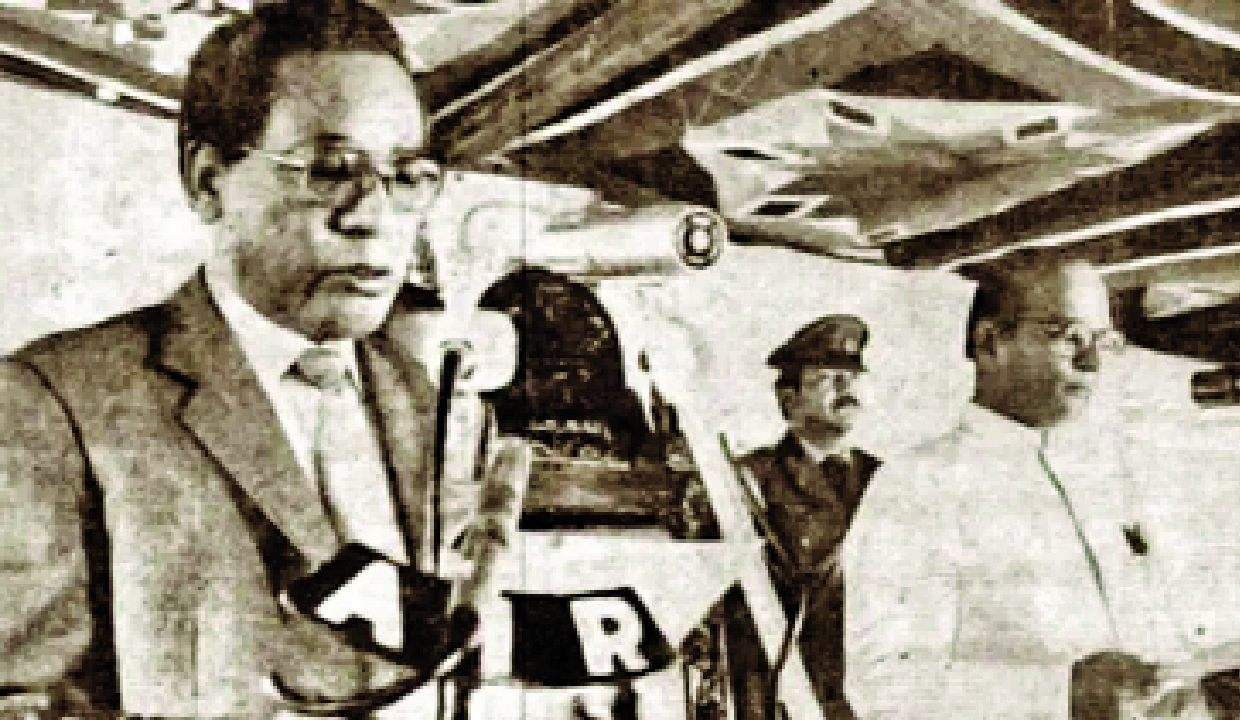
In From Guerrilla Fighter to Chief Minister, Zoramthanga Chhangte traces the turbulent journey from the 1966 uprising through years of exile and failed negotiations to the historic Mizoram Peace Accord of 1986. The book offers a deeply personal Mizo perspective on a conflict that ultimately gave way not to enduring bitterness, but to reconciliation and lasting peace
On August 22, Zoramthanga, a three-term (ending 2023) former Chief Minister of Mizoram and long-time President of the Mizo National Front, received his BA degree from Gauhati University, 60 years after graduating from Dhanamanjuri College, Imphal, then affiliated with Gauhati University. On June 26, the Indian Express carried in its column “40 years ago” its front-page lead as “Laldenga would be new CM of Mizoram in an MNF-Congress I coalition government”, replacing the incumbent Chief Minister Lalthanhawla, who would be his deputy CM. The Mizoram Peace Accord is one of India’s most successful internal peace processes, negotiated with Laldenga by four Indian governments, culminating in PM Rajiv Gandhi’s pointed efforts — this after Congress I had signed peace accords in J&K, Punjab, Assam, Nagaland and Tripura.
The story From Guerrilla Fighter to Chief Minister is told by Zoramthanga Chhangte, a Mizo who graduated from Laldenga’s PA and became his most trusted aide and Vice President of the MNF. He is an eternal believer in Jesus Christ, the Lord God of his life and its turbulent trajectory. The book has 80 short chapters covering the movement in graphic detail.
A former Havildar in the Indian Army, Laldenga was fluent in English and Hindi and taught English at a local school for Rs 5. The insurgency and bid for secession began on 1 March 1966 with the declaration of a Unilateral Declaration of Independence and the launch of Op Jericho, which simultaneously targeted Aizawl (capital of Mizoram), Lunglei and Champhai, along with scattered posts in Mizoram. The Army was not deployed in Mizoram at the time; only the Assam Rifles and paramilitary forces were present. Military operations were meticulously planned, combining deception, surprise and siege tactics, though the Mizo National Army (MNA) had very few weapons to start the insurgency.
The Aizawl attack had to be abandoned due to the loss of surprise, but rebels later ambushed and killed four Assam Rifles soldiers. The Aizawl Assam Rifles headquarters fell under siege, with water pipelines destroyed. MNA asked Assam Rifles to surrender as Army helicopters attempted to drop water and evacuate casualties but were unable to land. Zoramthanga writes that Gen Sam Manekshaw, then Eastern Army Commander, was wounded while flying in one of the helicopters, which is incorrect. Meanwhile, police outposts, the Aizawl jail and treasury were captured. Assam Rifles declared SOS. On March 5, for the first time in India’s counter-insurgency history, IAF jets strafed the MNA, and Aizawl was left pulverised and ablaze. The siege was lifted, and MNA withdrew into the jungles to fight another day.
The attacks against Lunglei and Champhai towns were successful and resulted in surrender. From 1 to 15 March 1966, barring Aizawl, major portions of Mizoram were under the administrative control of MNF, with the capture of nearly 700 weapons, colossal ammunition and Rs 2 million from the Treasury.
MNA rightly did not resist the advance of the Indian Army, which entered Mizoram from Silchar, advancing to Aizawl, which Zoramthanga equated with a scorched-earth operation. While Laldenga crossed into East Pakistan, MNA volunteers stayed back to protect civilians and continue the insurgency.
MNF was not welcome in East Pakistan during Gen Ayub Khan’s time. Over time, MNA contingents moved to China for training and weapons. The 1971 war forced MNF/MNA to shift to Burma’s Arakan hills. Ironically, MNA fought against the Indian Army along with Pakistan’s SSG in the Chittagong Hills. Laldenga and his party were keen to start peace talks with India and remained in Pakistan from 1971 to 1975, during which time Laldenga and Zoramthanga met President Zulfikar Bhutto.
Secret talks were held in Kabul, Bangkok, Geneva, Hyderabad and finally Delhi. Ajit Doval, then Assistant Director, IB, Aizawl, monitored the peace talks.
After Mujib ur Rehman’s assassination, MNF moved back into Bangladesh from Burma. The 1976 peace talks resulted in MNF accepting a ceasefire and a solution within the Indian Constitution but refusing to surrender their weapons. For the Delhi talks, Laldenga was parked at 34 Gulmohar Park, a safe house, while “negotiating with one Om Mehta as Doval was doing what he is best at — divide MNF and MNA”, with partial success. The Delhi talks failed, forcing Laldenga and Zoramthanga to escape from the safe house in 1978, but Laldenga was arrested and sent to Tihar Jail. Advocate Swaraj Kaushal (married to Sushma Swaraj of the BJP) got Laldenga released (in 1990, Kaushal became Governor of Mizoram, where I met him).
On July 31, 1980, the second formal ceasefire was announced, but talks failed again and Laldenga flew off to London. Brig T Sailo, whom I knew, had retired from the Indian Army and was CM of Mizoram; his son was underground. As counter-insurgency against the MNA intensified, the MNF was declared an unlawful organisation. The third ‘Quit Mizoram’ notice was given to non-tribals and Gorkhas. In April 1984, Congress won the state elections; Sailo was defeated with the help of MNF, Lalthanhawla became Chief Minister, and Laldenga returned from London. Another ceasefire was declared in December 1984 following the most intense round of talks between Congress and MNF, with the latter agreeing to lay down arms. On 30 June 1986, 20 years after MNF took up arms, Laldenga was appointed interim CM following an interim accord between Congress and MNF. It was a compromise between the central government and rebels-turned-democrats who were mainstreamed with a safe landing.
The provisions of the accord were: MNA to surrender arms, sever ties with other banned groups, MNF to accept the Indian Constitution, grant of statehood with Special Category status and Legislative Assembly, continuation of Inner Line Permit, choice of state language, grant of state university and High Court, compensation for those killed in the 1966 uprising, rehabilitation of cadres and a lot more. Zoramthanga's book is guided by faith through conflict towards a destiny of peace guided by Jesus Christ. It is dedicated to Mizoram’s martyrs. The narrative is through a Mizo lens; the account of the insurgency is scant and scattered, as Zoramthanga was focused on the peace process accompanying Laldenga. Op Jericho is a revealer. While Pakistan hosting L and Z in Rawalpindi after Dacca is a mystery, China providing training and a substantial quantity of weapons is not.
The peace process is a saga of failed talks which eventually led to a unique peace accord in which Rajiv Gandhi was heavily invested. The sound accord has led to durable peace and good governance, largely due to Mizos’ love for and fear of God-a must-read book.
The story From Guerrilla Fighter to Chief Minister is told by Zoramthanga Chhangte, a Mizo who graduated from Laldenga’s PA to become his most trusted aide and Vice President of MNF. He is an eternal believer in Jesus Christ, the Lord God of his life and its turbulent trajectory
The writer, a retired Major General, served as Commander, IPKF (South), Sri Lanka, and was a founder member of the Defence Planning Staff, now the Integrated Defence Staff; Views presented are personal.