Jantar Mantar protest targeted in alleged Pakistan-based conspiracy
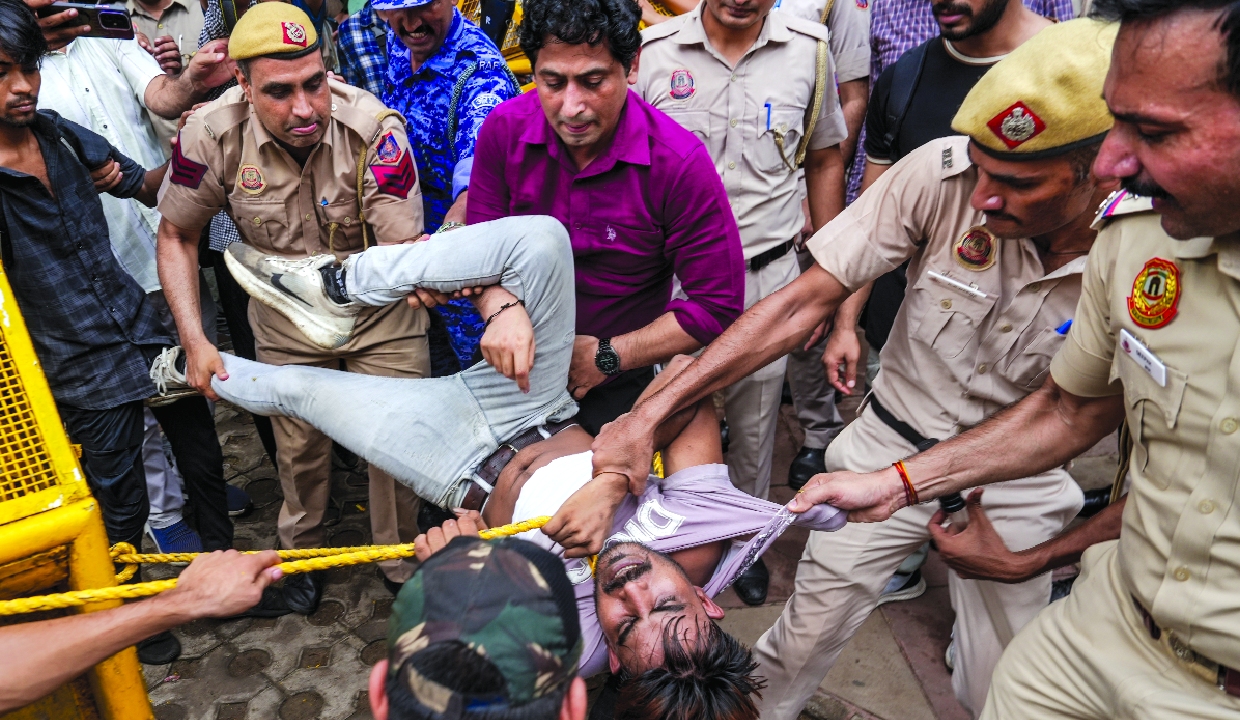
Recent police actions have revealed that terror networks linked to Pakistan saw the students’ protests at Jantar Mantar as a chance to cause trouble and unrest in the Capital. On August 4 and 5, Punjab Police reported breaking up two ISI-backed terror groups and arresting nine people, including four minors, for allegedly attempting to disrupt the protests. The five adults were Vansh Kumar (19) and Anmol Singh, also called Sahil (20), from Patti, Tarn Taran, and Harman Singh, also called Hammu (24), Sukhdev Singh (30), and Sukhman Singh (19) from villages near Amritsar.
Eight group members reportedly took a train to Jantar Mantar during the peak of the CJP protest. Punjab Police say the suspects allegedly received online training from handlers in Pakistan on making and using petrol bombs, and bought bottles, fuel, and other supplies after arriving in Delhi.
The police further claim, the suspects aimed to attack security personnel and protesters, hoping to turn the student protest into a larger security or communal issue. Their plan failed because of increased police presence.
They returned to Punjab, where they were caught in a joint intelligence operation. Police recovered three illegal pistols, nine live cartridges, four petrol bombs, and a stolen motorcycle from the suspects.
In another operation, West Bengal’s Special Task Force arrested Mohammad Hamim Mondal in Purba Bardhaman on the night of July 30-31. Mondal, who lives in Renaissance Township, is suspected of links to Jaish-e-Mohammed. Investigators allege that handlers in Pakistan told him to get a police uniform, join the CJP protest at Jantar Mantar, and try to cause unrest. Mondal was also said to be watching the movements of West Bengal Chief Minister Suvendu Adhikari and other top officials, looking for areas with less security.
His associate, Arpita Sarkar, was arrested on July 31 in Sahibganj, Jharkhand, for helping gather intelligence and run honey trap operations. Both have been charged under the Unlawful Activities (Prevention) Act.
Both groups allegedly followed orders from across the border, used encrypted apps and social media to plan and recruit, and deliberately chose a long-running, high-profile protest in central Delhi. It is not new for Pakistan’s intelligence agencies and related groups to try to exploit divisions in India, but recent events show they are speeding up their recruitment methods.
The fact that two different groups targeted the same protest at the same time, one led by ISI operatives in Punjab and the other linked to JeM in Bengal, shows this was coordinated and not a coincidence. This suggests that protest schedules are being closely watched, with a focus on high-profile, easy-to-access events that can be used to make unrest appear spontaneous, sources said.
Investigations are still looking into how much local help there was in Delhi, how large these networks are, and whether there is deeper infiltration.