India’s rising global confidence reflected in new national survey
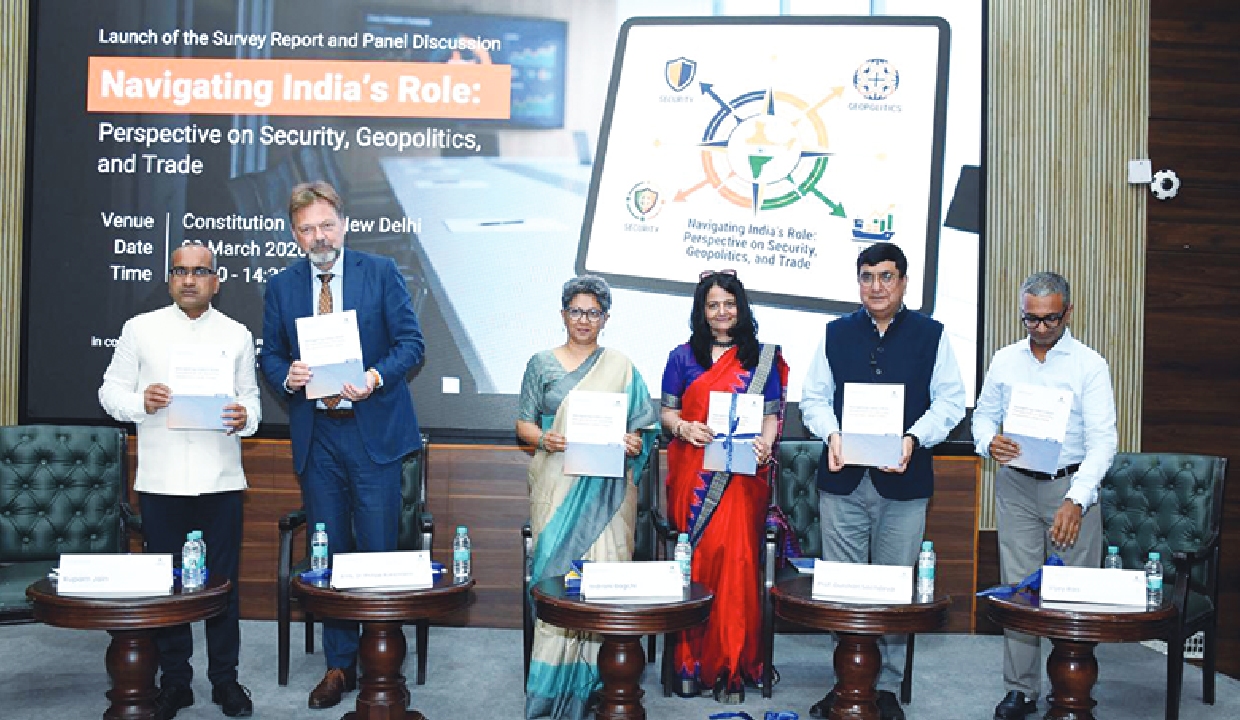
India’s growing strategic confidence and evolving global outlook were highlighted in a new national survey released at the Constitution Club of India in New Delhi. The report indicates that Europe and Germany are increasingly seen as India’s most trusted partners in an uncertain geopolitical environment.
The survey report, titled “Navigating India’s Role: Perspectives on Economy, Security, and Geopolitics,” was released by the Kalinga Kusum Foundation (KKF) in collaboration with the Friedrich Naumann Foundation (FNF) and research organisation Rajneethi. The event brought together diplomats, policymakers, scholars, journalists and industry leaders to examine how India’s strategic community perceives the country’s expanding role in global affairs.
Among the distinguished attendees was Philipp Ackermann, Ambassador of Germany to India, highlighting the growing significance of India–Germany and India–European relations. The discussion also came against the backdrop of the recently concluded India–EU Free Trade Agreement, widely described as a milestone in strengthening economic and strategic cooperation. The survey, conducted among 1,396 respondents from politics, business, academia, media and civil society, provides a detailed snapshot of how influential and informed citizens interpret global developments. Nearly 70 per cent of respondents believe India will become a global power within the next two decades, while economic growth, jobs, technology and trade emerged as the top priorities for India’s foreign policy. The findings also underline India’s long-standing preference for strategic autonomy in global affairs. Notably, Europe ranked highest on India’s trust index, ahead of the United States, Russia and China. Germany received particularly strong ratings for technological leadership, regulatory stability and climate-conscious industrial policy.
Delivering the keynote address, Sujeet Kumar, Member of the Rajya Sabha, said the survey reflects India’s evolving strategic consciousness, particularly among young professionals and the expanding urban middle class.
Referring to the India–EU Free Trade Agreement, Kumar said 75 per cent of respondents supported the pact, viewing it not only as an economic opportunity but also as a means to strengthen geopolitical balance. He also highlighted the deepening Indo-German partnership through what he described as the “3T framework” — Trade, Technology and Talent.
Experts during the panel discussion noted that in a world marked by geopolitical rivalries and supply-chain shifts, India’s search for stable, democratic and technologically advanced partners has naturally aligned it closer to Europe, particularly Germany. The report is expected to serve as a valuable reference for policymakers, diplomats and researchers studying India’s evolving global role.