India must become an AI creator, not just a user: Delhi CM
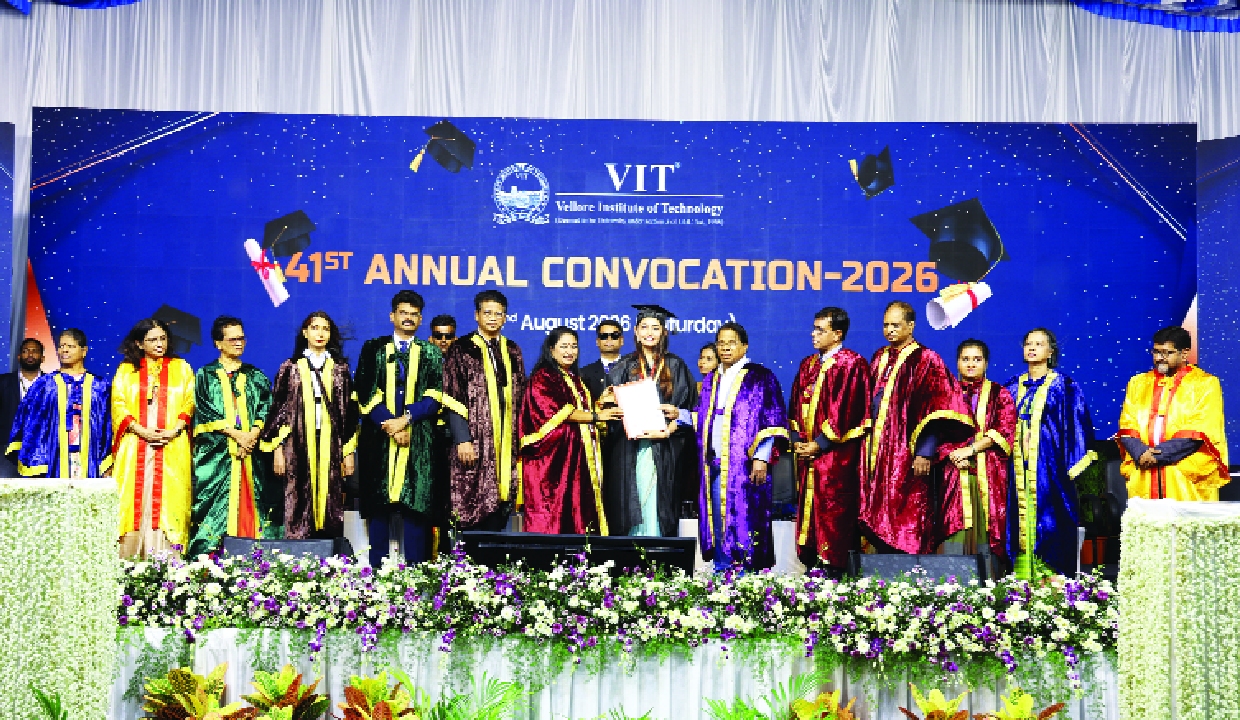
India must transform itself from a consumer of artificial intelligence into a creator of AI technologies, Delhi Chief Minister Rekha Gupta said on Saturday. Gupta was speaking as the chief guest at the 41st convocation of VIT University, Vellore, presided over by VIT Chancellor G Viswanathan.
She conferred degree certificates on graduating students during the ceremony.
Addressing the gathering, Gupta said many pressing problems faced by society could be addressed when Governments and graduates work together. Citing Delhi’s experience, she said the city had found solutions to challenges including pollution, traffic congestion and waste management by partnering with IIT institutions.
She urged graduating students to take up similar responsibilities after entering the workforce and contribute to solving problems in their cities while driving innovation for the country.
“Don’t just be users of artificial intelligence — build India’s own AI,” she said, pointing to the substantial investments being made by the Union Government under Prime Minister Narendra Modi through the India AI Mission. The initiative spans areas including semiconductors, computing infrastructure, defence, space, drones, robotics and biotechnology.
Gupta said India’s goal should be to move beyond consuming AI technology and instead produce it, describing this as one of the greatest contributions graduates could make to their states and the nation.
She also spoke about resilience, advising students not to fear failure or allow it to cause stress. Instead, she encouraged them to identify the causes of failure, understand them and work through them with determination rather than walking away from challenges.
Hard work, she said, remains the most important path to success. While a nation’s products and assets contribute to its growth, she said its most valuable resource is its intellectual capital, represented by its graduates.
Gupta said India’s development goals should be guided by the vision of “Make in India”, “Invest in India”, “Design in India” and “Brand in India”. While the world has recognised the talent of Indian engineers, she said it must now also witness the strength of Indian technology.
Viswanathan calls for greater access to higher educationIn his address, VIT Chancellor G Viswanathan said India’s Gross Enrolment Ratio in higher education stands at around 30 per cent, while the Union Government’s new education policy aims to raise it to 50 per cent.
India, he said, must compete with other Asian countries on this front, citing enrolment ratios of 90 per cent in South Korea, 60 per cent in Japan, over 60 per cent in China, 40 per cent in Malaysia and 45 per cent in Thailand.
Viswanathan said India has around 1,400 universities, 54,000 colleges and 16,000 standalone educational institutions, with about 4.5 crore students currently pursuing higher education. Ensuring access to higher education for students from poor and middle-class backgrounds, he said, is a shared responsibility of the state and central Governments.
Highlighting the imbalance between engineering and medical education, Viswanathan said India has more than 50 lakh engineering seats but remains far behind in medical education.
About 22 lakh students appear for the NEET examination every year, he said, competing for only around 1.3 lakh medical seats nationwide. Only around 2,000 to 3,000 seats remain vacant after allotment, he added.
As a result, nearly one lakh Indian students go abroad every year to study medicine. These include around 23,000 students in China, 18,000 in Russia, 15,000 in the Philippines, 10,000 each in Kyrgyzstan and France, 9,000 in Bangladesh, 7,500 in Georgia, 5,000 each in Italy and Poland, and 3,000 each in Iran and Nepal.
Citing World Health Organization guidelines recommending one doctor for every 1,000 people, Viswanathan said southern states, including Tamil Nadu, meet the standard, while states such as Bihar and Uttar Pradesh face shortages, with ratios of one doctor for every 2,000 to 2,300 people.
He said India needs greater investment in medical education. The country has 840 medical colleges offering a combined 1.3 lakh seats, with individual colleges typically admitting only 100 to 150 students a year, compared with up to 400 in Britain and 800 to 1,200 in China.
Raising the intake to 1,000 students per institution, he suggested, could help India reach eight lakh medical seats, provided adequate faculty and infrastructure are created.
Appeal over vacant vice-chancellor posts Viswanathan also pointed to continuing differences between governors and state Governments over the appointment of vice-chancellors. He said 17 universities in Tamil Nadu and more than 13 in Kerala currently have vacant vice-chancellor posts.
He appealed to newly appointed Union Education Minister Pralhad Joshi to coordinate between governors and state Governments so that the education sector and the interests of students are not affected.