
- HOME
- INDIA
- WORLD
- BUSINESS
- STATES
- LAW & JUSTICE
- ENTERTAINMENT
- SPORTS
- VIEWPOINT
- LIFESTYLE
- TECH
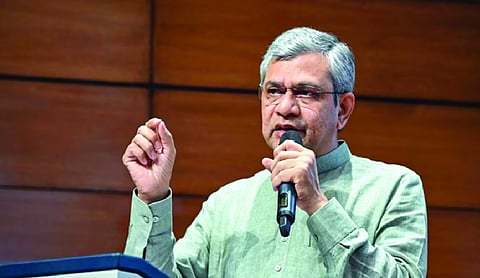
The hydrogen-powered train was launched on the Jind-Sonipat route on a pilot basis, and its expansion to other routes will depend on availability of resources, operational feasibility, and other requirements, Railway Minister Ashwini Vaishnaw informed the Rajya Sabha on Friday.
MPs from several parties raised questions regarding the new technology, including the total expenditure incurred on its development, details of hydrogen train projects approved and proposed across the country, the availability and cost of green hydrogen for such projects, and the domestic manufacturing capacity being developed for green hydrogen fuel.
Vaishnaw, in a written reply, informed the House that from the launch of the hydrogen-powered train on July 17, 2026, till August 3, it covered 2,492 km in commercial service on the 89-km Jind-Sonipat section.
“The hydrogen train has been developed by Indian Railways on pilot basis to demonstrate the use of hydrogen-powered train technology in Railways,” Vaishnaw said.
A dedicated hydrogen plant has been set up at Jind for providing hydrogen in this trainset. The hydrogen storage facility has been set up in accordance with the guidelines of the Petroleum and Explosives Safety Organization (PESO), ensuring adherence to prescribed safety standards and protocols, he said.
Highlighting the environmental benefits, the railway minister said the hydrogen trainset ensures zero carbon dioxide emission, with water vapour being the only by-product.
“The trainset works on fuel cell technology that does not have any moving part and conventional engine for traction power generation, therefore, the operation is much quieter, thereby reducing noise pollution. This project establishes Indian Railways in hydrogen technology,” he added.
Speaking about the cost incurred, he said the pilot project has been developed at a total cost of Rs 141 crore. “As the hydrogen trainset and its infrastructure have been developed on a pilot basis, direct comparison of the cost of hydrogen-fuelled trains with established traction systems at this stage would not present a fair cost comparison.”
He also outlined some of the train’s key features, including its indigenous design and development, its status as the world’s longest (with 10 coaches) and most powerful (2,400 kW) hydrogen trainset on a broad-gauge platform, and the fact that it comprises two 1,200-kW Driving Power Cars (DPCs), together generating 2,400 kW, along with eight passenger coaches.
At present, Indian Railways is operating the hydrogen-powered train technology on a pilot basis on the Jind-Sonipat circuit. “The decision to run hydrogen trains on other routes depends on availability of resources, operational and other requirements,” Vaishnaw said.