Hardworking Rahul on the solo-run
A proactive leader on the solo march and an inertia-ridden organisation refusing to shrug off its lethargy. If it is an interesting phenomenon, it is more dichotomous that has landed Congress - the Grand Old Party (GOP) - in a bind. Not the political rivals but the party’s top leadership should take the blame for this confusion and for showing no hurry to extricate themselves from this situation.
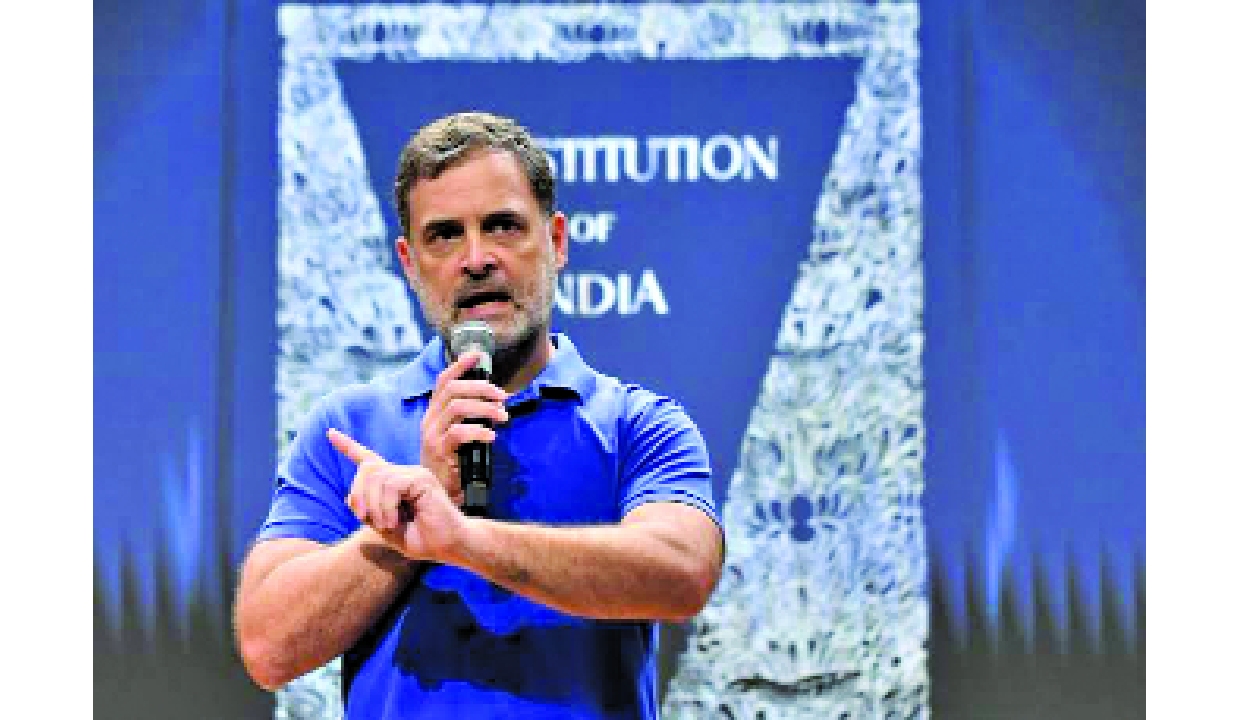
There is no doubt that Leader of Opposition Rahul Gandhi is a man on the march. From a reluctant player, during his first two terms as Lok Sabha MP and in between becoming Congress president, he has come a long way to become proactive, impressively and daringly raising political and societal issues. And above all, managing to establish a connect with the younger generation, or Gen Z, who have steadfastly stood behind Prime Minister Narendra Modi during the last one decade. Squatting on a dharna outside Parliament Street Police Station in support of a pellet-injury-hit youth is the latest in the series of steps in this direction.
The contrast between Gandhi’s high-profile individual outreach and the perception of a sluggish Congress party stems from deep structural decay, heavy reliance on a top-down (mostly defunct) leadership model, and disconnected regional hierarchies. When high-visibility campaigns fail to translate into organised local momentum, it exposes a disconnect between national optics and ground-level execution. This has repeatedly happened, but there is no attempt to learn lessons and set the house in order.
Despite his sensible interventions and thoughtful suggestions on vital national and international issues, Gandhi gives an impression of still being a loner in the GOP’s vast spread all over the country. That is strange enough. But why so? Does he himself need to reflect or change his approach towards the organisation by shrugging off indecisiveness? Shouldn’t he adopt a proactive approach to set the party and its leaders right, as he has been doing in his solo efforts? Firstly, he must follow the dictum suggested by none other than Gandhi himself. Pick up the right person for the right job with a strong rider of accountability. He needs to do this in the light of his observation that the party has been putting up the racing horse on the job to pull a cart and vice versa. Even before that, while on a visit to Gujarat, he had spoken about the BJP sleeper cells active in the state Congress (that scenario prevails in many states and Union Territories) and the need for heads to roll. It has been months now, but the follow-up action is still to come. The BJP and regional parties’ sleeper cells are thriving all over the Congress network.
An immediate follow-up action on such counts would have given Gandhi a decisive edge and created deterrence, thereby making it easier for him to tone up the organisation. Indecisiveness has portrayed his weakness; this attitude has emboldened those becoming roadblocks for the party to act more vigorously in internal sabotage. Indecision, reluctance to take hard decisions and the tendency to protect even the “failed horses” under the garb of being favourites of someone have become the Congress’s bane. It is hard to believe that Gandhi and other leaders are not aware of this malady. What is intriguing is that they are knowingly allowing such a situation to prevail at a greater cost not only to the party but to the nation as well, as it weakens the position of the country’s main premier opposition party in the overall democratic context.
A strong reason behind Gandhi’s “loner status” is that leaders around him in the AICC and PCCs have found a convenient way to shrug off their responsibilities and justify inaction by seeking refuge under the leader’s umbrella. “Rahul Gandhi naraz ho jayen ge (Rahul Gandhi will get annoyed)” is their usual refrain to justify not taking a decision in any particular situation. For instance, how could it be justified that it takes months, sometimes years, to make organisational changes at the AICC or the PCCs level? It is criminal negligence; firstly, a non-performing leader is allowed to continue and, secondly, the organisational set-up is given to him/her at a time when a change should have been effected, as a reward for non-performance.
A case in point is the sensitive and strategic Jammu and Kashmir, where Congress, being a national party, other than the ruling BJP, has an important role to play but is being prevented from doing so by organisational shortcomings which the high command refuses to remove. On the occasion of PCC president Tariq Hamid Karra completing two years in office, despite all the controversies he has courted due to his “style of functioning” and total lack of connect with the rank and file, the AICC in-charge Syed Naseer Hussain rushed to Kashmir to work on providing a new organisational set-up to him as a reward. This happened in the backdrop of a controversy germinating from Karra’s alleged non-appearance at the Independence Day function held at the party office.
Shouldn’t completion of two years in office have been a stocktaking time, with Karra asked to present his report card? For that reason, any AICC or state/UT functionaries? Appointment or continuation in office shall be directly related to the performance of the incumbent, which should be the thumb rule from AICC down to PCCs.
Such a scenario prevails in many other states and UT units, with no sense of accountability attached anywhere. Apart from the states/UTs, another weak link is the nonchalant attitude of some top AICC office-bearers, particularly those made in charge of the states and UTs. In the absence of accountability, they are merely living in comfort zones, at times becoming Gandhi’s cheering brigade. This has become a convention, to be seen to be on his right side.
How best to use the services of ageing and well-entrenched regional and a set of national-level leaders is a daunting challenge for Gandhi, as these leaders are making the generational transition difficult. To tackle this situation, he needs to have a set of well-versed and trusted advisers rather than acting solo, which will also help in lessening over-reliance on brand Gandhi.
A classic case of this syndrome is at play in yet another sensitive border state of Punjab. The old guard in the state is feverishly working unitedly to thwart generational change, which has come in the form of Rahul Gandhi-loyalist PCC chief Amrinder Singh Warring, who, like Karra, has also completed two years in office. Serious factionalism has risen ahead of the 2027 Assembly elections. No doubt the old guard is taking undue advantage of the situation, but it is also a reflection on Warring’s functioning and ineffective handling by the central leadership. Such situations can only be tackled through quick and tough decisions. No matter if it involves removing a so-called loyalist in the overall interest of the party, as is the case in Jammu and Kashmir and Punjab.
The writer is a political analyst; Views presented are personal.