Gen-Z youth: The thin line between protest and provocation
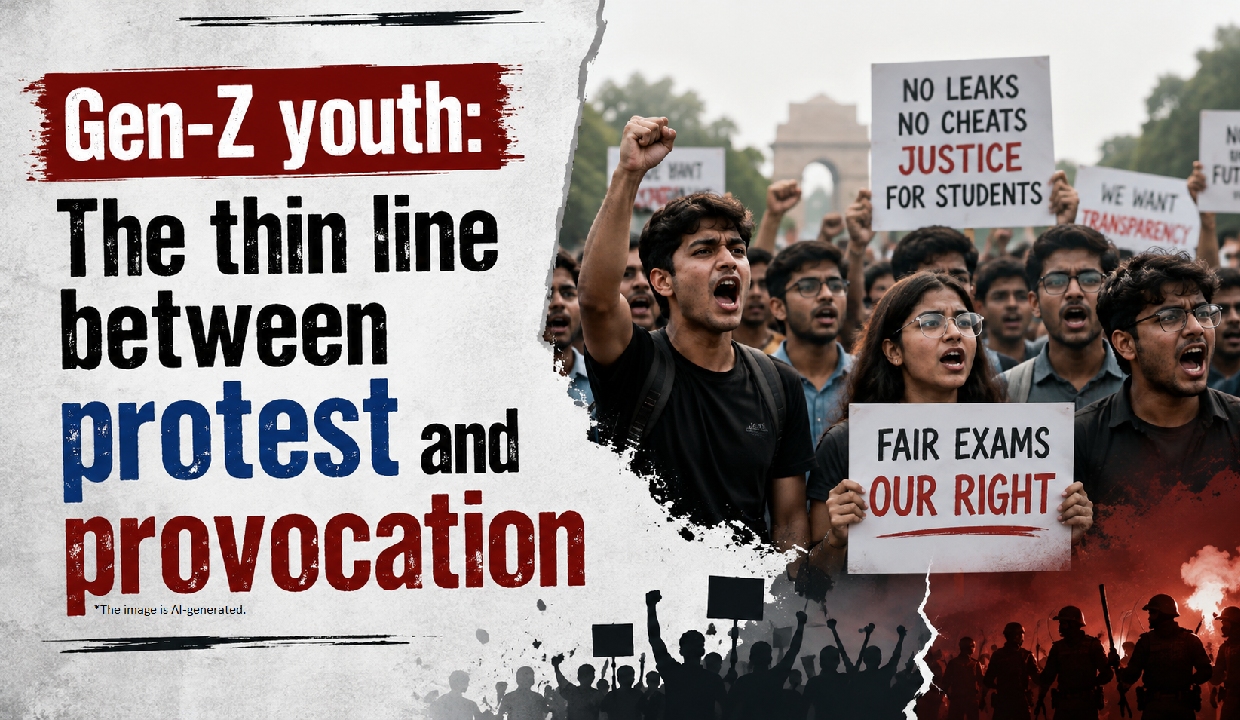
The highly objectionable language used by some Gen-Z youth during the NEET protest at Jantar Mantar not only damaged the spirit of a legitimate agitation but also crossed the boundaries of democratic decorum.
What began in June 2026 under the banner of the Cockroach Janata Party as a platform for students’ genuine anger over the NEET paper leak and examination irregularities eventually delivered results — including the resignation of Education Minister Dharmendra Pradhan.
Yet the same movement was stained by instances of extreme vulgarity directed at Prime Minister Narendra Modi, his late mother and the security forces — language that no civilised society can accept. Some participants crossed the Lakshman Rekha of democratic protest by resorting to such abuse.
Apologies and the claim of provocation
Once these videos went viral on social media, widespread outrage followed across the country. The same youth who had been carried away in the heat of the protest were now confronted with the consequences of their words.
Several Gen-Z youngsters released public apology videos. One 15-year-old girl explained that she had gone to Connaught Place with friends, where the atmosphere of abuse was already intense. Under that influence, she too uttered inappropriate remarks. She expressed deep shame, called it her first and last mistake, and sought forgiveness from the nation.
Other young people similarly admitted that they had been swept away by the moment and provoked into using such language.
Their claim deserves attention. Many of these youth now say that an atmosphere was deliberately created at the protest site in which abuse and indecency were normalised. Certain elements actively instigated them, pushing the real issues — paper leaks, examination fairness and students’ futures — into the background.
Under the cover of the protest, basic linguistic dignity was completely abandoned.
The right to protest is a fundamental democratic right, but it does not include a license for insult or obscenity. When the younger generation — the future of the country — adopts such language, it reflects not merely an individual failing but an erosion of social values. Certain elements appeared more interested in political point-scoring than in addressing the genuine concerns of students.
A restrained response from the Prime Minister
In this entire episode, Prime Minister Narendra Modi responded with notable restraint and a paternal tone. In an Instagram video message, he observed that some mischievous children at Jantar Mantar had used language unbecoming of a civilised society, and that even his late mother had been targeted.
Yet he emphasised that mistakes occur in youth and that children deserve an opportunity to reform. Using a powerful analogy, he said that when the tongue is bitten by the teeth, we do not break the teeth — because both belong to us, just as these children belong to the nation.
By choosing restraint over retribution, the Prime Minister occupied the moral high ground and appealed to society to guide these misguided youth rather than harass them or drag them through courts.
Lessons for student movements and society
This episode offers clear lessons. Student movements must remain free from political provocation and ideological capture.
Social media proved to be a double-edged sword — it helped mobilise the youth but also created a permanent digital footprint of their worst moments. Families, educational institutions and society must prioritise the teaching of linguistic civility and democratic values.
Abuses solve no problem; they only damage the credibility of the movement itself. Allowing protests to descend into abuse is akin to playing with fire — it burns the credibility of the cause.
Gen-Z is a product of the digital age — sharp, aware and eager for change. But on the path of change, maintaining dignity in language and behaviour is essential.
The young people who have now apologised have taken the first step towards accountability. Society, in turn, should offer them a second chance so they can grow into responsible citizens. Protests remain a vital strength of democracy — but only when they stay dignified, focused and civil.
In the end, the Jantar Mantar episode reminds us to remain vigilant against atmospheres that divert attention from students’ real issues. Elements that provoke the youth must be identified, and democratic linguistic dignity must be protected at all costs.
A mistake was made, apologies have been offered — now is the time to move forward, learn, and build a more civilised society.
Youth power is the country’s greatest asset; if given the right direction, no goal is impossible.
The author is an assistant professor at Allahabad Degree College, University of Allahabad; Views presented are personal.