Gen Z: A vibe is not a revolution
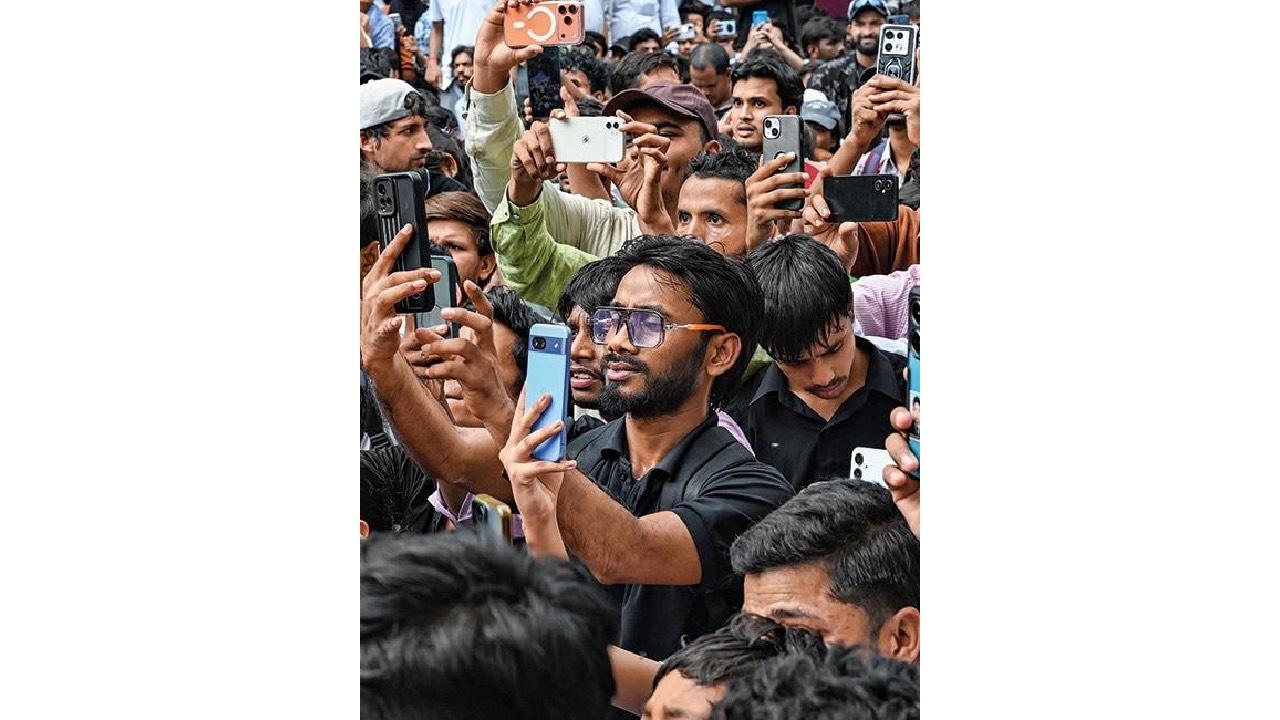
Look at him on the road to Parliament. Twenty-two, hoarse from sloganeering, phone held high, live streaming his defiance to the nation, background music perfectly chosen. The country has decided he is a revolution.
Now look at the same phone an hour later, on the bus home. The astrology app is open, because a job interview is coming and the stars must be consulted. There are three messages from his mother about a girl his parents have shortlisted; he will oblige his mother. There is an EMI reminder for the phone itself, which he bought on credit he does not really have. And there is the spicy reel he is watching to recover from the protest, served to him by a machine that knows him better than he knows himself.
The youngster screaming at the police on Instagram, and the youngster enquiring how to enchant a reluctant girl on an astro app: both screens are real. The country has chosen to see only the first one and has begun garlanding it. I have spent more than twenty years looking at the second one, and I am writing this to say: withdraw the garland. The garland is the surest way to make certain the young man never changes.
Every generation is certain that the next one is more rebellious. Hardly anyone stops to ask: rebellious against what, and from where. The one doing the rebelling has himself been assembled, by the school, the media, peer pressure, religion, society and culture, all of them stamping themselves on him. What they have produced is a type. We even have a name for the type. We call it Gen Z. Whether anything beneath a new name and a new type has changed is a separate question, and one that is not entertaining enough to be asked.
Notice, before anything else, where the name itself came from. Nobody in this generation chose it. "Gen Z" was popularised by marketers and demographers, the people whose job is to slice the population into cohorts so that each cohort can be sold to more efficiently. It is a shelf label, the kind pasted on a product category. A generation that wears its price sticker as its identity has already told you something about its condition.
How many of the Gen Zs are actually there in India? Around forty crore between the ages of fourteen and twenty-nine, the largest such population on earth. Three out of every ten eligible voters are between eighteen and twenty-nine. In Bihar it is closer to four in ten. In the seven states going to the polls next year it is about twenty-two per cent. By 2029, this generation overtakes the millennials as the largest voting bloc in the country.
Every political party is on reels now. Men who have probably never opened a laptop are doing Instagram live sessions, showing you their dogs, wearing sneakers. So it has been decided. The youth have woken up. They will now decide elections. A generational shift has arrived.
I do not think anything has arrived.
What is being called a generational shift is a momentary situational phenomenon, and everybody has mistaken it, the celebrating and the nervous alike, including the political parties. This badge of honour is being awarded far too quickly. They are rebels, we say. But are they really?
Let me say where I speak from, because it matters. I am not reading this generation from a corporate or academic survey. For over two decades my daily work has been with the young, not at rallies and not through a screen alone, but in direct and intimate question and answer, one person at a time, in lakhs across the years. My work has been to go after their weaknesses, which means I have had to know those weaknesses very closely. The second screen is my workplace. What I am about to say, I have heard from their own mouths, day after day.
Where the queue stands
Leave the placards aside and look at where this generation actually stands in line.
The astrology app market in India was worth around fourteen hundred crore rupees in 2024 and is projected to grow tenfold by 2030, at close to fifty per cent a year. There are now more than nine hundred religious technology startups in the country. The largest player in the category booked over twelve hundred crore rupees last financial year, up eighty-five per cent, with crores of registered users and more than thirteen thousand astrologers waiting at the other end of a chat window. The investors have a name for the sector. They call it faith tech.
Who is paying for it? By the industry's own account, the young. Eighty-five per cent of the users of these platforms are under thirty-five. The market for superstition in this country is being sponsored by the generation that calls itself forward-looking. Yes, superstitious rather than rebellious is a word that better applies here. And a person who cannot even beat imaginary stories will not stand up to a living oppressor.
Show one of them an old village woman, unlettered, tying a thread around a tree for some wish of hers, and watch the laughter. They will say she is backward. "Aunty got no chill!"
Then look at what the one laughing keeps on his own phone. The crystals, the tarot, the aura, the vibes, the chakras, the manifestation, the reiki, the past life regression, the akashic records. He has not shed the superstition. He has anglicised it. He has made it cool, made it tech-savvy, put it on a subscription. And that old woman had a defence he does not have, because she got no schooling, no exposure, no internet, nothing at all. He got everything. What is his excuse?
Instagram is the homeground of Gen Z, we say. Then how do you account for the fact that the babas of today are bigger on Instagram than even on Facebook? The most followed of them carries over a crore on Instagram and under ten lakh on Facebook. Facebook in this country is where the oldies sit. Instagram is where their children are. So look again at that gap and ask whose devotion is actually being counted. The fame was made by reels, then multiplied by cricketers and film stars arriving to touch the feet, all these, by the way, being Gen Z icons. This is not an inherited devotion carried on out of habit by the elderly. The young have chosen to be in the queue. Those queuing up before authority of one kind cannot challenge authority of another kind.
Every Saawan the highways fill with the barefoot ones carrying water. Stand by the road and look at the faces. You will not find many grandfathers there. Who are they? Gen Z.
Ask the young what they want from a working life, and the Lokniti-CSDS youth surveys have been consistent: more than half say a government job, against a quarter who want to build something of their own. They want security, not risk. Nearly four in five describe themselves as religious, and six in ten want a film banned if it hurts religious sentiment.
Then there is marriage, which is where you find out what a person actually believes. Eighty-four per cent of married youth in this country had an arranged marriage. Six per cent had a love marriage. More than nine in ten of the arranged ones were within caste, and the actual incidence of inter-caste marriage is about five per cent. Among the unmarried, half want their parents to choose the partner. The charts are matched before anything is settled, and somebody's life gets cancelled because two pieces of paper did not agree.
And then there is dowry. The World Bank looked at forty thousand rural marriages across five decades and found dowry paid in ninety-five per cent of them, with the amount remarkably stable the whole way through. And it is not only a village thing either. It is not a poor man's thing. It is not even a Hindu thing. Kerala, the most literate state in the country, records the highest average dowry of all, and thousands of women a year die over it. A hundred years of modern education in this country, and it has not touched this at all.
The one who wants the safe government posting, the one shouting the sectarian slogan, the one waiting for his parents to find him a wife, the one collecting a dowry, the one who will not leave his caste for anything, all of these are as young as the ones on the road to Parliament. Often they are the same ones.
Rebellion from such a segment is just another entertainment for a bored, conditioned self.
What they ask when nobody is filming
The placard is the public face. I have spent twenty years with the private one, and the two do not match.
The questions that come to me daily, in lakhs over the years, are not about transforming the system. They are these:
My parents want me married, what do I do? There is someone I love, but the caste is different. How do I tell my father? Should I leave my job? I am afraid. How do I stop scrolling? How do I wake up on time? How do I concentrate for even one hour? I failed an exam and I cannot face my family. My girlfriend's kundli did not match. I want to do something meaningful but my parents will not allow it, and I cannot go against them.
Read that list again. A generation whose most urgent private question is how to gather the courage to speak to its own father is being publicly garlanded as the force that will confront the State. The one who cannot cross his family's threshold is being told he will cross the establishment! The gap between the private question and the public image is this entire article in one line.
And what feeds the inner life of this generation? Not the book. India's own Time Use Survey found that barely four per cent of Indians now read anything for pleasure, down from five and a half per cent just five years earlier, and the analysts are unanimous about where the hours went: to the reel. As for ripeness, the ASER surveys of rural fourteen-to-eighteen-year-olds, the very cohort being crowned, found a quarter unable to read a Class 2 text fluently in their own language and more than half unable to divide a three-digit number by a single digit. Every revolution in history was led by its most intensely educated young minds, self-educated where the schools failed them, reading banned books by lamplight. Show me the lamplight here.
And then there is love, the oldest school of intensity. A revolutionary is first a lover; the two run on the same fuel, the capacity to stake everything on one thing. Measure this generation there. Six per cent love marriages, we saw. And in the dating world it has built for itself, its own apps publish a running glossary for the ways of neither loving nor leaving: the situationship, the ghosting, the breadcrumbing, the benching, and now what the surveys call dial-toning, which more than half of young daters admit to, keeping someone on a low flame with an emoji a week, commitment withheld, exit withheld. Whether the partner is chosen by the parents or kept pending on an app, the common factor is that nothing is staked. And the heart that will not burn for a beloved is not about to burn for a nation.
And the dependence is not only emotional. Below thirty, the overwhelming majority are living on their parents, financially and otherwise. Even in the West, where the entire culture is built on leaving home at eighteen, seventy-two per cent of the young say they could not support themselves without their parents. Here, where the young adult lives inside the family's money and the family's approval, nobody should pretend the figure is smaller. And where the money is their own, look at what is happening to it. Four out of ten first-time borrowers in the country are now from this generation, and the credit bureaus say so with pride. The loans are not for building anything. Personal loans make up the largest share of their borrowing, and the industry's own study found that loans taken for phones and gadgets rose from one per cent of the total to thirty-seven per cent in four years, while loans for medical emergencies fell. In the first half of one financial year, close to a lakh crore rupees moved through buy-now-pay-later apps. A generation that cannot wait for a phone is being described as the generation that will patiently rebuild a nation.
Then the phone itself. The young Indian gives it upwards of six hours a day by most measures, the highest of any generation, checking it dozens of times before lunch. Understand what this means. The conditioning of every earlier generation came from the village, the school, the temple, the family, all of them slow and general. This is the first generation whose conditioning is personalised, profiled, and fed back to it minute by minute by a machine that has studied it individually. Even its rebellion now arrives as recommended content. The protest reel monetises. Dissent is a genre, sitting in the feed between the cooking video and the astrology ad. The one genuinely new thing about this generation is not its awakening. It is that its sleep has a better delivery mechanism.
And the fragility has been measured, though I did not need the measurement. A Sapien Labs study across eighty-four countries scored young Indians between eighteen and thirty-four at the bottom of its index of mental functioning, while Indians over fifty-five, in the same country at the same moment, scored at fully healthy levels. Anxiety disorders in India have risen by over a hundred per cent since 1990, by The Lancet's accounting. And the darkest number of all: by NCRB's count, more than fourteen thousand students died by suicide in a single recent year, over a lakh in the past decade, with failure in an examination recorded as the cause in around two thousand cases a year. One result, one rejection, and a young person's entire sense of worth comes down. I say this with no distance at all. These are the faces that sit in front of me. I have watched a single harsh word send a young person home for a week. I have watched them seek a blessing when what they came for was an answer. This is not the raw material of a revolution. This is the raw material of my daily work, and the work is to remove exactly this.
Let it be said plainly: I am describing the type, not sentencing every individual. The individual is precisely the one this article wants to rescue from the type. But the type stands thus. Half educated by the market's own measure, with fewer than half of graduates found employable by their own recruiters. Fully superstitious, with the apps to prove it. Living on their parents and calling it independence. Borrowing for gadgets and calling it freedom. Scrolling eight hours and calling it awareness. So dependent on approval that one result can shatter the whole structure. This is what is being garlanded as a generational awakening.
Nobody knows what to rebel against
The coronation, mind you, did not begin on the street. For years now, every boardroom has had its Gen Z deck, every HR department its Gen Z sensitisation workshop, every campus its seminar on teaching the "unprecedented generation", all resting on the same premise: something special has arrived, and the world must adjust to it. Then, this summer, the premise appeared to find its proof. A satirical Instagram page, born of a judge's unflattering entomology about the jobless young, swelled within days into one of the largest followings on Indian social media and then a march on Parliament over leaked papers, and a Union minister's chair was duly vacated. The coronation was declared complete: the special generation had acted at last.
So it is worth asking soberly: what was that crowd?
A general sense of victimisation and excitement, free time, entertainment, and free food will move a section of the youth out of the house and into an assembly; people gathering somewhere is not a generation waking up. So look instead at what the movement asked for. The crowd wanted one minister to go. He went, and the same day the agitation was called off. The education system that exists for the sake of "placements" stands exactly where it stood; the social system that settles a young person's worth by a rank, and pressures him even into suicide, stands exactly where it stood. A movement against a system does not dissolve on the day a single man resigns. A movement against a man does. And the page behind it, set up by professionals and adopted within weeks by the student wings of the established parties, was spontaneous in appearance only.
The grievance itself was legitimate: the queues for institutions and government jobs are long, and somebody breaking a queue is a fraud, and fraud deserves anger. But go one level deeper, because I have, over the decades, heard what these aspirants actually want, endlessly, in their own words. The anger was not against the queue. The anger was for the queue. The protester's grievance was that he had been cheated of his fair place in the line for a government job. His dream, stated plainly, is that the system should function honestly so that his rank may be secure. A rebellion whose maximum demand is better admission into the machine is not a rebellion against the machine. It is the machine's own quality-control department, staffed free of cost. And this is no comment on one summer's march. It is the standing pattern of this land: every few years the young erupt over a leak, a paper, a recruitment, and every eruption ends where it began, at the head of the same queue.
And the courage? Somebody abused a man in authority on camera, and the country decided it was watching a rebel. Abusing authority is not rebellion. Instead of rebels, what we rather have here are the cultural offspring of the abusive roast channels with audiences in crores. For a decade, youtubers and roasters and even some standups have taught the young that contempt is wit, that the cruellest line wins the room, and that a man will sit there and be humiliated if the money is good. The harvest of that abusive online culture has come in, and it is being mistakenly called dissent. And the moment somebody threatens back, the apology arrives very quickly. The same young man who will not tell his father about his girlfriend is surely not going to tell the State anything it does not want to hear, not once the cameras are gone.
It is cool to be rebellious. Not that anybody knows what he must rebel against. Rebellion here is a mood one puts on, an aesthetic, what they themselves would call a vibe. And a vibe does not make a revolution. A vibe lifts when the weather changes. A revolution is what remains when the weather turns against you, and the weather turned the day one minister resigned.
I am not unsympathetic in saying this. One feels suffocated, and one wants to react, and this generation is disgruntled and looking for an outlet. The inheritance is unjust. Climate change, the wars, the accumulated nonsense of everybody who came before, all of it lands on them, and none of it was their doing. My quarrel is not with people who happen to be twenty-three. Two decades of my life say otherwise. My quarrel is with the celebration being conducted over their heads.
Understand what the celebration actually does. A doctor who spends his life treating patients does not insult them when he refuses to call the disease health. But the one who garlands the patient and declares him a champion has done him real harm, because the patient now has a reason never to enter the clinic. That is what this euphoria is. It is not a harmless exaggeration. It is theft. It steals from the young the one thing that could actually help them, which is the knowledge that the work remains undone. Tell a conditioned young person that he is already a revolutionary, and you have sealed the conditioning shut and decorated the lid. Praise is the sedative here, and it is being administered by everyone with something to gain from a sleeping patient: the parties who want the vote, the platforms who want the watch-time, the brands who invented the label in the first place.
Same centre
Nothing changes because the generation has changed. It needs something else.
Something is wrong with the mechanics of a fan, and it is making a noise. The noise is what disturbs you, so you take a gun and shoot at the noise. And the noise seems to be coming from everywhere, so you fire in every direction. You never look at the fan, because you never studied mechanics.
Even that example is too kind, because the fan at least sits outside you. The machine making all this noise is situated within. The noise arises here, reflects off there, returns, and you stand firing in all directions convinced the culprit is somewhere out there.
There is a name for the one operating that machine: ahankaar, the ego. The ego is the first superstition. So long as there is an I here that must be secured at any cost, everything else follows without anybody having to sell anything.
There is a restlessness inside that gets felt and never understood. Feeling a thing and understanding a thing are not the same, in the way you feel the pain in your stomach without knowing what is causing it. So the running starts, and it runs outward. Whatever is out there gets made enormous, because it is now going to save me. And whatever has been made enormous has to be controlled. That is the whole business, and it has nothing to do with faith. It is the ego's compulsion to make a random universe deterministic.
The ego is not afraid of revolutions. It steps into revolutions very happily. It is afraid of reality. And when it announces that somebody out there is the problem, that too is an arrangement for keeping attention away from itself. This is not about one individual. It is about the blind collective that every one of us takes part in.
You can bring down one system and receive a brand new institution the next morning from the same centre. Change of generation changes nothing. Change of centre is everything. Rebellion that comes out of conditioning is not freedom at all.
In Iran in 1979, women were at the front of the movement that threw the Shah out, and when the Islamists took over, those same women were put inside the veil. So what had changed? Russia had its revolution in 1917, and not long afterwards it was handed one of the bloodiest dictators history has seen.
Temple scandals have broken before, in numbers, and watch how little moves each time. There is always an identity waiting to be protected at the end of it. The guru falls, but the follower does not. The failing may be entirely our own, but we will not embrace the outsider over our own. Unless education throws light on that identity itself, on the one who demands to belong somewhere, the flag simply changes hands, and the chest that swells is the same chest.
Time is the pretence of change, a promise that is never kept. Generations come, and generations go, in the same darkness. Without education of the self, it is wishful thinking to expect that a new generation will bring anything with it. The curtain falls, the curtain rises. The characters change, the costumes change, the theme of the play does not. The primitive power of collective darkness will not be challenged by soda water bubbles.
And this is what I am afraid the masses will do. They will follow. A generation that hands its marriage to its parents and its future to an astrologer is not going to withhold itself from the next man who arrives with a face and a slogan. The queue will form, exactly as it forms for the charts and the threads and the free first consultation. As long as the inner condition remains untouched, the outcomes will keep matching the condition.
There has been such a thing as a young rebel in this country, and it is worth remembering what he looked like. He sat in a colonial jail at twenty-three, reading, writing, turning his attack first upon his own inherited certainties, his own religion, his own conditioning, before he turned it on any government. Rebellion, where it has ever been real, has begun as an assault on one's own falseness. It has never begun with a reel.
Education of the self, and not the kind available in schools and colleges, that is the only revolution there is. My twenty years with the young have been spent on nothing else, and this is precisely why I refuse to flatter them. Nobody is condemned by the year of his birth. Nobody is rescued by it either.
And now, to you
My young friends, everything above was said about you. Let me now say something to you.
I am being blunt because I am your well-wisher, not your enemy. Somebody who has given twenty years to sitting with you cannot be your enemy. The ones celebrating you have known you for one news cycle. I have known you long enough to have watched you cry. They hear your loud slogans, I have heard your silent wails.
I know your restlessness is real. That thing in your chest at two in the morning that no reel can settle, that is not a disorder and not a phase. It is the truest thing about you. My complaint has never been that you feel it. My complaint is only with where you have been taught to fire from it: at the minister, at the system, at the parents, at everything except the place it actually comes from.
So do not accept those coming to garland you. When they tell you that you are the awakened generation, understand that you are being paid a wage to stay asleep. Flattery is the cheapest salary ever invented, and everyone offering it wants something from you: your vote, your watch-time, your money on an EMI. The one who tells you the work is still ahead of you is the only one who has brought you a gift.
And do not wait for the great occasion. The revolution you are capable of is not on the road to Parliament. It is nearer and it is harder. It is telling your father the truth this evening. It is deleting the app you consult before you dare to live. It is sitting for one hour with a book that was written to shake you, instead of a feed that was written to keep you. It is asking, when the anger rises, one question before you fire: who exactly is burning in here, and what is he trying to save?
Ask that question and stay with it, because feeling the restlessness is not the same as understanding it, and a moment of clarity will not be enough. You will see your own falseness clearly on a Tuesday and be back inside it by Friday, unless the seeing is joined by the intent to be free of what you have seen. That intent is the only thing in this world that is entirely yours to give. Nobody can supply it, nobody can steal it, and no astrologer can predict it.
You have been cheated, yes, but not in the way the slogans say. The exam leaks and the rest are the small cheating. The big cheating is that in all your years of education, nobody ever turned your attention toward the one doing all the wanting, the fearing, the scrolling, and nobody told you that this one is a bundle of borrowed things, and that there is a way to look at that bundle and be free of it. That education was your birthright, and it was withheld. Go get it. It does not require a college, a movement, or a generation. It requires one honest person, and you are allowed to be the first one you meet.
So drop the tag. It was never your name; it was a label printed by people who wanted to sell you something, and everyone since has used it for the same purpose. You are not Gen Z or any fancy thing. You are not special, and hear that as the liberation it is, because the one who is not special has nothing left to defend. The work is the work it has always been. Your birth year does not excuse you from it, and it does not disqualify you from it either.
It is open. It has always been open. Come.
Acharya Prashant is a philosopher and author whose work centres on self-inquiry and its application to contemporary life.
Leave a Comment
Comments (14)
Wonderful and honest !!! I really hope the ones for whom it's intended read and understand what's been said and liberate themselves from that tag of gen-z
बिना आत्मज्ञान के सभी विरोध व आंदोलन महज आत्मप्रवंचना है ।
“बहुत गहरी बात है—सिर्फ़ विद्रोही दिखना क्रांति नहीं है। असली क्रांति तब शुरू होती है जब युवा अपने भीतर बैठे डर, अंधविश्वास, सामाजिक conditioning, दिखावे और दूसरों की स्वीकृति की जरूरत को चुनौती देता है। व्यवस्था बदलने से पहले स्वयं को देखना और बदलना ज़रूरी है। ‘A vibe is not a revolution’ आज की पीढ़ी के लिए एक जरूरी आईना है। 🙏🔥”
This article made me realize that a trend or a vibe is not a revolution. Real change begins when we question our beliefs, overcome fear, and choose truth over social pressure.
Maas education of the self is the only solution for gen z or any other generation.