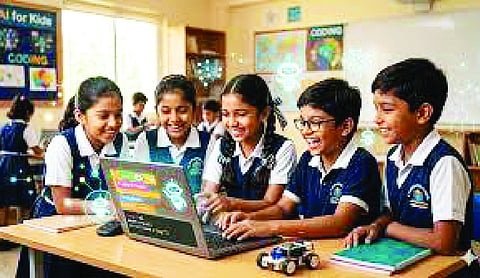

For previous generations, childhood slowly faded from their memory. For Gen Alpha, it may become something that machines remember. Search engines, recommendation systems, digital classrooms and AI tutors as part of everyday learning do more than just capture the things children do: they infer what they do, predict what they like and create opportunities for them. This is the start of an ‘AI shadow’ — a series of guesses and presumptions that a machine draws from a child’s online footprints. This is important, as AI continues to grow up quicker than the organisations that regulate it.
The child that India is today is an impressive digital kid. According to the Annual Status of Education Report (ASER) 2024, 89.1 per cent of adolescent youths aged 14-16 mentioned they had a smartphone in their home. However, how they use that access demonstrates it: 76 per cent of them use their smartphones most often for social media, and only 57 per cent use them most often for educational purposes. This is also highlighted in UNICEF India’s guidance, which states that access to the internet still has to catch up with the institutional infrastructure, as only 63.5 per cent of schools in India have internet facilities as part of their infrastructure. A study conducted by UNICEF U-Report also reveals that 40 per cent of young people use the internet for more than four hours a day. The key change is not that kids are growing up digital, however. Digital interaction is becoming a regular component of childhood architecture. AI is now taking things one step further.
India’s experience is part of the global shift. In June 2026, a UNICEF analysis found that at least 20 million children had used AI across 10 countries. About 13 million used AI for studies and homework, while over 2 million used it for guidance on personal matters. AI has become part of childhood, offering opportunities such as personalised tutoring, one-to-one support and help in identifying learning gaps.
UNICEF’s Guidance on AI and Children 3.0 acknowledges this potential but cautions that evidence on AI’s impact on children remains limited. It urges ‘child-centred’ AI systems that safeguard children’s rights, privacy, development and autonomy. The more personalised AI becomes, the more information it requires. An AI tutor can identify what a child struggles with, what interests them and which explanations work. This can make it an effective teaching aid, but also create an ‘AI shadow’. If algorithms repeatedly predict what a child can or should do, those predictions may influence future choices.
Not all of these risks are equal. The first digital divide was in part access, coupled with access to a device and connection or electricity. The second was skills - who knew how to use technology effectively. The new polarisation may be one over the interpretation, who is interpreting them with technology. In a recent report, UNICEF stated that unequal access to and skills with digital technologies can exacerbate inequalities in childhood: ‘Childhood in a Digital World’. It also has some more recent AI evidence, as children were more than three times more likely than their parents to say they had used AI across the 10 countries studied. In most of these countries, at least three-quarters of parents/caregivers were never users of AI, thus creating an AI usage divide within the family. If a parent is not familiar with the AI environment, it’s difficult to guide a child through it. The disparity in AI use could thus not just be between children with access to AI and children without access to AI.
International law and the data-protection regime in India already acknowledge that children should be afforded special protection. The Digital Personal Data Protection Act, 2023, Section 9, mandates, for the processing of a child’s personal data, that their verifiable consent be obtained, and prohibits tracking, behavioural monitoring and targeted advertising directed at children, except under narrow exceptions. The Rules were further modified in 2025 to include a few exceptions for the safety and welfare of children. These are key safeguards. However, AI poses a more challenging question than traditional data protection: How to protect information that is not directly disclosed?
UNICEF’s new guidance is very clear about this. It calls for the storage of children’s data for as long as necessary, to ensure that data gathered regarding a child does not accompany him/her when he/she grows up. It also requires transparency, accountability, fairness and child protection with regard to children’s developing autonomy. It indicates a principle which India needs to take seriously: developmental data minimisation. Gather materials required for a child’s learning and/or security. Keep it as short a time as possible. Don’t let childhood behavioural profiles go undocumented. Then the "algorithmic forgetfulness" principle should be in place. Children should be given the opportunity to develop beyond the machine’s understanding of themselves. This is really a ‘right to be wrong’ thing. One of the greatest assets of AI is its ability to recognise patterns. Change is the strength of childhood. The risk is that a system designed on the basis of AI will end up categorising what the child is good at today as what he or she should be tomorrow. The impact of AI on children’s cognitive development, emotional dependence and exposure to harm is still emerging, according to UNICEF. UNICEF explained this evidence was limited in scope and that the adoption of AI was quickening the pace. This is possibly one of the key facts. There are more technologies being scaled up than there is evidence of consequences.
The agenda for change in India is progressing: India must not wait for the AI shadow to tag its children as a permanent reality of their lives to contemplate its meaning. There are four steps that are critical:
1. AI literacy in school beyond just prompting and fact-checking, empowering children to comprehend the functioning of systems and their ability to produce outputs and make predictions.
2. Support materials and advice for parents to help them navigate the AI environments their children use.
3. Regular and clear requirements for businesses to render the processing of children’s data understandable, appropriate and traceable.
4. Restrictions on retention and inference that childhood data is not an implicit credential for a lifetime.
Most importantly, the information that is gathered during childhood should not be a secret credential for a lifetime. AI’s promise is that it will be able to better understand learners. What risks do you face is that it might start to shape them. Gen Alpha might be the first generation to rise up with an AI shadow. The biggest danger is that AI will know too much, too soon and that it will confuse a moment in childhood for a lifetime map. Prior generations thought it was a given they would be able to become a person who their youths couldn’t imagine. Gen Alpha deserves the same freedom.
The writer is Professor, Department of Commerce, CHRIST University; Views presented are personal.