From Chicago to New York: A civilisational continuity
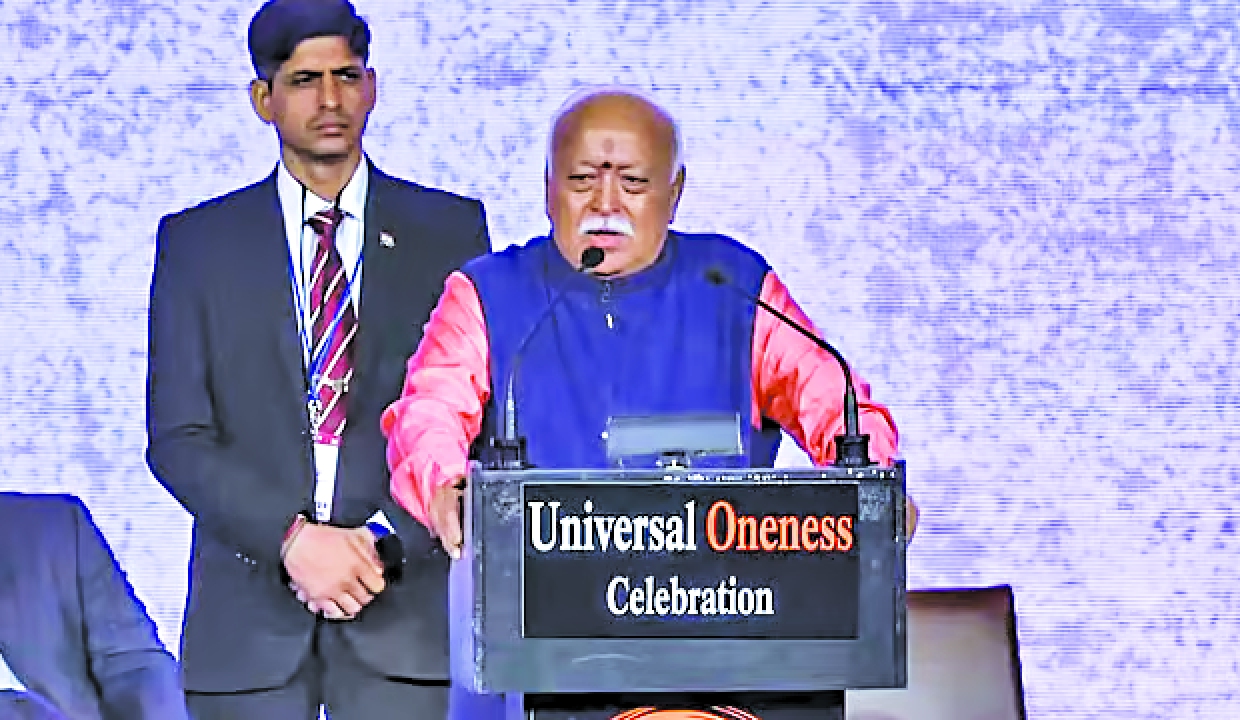
Nearly 132 years after Swami Vivekananda stood before the Parliament of Religions in Chicago and introduced the spiritual confidence of India to an astonished Western audience, another significant articulation of Bharatiya civilisational thought has taken place on American soil. In the centenary year of the Rashtriya Swayamsevak Sangh, Sarsanghchalak Mohan Bhagwat’s address at the Universal Oneness Celebration in New York carried an unmistakable message: Hindu thought does not seek the triumph of one community over another; it seeks a world that recognises the fundamental unity of existence.
The historical circumstances are, of course, very different, and no two speeches need to be artificially equated. Yet the philosophical continuity between the message Swami Vivekananda carried to America and the ideas articulated by Mohanji Bhagwat is striking. At the centre of both lies an ancient Indian conviction that diversity need not produce division and that spiritual consciousness can provide a foundation for human fraternity.
Mohanji began with an illuminating contrast. America frequently speaks of “pluralism”; Bharat speaks of “unity in diversity”. But for Bharat, he argued, both unity and diversity are part of its very DNA. Diversity is not an inconvenience to be grudgingly tolerated. It is something to be “celebrated”, “respected” and “accepted”, without losing sight of the underlying oneness connecting humanity.
This was not merely a political appeal for tolerance. He took the argument much deeper, to the philosophical foundations of Sanatan Dharma.
“Unity of existence is our truth,” he declared. His formulation that “diversity is natural and unity is truth” beautifully condensed an enormous body of Bharatiya philosophical wisdom into a few words. Here was Hindu thought occupying centre stage without becoming exclusionary. Bhagwat did not ask Hindus to diminish their identity in order to demonstrate their tolerance. Instead, the argument was almost the reverse: it is precisely because Hindu civilisation understands the unity underlying different manifestations of life that it can confidently celebrate plurality.
That distinction matters enormously.
For too long, Hindu assertion and universalism have sometimes been presented as opposites, as though Hindus must choose between being unapologetically Hindu and being genuinely pluralistic. Mohanji’s speech rejected that false choice. Sanatan Dharma’s universalism does not require Hindus to become less Hindu. Its conception of fraternity arises from within its own civilisational worldview.
His definition of Dharma was equally significant. Dharma, he said, is the principle through which the universe is sustained and through which human beings can properly manage the quality of life. He described the balanced “middle path” as Dharma. This transforms the discussion from identity politics into civilisational responsibility.
The Hindu ideal is not simply “live and let live”. It goes further towards recognising that existence itself is interconnected. Mohanji reminded his audience that Bharatiya saints pray even for the disappearance of enmity from the minds of those harbouring ill will. This is not weakness. It represents a civilisation sufficiently secure in itself to desire welfare beyond the boundaries of its own community. Perhaps one of the most important parts of the address was directed specifically towards Bharatiyas living in America. Mohanji asked them to remain loyal to their Karmabhoomi. Only after fulfilling that obligation, he said, should their desire to contribute to their Janmabhoomi find expression, and the finest way to do so is by living the values Bharat has given them.
This deserves attention. It was not a call for an expatriate community to remain detached from American society. It was an appeal for integration without civilisational amnesia: be responsible citizens of the country in which you live, while carrying with confidence the values of the civilisation from which you emerged.
And what should Bharatiyas give the world?
Not domination. Not conversion. Not cultural uniformity. His answer was example.
“The duty of a Bharatiya,” he argued, is to carry this message to the world “through practice, not through preaching”. That may have been among the most profoundly Hindu lines of the entire address. The symbolism of the occasion becomes still more striking in the RSS’s centenary period. From its beginnings in Nagpur in 1925, the Sangh and the wider ecosystem inspired by it have developed a substantial presence among Hindu communities outside India. A gathering bringing together numerous Hindu-American organisations, faith leaders and a large diaspora audience therefore carries significance beyond the event itself. It demonstrates that organised Hindu civilisational consciousness is no longer confined geographically to Bharat. The scale and breadth of mobilisation around the Sarsanghchalak unquestionably illustrate the Sangh’s emergence as one of the most consequential organised voices of Hindu civilisational identity globally.
And therein lies the larger significance of New York. Mohanji invoked Swami Vivekananda’s teaching that every nation has “a message to deliver, a mission to accomplish, and a destiny to fulfil”. For Bharat, he said, that destiny is to realise, and repeatedly help the world realise, the unity amid diversity. At a time when societies across the world struggle with religious conflict, racial tensions, ideological polarisation, loneliness, consumerism and competing absolutisms, the proposition that humanity can celebrate difference while recognising an underlying unity is anything but antiquated.
He also connected this philosophy with responsibility: what matters is not merely how much one earns but how much one gives back. “We have to give back. That is our Parampara,” he said, presenting the Bharatiya idea of life as a sustainable model worth carrying forward. That is ultimately what made the address important.
In Chicago in 1893, Swami Vivekananda famously presented Hindu civilisation before the modern West with extraordinary confidence. In New York in 2026, Mohanji Bhagwat spoke from a different platform, in a different century and under entirely different historical circumstances. But an ancient civilisational conviction could still be heard: humanity is one; diversity enriches that oneness; Dharma sustains rather than divides; and the highest expression of Hindu consciousness is not merely the welfare of Hindus, but the welfare of all. More than a century after Chicago, Sanatan Dharma’s proposition to humanity therefore remains remarkably relevant: not that the world must become uniform, but that it must learn how to remain diverse without forgetting that we belong to one another.
The writer is a commentator on socio-political issues; Views presented are personal.