
- HOME
- INDIA
- WORLD
- BUSINESS
- STATES
- LAW & JUSTICE
- ENTERTAINMENT
- SPORTS
- VIEWPOINT
- LIFESTYLE
- TECH
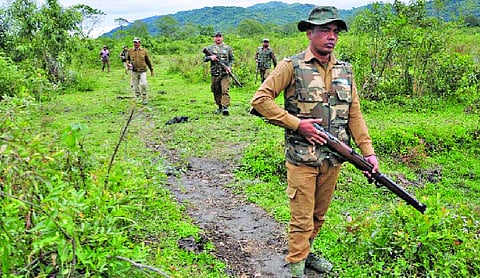
From the Bishnoi sacrifice at Khejrali to the daily battles against poachers, smugglers and hostile terrain, frontline forest staff remain the largely unsung soldiers of conservation. The courage of officers who protect forests deserves not merely remembrance, but stronger institutional and legal protection
India recently observed Forest Martyrs’ Day on September 11, when we remembered frontline staff who sacrificed their lives on duty while fighting for the conservation of forests and wildlife.
It was established in 2013 by the Union Government’s Environment Ministry and has historical roots in the 1730 Khejrali massacre in Rajasthan, when 363 Bishnoi community villagers, led by Amrita Devi, sacrificed their lives to protect sacred Khejri trees from being cut down. While many such movements to save trees from being axed in post-Independence India, such as the ‘Chipko Movement’ of the Himalayas and the ‘Appiko Movement’ of the Western Ghats, have been successful, long-term conservation efforts also depend on frontline staff of the Forest Departments of states and Union Territories.
Often, the staff encounters gangs carrying deadly weapons and firearms while protecting valuable trees such as red sanders, sandalwood, teak and rosewood, as well as the highly prized body parts of wild animals such as rhinoceroses, tigers, leopards and elephants. To extract body parts such as a single horn from a rhinoceros, bones and skins from tigers, elephant tusks and leopard skins, poachers immobilise wild animals by laying jaw traps at water sources and then use firearms or even directly fire bullets to kill them. Gangs cutting valuable trees, if obstructed, attack the staff with sharp knives or bow saws, or other deadly weapons, or open fire with country-made guns. While apprehending the culprits, there have been several instances across the country in which forest officials have lost their lives or been grievously injured. Many a time, they are even ambushed in the forests. There are occasions when Forest Guards and Forest Watchers are attacked by tigers and trampled by elephants and killed. Forest staff have been electrocuted while walking on live wires laid to kill ungulates for meat. There are numerous ways in which forest protection staff lose their lives.
The hunting of wild animals is not confined to the above-mentioned species, whose body parts are valuable; it also extends to ungulates such as deer, sambar and gaur for meat. Many sanctuaries, especially in tribal belts, are vulnerable to ungulate hunting, and a number of them have become devoid of prey populations, preventing any growth in the populations of tigers, co-predators and prey animals.
In the 1980s and early 1990s, Veerappan, a notorious poacher and sandalwood smuggler, led a gang of criminals that once wiped-out tusker elephants from the forests and also eliminated forest personnel who came in the way. The brutal murder of 1979-batch IFS officer P Srinivas on November 10, 1991 is still in the public memory. The Government of Karnataka had fixed Forest Martyrs’ Day on November 10 and observed it every year until the Government of India changed it to September 11.
The forests of Chamarajanagar district of Karnataka share boundaries with Hosur, Dharmapuri, Erode and Sathyamangalam districts of Tamil Nadu. The Cauvery River demarcates the boundary with Hosur and Dharmapuri. Forests on either side of the Cauvery were vast, road networks were poor, and there were a large number of strategically located hideouts that provided a distinct advantage to Veerappan and his gang to thrive in the landscape. Forest and police personnel needed an extraordinary level of fitness to walk through the inhospitable terrain for any checks inside the forests. It was extremely challenging for them to track down Veerappan in the landscape. Srinivas, in 1990-91, was working on Veerappan’s surrender. Veerappan double-crossed him and invited him to a place in the forests, 6 km from his native village, Gopinatham. Srinivas fell into his trap, went there without any protection, and was shot and beheaded. His head remained untraced. Despite the pressure exerted by the police forces of two states, Veerappan lived for another 13 years until he was finally killed in an encounter by the Tamil Nadu Police in July 2004.
Veerappan has left a legacy of hardened criminals in Hanur taluk of Chamarajanagar district. There are two wildlife sanctuaries in the taluk: the Cauvery Sanctuary and MM Hills Sanctuary. Camera-trap studies by NGO Sanjay Gubbi reveal that the tiger populations in both the sanctuaries are increasing after black granite quarrying in Protected Areas was suspended. The instances of hunting wild ungulates by criminal gangs are also found to be too many. Forest protection staff have to toil that much harder to put a stop to the unprecedented killing of wild deer and sambar. There is a growing market for wild animal meat in Bengaluru and Mysuru.
About a year ago, a tigress and her four cubs were poisoned and killed in Minium village of the Hoogyum Range of MM Hills Sanctuary. A few months later, another tiger was killed in Hanur, and an elephant calf was electrocuted by live wires laid in Cowdhalli forests to kill deer and sambar for meat. While patrolling the forests, the staff generally remain subdued and avoid opening fire, even when criminal gangs show aggression. Maybe the staff are scared of the harassment that follows. In several encounters, the staff suffer more severe injuries than the criminals.
Last month’s encounter in Hanur Range of the Cauvery Wildlife Division was an exception, where three of the four poachers were shot and one escaped. While the magisterial inquiry report is still awaited, the Forest Guard is believed to have opened fire only after the poacher fired first and missed the patrolling staff. The incident happened in the early hours, deep inside the sanctuary and more than 6 km away from the nearest village. What was recovered from the spot were two muzzle-loading guns, head torches with batteries, three mobile phones, several knives, screwdrivers, cutting pliers, cooking vessels, vegetables, biscuit packets and two bags of wild meat, which leaves little doubt that the poachers had carefully planned the operation. But for the village rivals tipping off forest officials with the details, it would indeed have been difficult to trace the criminals in the vast forests.
The incident has also taken a political turn, with the Tamil Nadu Chief Minister openly advocating the innocence of the poachers and also attacking the decision of the Karnataka Government to go ahead with the Mekedatu dam on the River Cauvery, which is environmentally unsustainable. The FIR against the staff is under investigation, and I hope that the truth will prevail and that they will not be victimised in the political crossfire.
There are several NGOs serving the cause of conservation in the country. They possess sufficient trained manpower to carry out field duties and have resources to hire legal experts to aid in court cases. Often, field-level foresters see them as competitors. This is not correct. Foresters must ensure that NGOs’ resources are fully integrated with those of the departments and utilised for conservation.
Ten leopard skins and banned hunting equipment were recently recovered, and four accused persons were arrested in Uttar Pradesh’s Agra about a month ago. The preliminary investigation revealed that six of these leopards were poached in Kuno Wildlife Division, two in Sheopur and two in the Chambal Sanctuary in Morena. Heavy iron traps were used to immobilise the animals. Kuno is an area where cheetahs have also been introduced, and its success is a matter of national pride. Personnel from Wildlife SOS, an NGO, are reported to have tracked the offenders and tipped off the UP Forest Department in Agra.
As fingers were pointed towards the Madhya Pradesh Forest Department for poor regulatory work, its Chief Wildlife Warden was clearly angry with the NGO and claimed that the accused persons had links with Wildlife SOS to facilitate such activities. The NGO’s CEO, Kartick Satyanarain, vehemently denied the allegation, saying that his organisation has spent more than 32 years working in wildlife rescue, rehabilitation and conservation across 19 states and has assisted state forest departments in rescuing over five lakh wild animals. UP is happy with the NGO and booked the accused with its help, while MP is gunning against it. My experience is that no NGO can survive so long in the field of conservation if it assists and abets offenders.
In the 1980s and early 1990s, Veerappan, a notorious poacher and sandalwood smuggler, led a gang of criminals that once wiped out tusker elephants from the forests and also eliminated forest personnel who came in the way. The brutal murder of 1979-batch IFS officer P Srinivas on November 10, 1991, is still in the public memory
The writer is Retired Head of Forest Force, Karnataka, and teaches Economics at Karnataka Forest Academy; Views presented are personal.