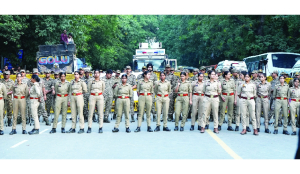
Flags, placards and a wall of barricades
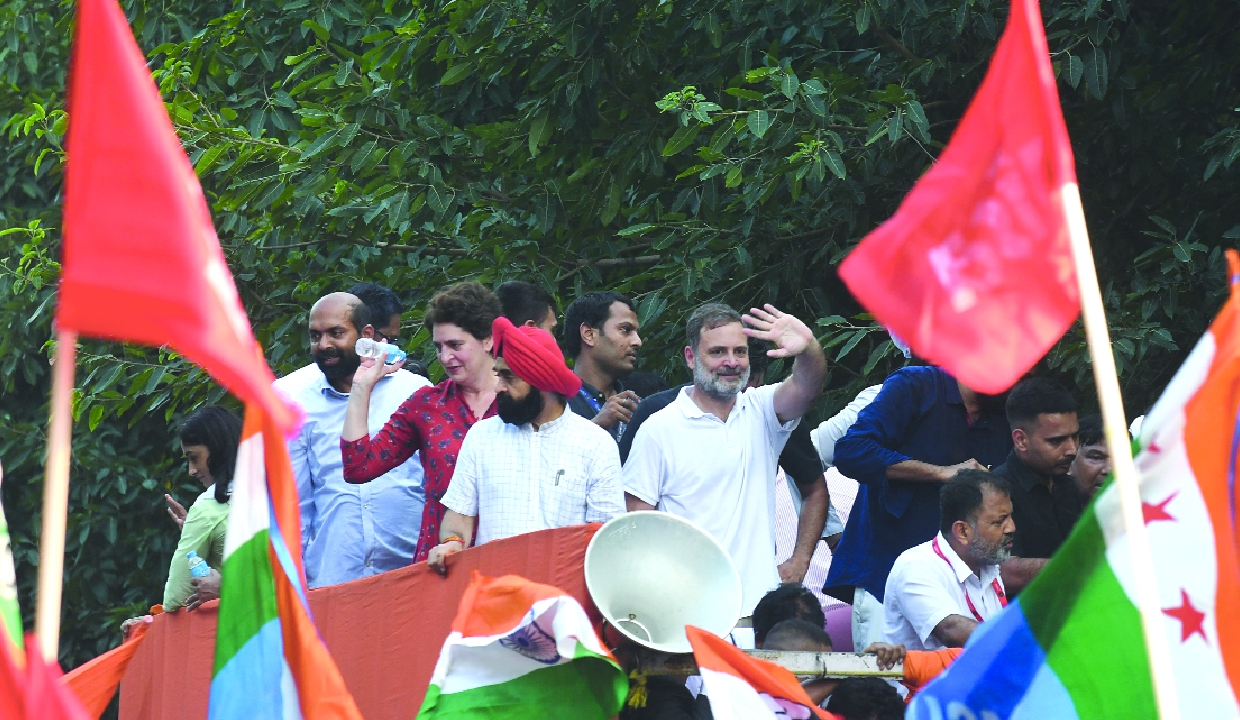
Rahul, Priyanka lead Opposition march towards SC over electoral issues
Three layers of police barricades stood between the INDIA bloc’s march and the Supreme Court on Monday, as Opposition leaders and supporters moved through Central Delhi carrying flags and placards.
The procession advanced along Barakhamba Road toward Bhagwan Das Road, where security personnel were positioned to prevent the crowd from moving further. Rahul Gandhi, Priyanka Gandhi Vadra and other Opposition leaders led the mobilisation, which halted at a police blockade as the alliance sought to take its protest over electoral issues to the country’s highest court.
The march, organised under the banner “Chalo Delhi: March for Democracy,” drew political leaders, party workers and student groups into the heart of the Capital. The stretch between Connaught Place and Mandi House filled steadily with demonstrators through the morning, as security arrangements extended across the surrounding roads in anticipation of the procession’s approach to the court.
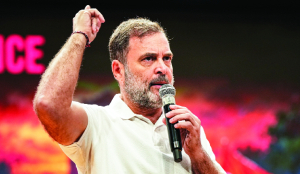
Rahul Gandhi led the march alongside his sister Priyanka and Neha Bora, president of the All India Students’ Association. Other opposition figures joined the procession, including Samajwadi Party chief Akhilesh Yadav and Rashtriya Janata Dal leader Tejashwi Yadav. Supporters from the Congress, the Indian Youth Congress, the National Students’ Union of India and Left-affiliated student groups swelled the crowd as it pushed forward.
The mobilisation carried a visible mix of political workers and student participants, moving together behind a wall of flags and placards. At several points, demonstrators climbed onto police vehicles, waving national and party flags as the crowd pressed through barricaded stretches of road, a striking, almost defiant image against the grey backdrop of security cordons.
The route through central Delhi was anything but smooth. Police installed barricades at multiple points, with the main blockade on Bhagwan Das Road, directly along the approach to the Supreme Court. The layered barriers narrowed the available path and drew a hard physical line between the marchers and the court complex. Security personnel, including Rapid Action Force units and other paramilitary forces, held their ground in the area.
As the procession moved from the Connaught Place-Barakhamba Road junction toward Bhagwan Das Road, its forward momentum finally stopped. The marchers had set out to reach the Supreme Court itself, but police prevented the full crowd from advancing further.
Demonstrators gathered at the barricades as leaders weighed their next move.
At one point, Rahul Gandhi climbed atop a truck, joined by Akhilesh Yadav and Tejashwi Yadav, the three leaders rising above the sea of supporters below.
The image offered a sharp visual contrast, political leadership elevated above the mass of the crowd it had summoned to the streets.
The police blockade ultimately became the day’s defining feature. Three layers of barricading lined the approach to the court, backed by Delhi Police personnel and additional security forces. Similar security arrangements extended around Bengali Market and other nearby stretches, as part of a broader effort to contain the march before it reached its destination.
The crowd was not limited to party workers alone. Students and other citizens joined the mobilisation, while a contingent of lawyers reportedly carried copies of the Constitution through the procession, with groups of different affiliations converging around a shared demand for accountability from the Election Commission.
Even as the march stalled outside, the opposition’s legal effort moved forward in parallel. A legal team filed a petition in the Supreme Court concerning Chief Election Commissioner Gyanesh Kumar, and a small delegation was granted access to the court premises to complete the filing, a quiet legal manoeuvre that proceeded even as the larger crowd remained locked outside the barricades.
By afternoon, the march had reached its physical limit at Bhagwan Das Road. The opposition’s leaders and supporters had travelled the length of central Delhi together, only to find their path to the Supreme Court closed by a wall of police barriers, leaving the day split neatly in two: a procession stopped on the street, and a case quietly filed behind the cordon it could not cross.
Jantar Mantar out, three new protest sites in
New Delhi: After decades as one of India’s most prominent places to voice dissent, Jantar Mantar in the high-security Central Delhi area will no longer serve as a designated protest venue. Delhi Police has named three new venues as designated protest sites. These are Ramlila Ground, Burari Ground, and CBD Ground in East Delhi.
The Delhi Police decision has prompted the Opposition parties to criticise the Government as a bid by the Centre to stop democratic protests. At the same time, the traders’ body welcomed the Centre’s decision to de-notify Jantar Mantar as a designated protest site, saying the move would reduce inconvenience to the public and businesses in Delhi. However, the traffic situation in the areas near Jantar Mantar, which is also close to several important Government buildings, may improve for the general public.
While Ramlila Ground in Central District is four km from the current site, the CBD Ground in East District is 12 to 13 km away, and Burari Ground in North District is nearly 21 km away. The order denotifying Jantar Mantar as a designated site for protests was issued by Delhi Police Commissioner Anurag Kumar.
“Ministry of Home Affairs, Government of India, had constituted a committee to examine alternative proper venues for citizens’ right to organise protest/demonstrations in place of the existing ‘designated site’,” the order read. Based on the committee’s recommendations, it said, Jantar Mantar has been denotified as a protest venue.
Further, it said that the committee will issue a detailed, revised SOP for organising protests and demonstrations at these three venues separately. This partially modifies earlier Standing Order No. L&O/48/22 dated 28.04.2022,” the standing order issued by Delhi CP said.
The development came amid protests by the Opposition bloc INDIA and the satirical political group Cockroach Janta Party (CJP) in central Delhi against Chief Election Commissioner Gyanesh Kumar over the Special Intensive Revision (SIR) controversy.
Commenting on the development, CJP co-convener Saurav Das on Monday said the Government’s decision to denotify Jantar Mantar as a protest site is “unacceptable”, and they “do not accept this arbitrary decision”.
In a statement, the New Delhi Traders Association (NDTA) welcomed the Centre’s decision to de-notify Jantar Mantar as a designated protest site, saying the move would reduce inconvenience to the public and businesses in the national capital. The NDTA said designating Ramlila Maidan, Burari Ground and CBD Ground in east Delhi as alternative protest venues was a practical decision that would benefit the public and markets in New Delhi in the long run.