Eid under watch: Barricades, fear, fragile calm in Uttam Nagar
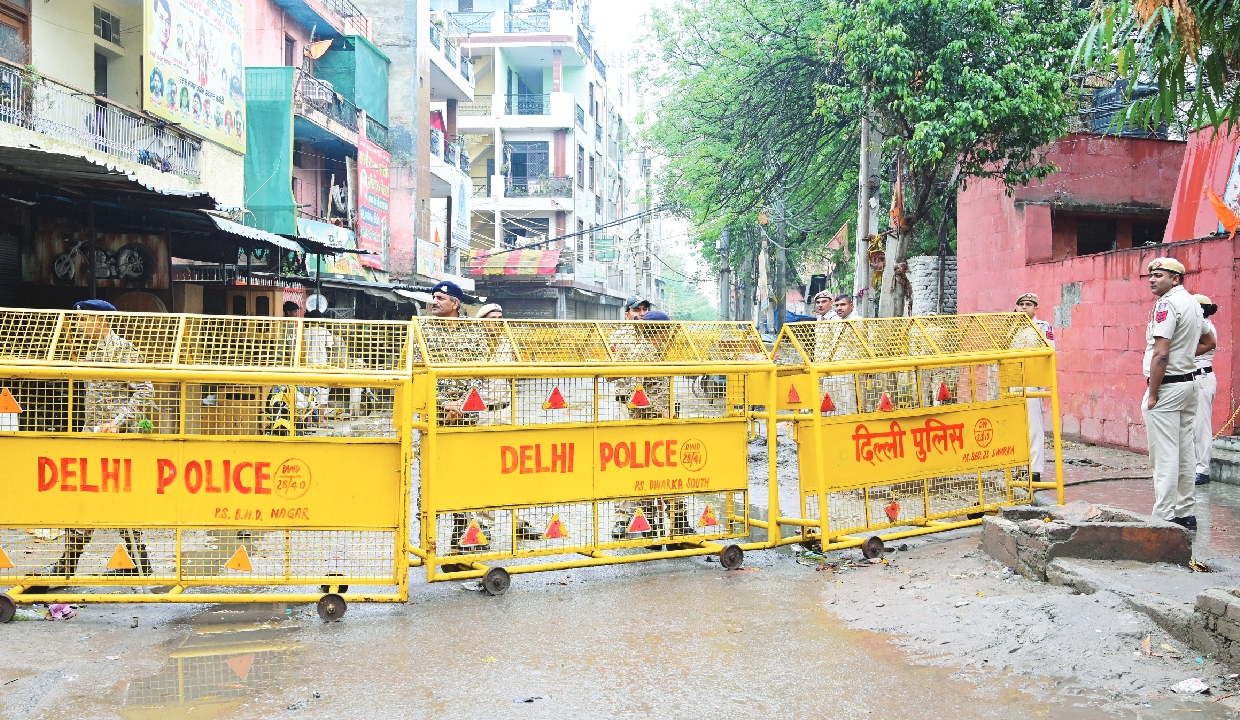
You don’t enter Uttam Nagar’s JJ Colony these days. You are allowed in step by step, barricade by barricade, under watch, under escort, and under suspicion. Days before Eid, what was once a cramped but lived-in neighbourhood has turned into a tightly controlled grid of fear and vigilance.
More than 35 police personnel have been deployed across the colony. Riot-control vehicles wait at corners. Entry is filtered, movements are monitored and persons carrying cameras are not being allowed.
The trigger lies in the killing of 26-year-old Tarun Kumar Butolia earlier this month. But the story here is no longer just about a crime. It is about what follows: rumour, anger, silence, and a fragile calm held together by force.
To reach Tarun’s house, one has to pass through layers of control. The first barricade stops you at the colony’s edge. Then another, and another: every few steps. By the time you approach his lane, a final cordon cuts off all access. Beyond that, nothing moves. Even with official permission, movement is not free. A constable escorts every step, never too far, never out of sight. There are no cameras. No lingering. No conversations without watchful ears. “Police have been deployed at all points in the area. No one will be allowed to take the law into their own hands. Eid will be conducted peacefully,” said DCP (Dwarka) Kushal Pal Singh.
But reassurance does not easily settle a place like this. Many Muslim families have already left during mid-Ramazan. Those who remain speak of celebrating Eid quietly, indoors, away from attention. Near a mosque, men fix CCTV cameras into place. “Tomorrow is Eid. We need evidence,” a constable says plainly. “So we are installing cameras everywhere.”
Inside, the colony has fallen into an uneasy quiet. It is not stillness, but a kind of withdrawal. Small groups gather in corners, speaking in low tones. Phones glow with endless reels. Shutters are down. Work has stopped. “Our livelihood has completely stopped. We just want this to end soon,” says a man who works at a nearby dhobi ghat. On asking his name, he said, “I will not tell you my real name; everyone is just figuring out our religion here. No one wants to know the real truth.”
The anger here does not always speak loudly, but it is present. Much of it is directed at what residents call misinformation. Viral videos, they say, have misrepresented the area, dragging it deeper into tension. “One video shows a leader visiting ‘Uttam Nagar’. That is not here,” a resident says. “But people believe it is. And that creates more trouble.”
The violence that led to this moment unfolded on March 4, during Holi. A dispute between two families escalated. Tarun was attacked with cricket bats, iron rods, and stones. He later died. Since then, threats, some real, some amplified, have travelled faster than facts.
Social media posts allegedly calling for “Khoon Ki Holi” have added to the anxiety. The Delhi High Court has asked the police to ensure peace. One man gestures towards a nearby temple. “I am a Muslim, but I take care of this temple,” he says. “We have always lived like this here.” Another adds, “There was never any tension. This is the first time.” Across the lane, a Hindu resident expresses cautious confidence. “Nothing will happen and Eid will be celebrated peacefully,” he says. He adds that locals trust the police and will not let outsiders disrupt harmony.
Yet, beneath these words lies unease. A man named Ramesh points to the absent presence of those accused. Their family owns many houses here. They have influence,” he says. “But right now, none of them are here.” Tarun’s home stands sealed within its own silence. His family is inside, under protection, cut off from the outside world. His brother refuses to speak.
In JJ Colony, life has narrowed to waiting. Waiting for Eid. Waiting for calm to return. Waiting for the barricades to go. For now, peace here is not natural.