Cost escalation of bullet train project not entirely on railways: NHSRCL
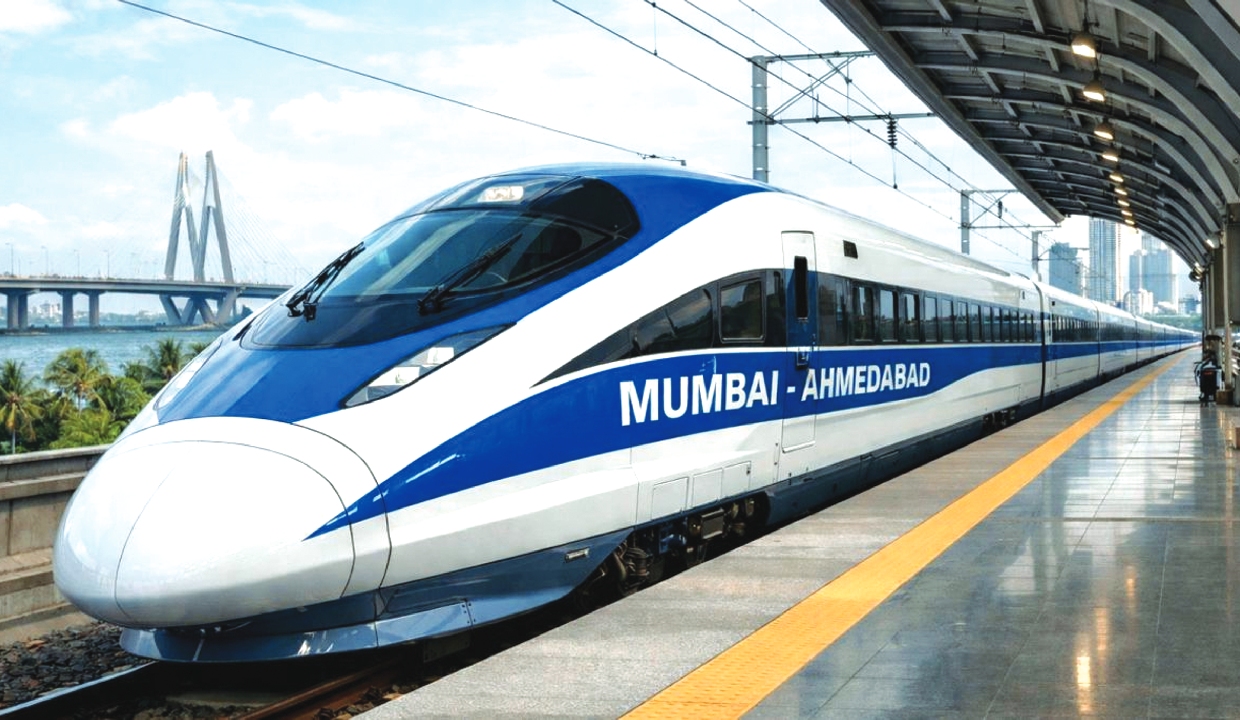
The National High Speed Rail Corporation Limited on Thursday said the cost escalation burden for the upcoming 508-km-long Ahmedabad-Mumbai bullet train project will not be borne entirely by the Indian Railways. The NHSRCL, which is constructing the country’s first high-speed corridor, issued a clarification on social media in response to a post by Congress Kerala unit, which alleged, that the railways will bear an additional Rs 90,000 crore out of the cost escalation of the project from the original Rs 1.1 lakh crore to Rs 1.98 lakh crore now.
“The commentary circulating on the Mumbai-Ahmedabad High Speed Rail Project relies largely on conjecture and selective interpretation rather than verified facts. Several of the claims made are factually wrong,” the NHSRCL said. Justifying the current cost assessment, it stated that the updated project cost estimates are comparable to global benchmarks.
“The initial estimate was prepared at a preliminary stage nearly a decade ago. As is standard practice in major infrastructure projects worldwide, costs are refined once detailed design, engineering, land acquisition and construction contracts are finalised,” the corporation said.
It added, “India has undertaken projects of similar scale in highways, metro rail and airports where revised estimates followed detailed project reports and tendering.” Responding to Congress Kerala unit’s claim that the Japanese agency, JICA, which agreed to fund 81 per cent of the original estimated cost, will not fund the escalation, the NHSRCL said, “The agreement between India and Japan for funding the project is comprehensive, and the speculations made have no base.”
“The project continues to be backed by one of the most concessional sovereign loans ever extended for infrastructure, with extremely low interest and long repayment periods. Such financing terms are precisely why the project was structured as a bilateral partnership. Assertions to the contrary appear speculative rather than factual,” it added.
Dismissing the reports that the railway will have to fund a big chunk of the escalated amount, the corporation stated, “It is also incorrect to state that the burden is being placed on Indian Railways.
The project is implemented through the dedicated entity National High Speed Rail Corporation Limited (NHSRCL), which has its own financing structure involving the Government of India and the participating state Governments.”
“Treating it as an operating liability of Indian Railways reflects a misunderstanding of the institutional framework,” it said. According to NHSRCL, the national transport infrastructure is evaluated worldwide by looking at economic benefits.
It maintained that the high-speed rail corridors generate value through time savings and productivity gains, reduction in aviation and highway congestion, regional economic development along the corridor, technology transfer and domestic manufacturing capability. “These wider economic multipliers are the basis on which such projects are evaluated internationally,” it said.
Regarding allegations about an increase in ticket prices from Rs 3,000 to Rs 6,000- Rs 7,000, the NHSRCL said, “Ticket pricing will be affordable. The speculative numbers have no basis and are meant to mislead people.”
Emphasising the bigger objective of the project, it stated, “The Mumbai-Ahmedabad High Speed Rail Project is India’s first high-speed rail corridor. Its purpose extends beyond a single route: it establishes the technological, engineering and industrial base required for future high-speed rail development in the country.