Congress must end its inertia to lead the INDIA bloc in these testing times
There is good and bad news for the Congress, which is struggling hard to shed inertia and indecisiveness and emerge from its own cobweb. The more it tries, though through feeble attempts, the more it remains the same, without realising the need to become battle-ready for the coming electoral contests. While circumstances are fast changing in favour of the Grand Old Party (GOP), its leadership seems mostly unaware of the role that the party, as the premier opposition party, is expected to play at such a crucial juncture.
As the crescendo has gathered stormy proportions over the functioning of the Election Commission of India (ECI) — a front-ranking constitutional body responsible for conducting free and fair elections — in a totally opaque and centralised manner, the INDIA combine of opposition parties finally coming together is a significant development. It is another matter that they shared the table after a couple of electoral setbacks and regular sniping at each other. However, circumstances have perhaps left them with no option but to come together and resolve to fight back to protect the “sanctity of the vote”.
If the INDIA bloc meeting has thrown a direct challenge to the ECI and the Narendra Modi-Amit Shah combine by declaring a joint programme of nationwide protests against the usurpation of the electoral process, it has come as a happy augury for the Congress, which, until the other day, was at the receiving end of its alliance partners. Instead of making the Narendra Modi-led dispensation its main target, the allies had preferred to target the Congress, and more so Rahul Gandhi.
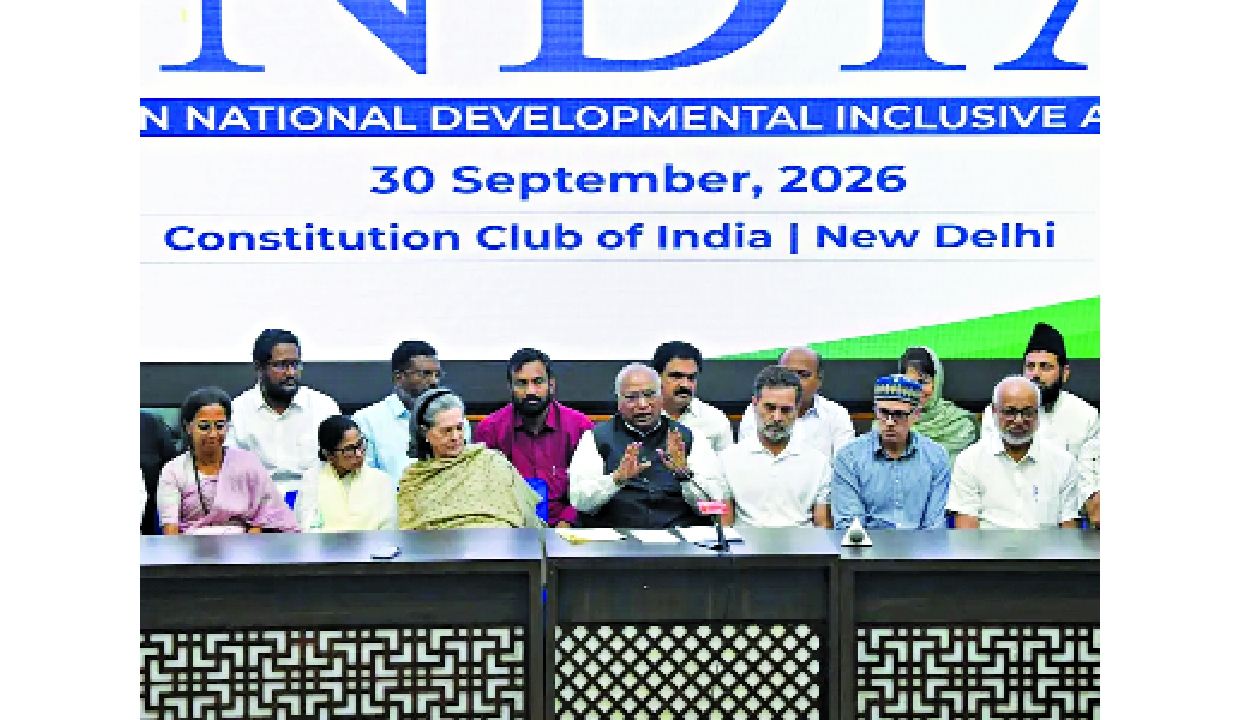
From all available accounts and the optics of it, the September 30, 2026, INDIA bloc meeting has firmly established the Congress as its leader. Not only was the most mercurial and unpredictable ally-leader and Trinamool Congress chief, Mamata Banerjee, seen going overboard to exhibit her bonhomie towards the Congress leadership led by Sonia Gandhi and, surprisingly, even Rahul Gandhi, but more or less all the 20-odd alliance partners attending the meeting ceded total space to the GOP in deference to its status as the only national party with a pan-India presence among the alliance ranks. This feeling was altogether missing during the last three years of its existence.
The media reports undoubtedly suggest that the alliance’s high-profile meeting successfully unified the opposition around a roadmap, surprisingly crafted by the Indian National Congress. This, in turn, has placed the party on a firm political footing. Unimaginable until the political events shaped by the goings-on in the corridors of Nirvachan Sadan, the INDIA combine adopted the core resolutions that had earlier been passed by the Congress Working Committee (CWC).
The narrative and agenda of the combined meeting heavily mirrored the strategy crafted by the Congress just a day earlier during its CWC meeting. This position solidified the Congress’s leading role within the alliance through several key developments.
However, the second development, emerging from the same AICC corridors where the CWC meeting was held to set the course for the INDIA bloc deliberations, should worry the Congress’s top leadership. It concerns poll-bound Punjab, where the Congress, with good chances of returning to power after a decade, has been on a suicidal mission. The high command’s decision to replace Pradesh Congress Committee (PCC) chief Amarinder Singh Warring, after initial reluctance and dilly-dallying, is more baffling than creditworthy. It came after wasting precious time trying to control factionalism and humiliating senior leaders tasked with bringing the warring factions together. The then AICC in-charge of Punjab and former Chhattisgarh Chief Minister Bhupesh Baghel lost both face and his job. This was through no fault of his, as he ostensibly followed the high command’s directions (read Rahul Gandhi) to protect Warring at all costs, despite growing resentment against him within the PCC. Even more importantly, further embarrassment was in store when the high command chose to sweep under the carpet the findings of the committee headed by AICC treasurer Ajay Maken, who had been entrusted with the task of gauging the mood of a cross-section of the state leadership. The committee, it is believed, found an overwhelming mood in favour of a change in the PCC leadership.
The Punjab episode should be an eye-opener for the GOP’s top leadership and force it into the introspection that is sorely needed to set its house in order at a time when the entire opposition has reposed confidence in Rahul Gandhi’s leadership. Effecting a change on the basis of the Maken committee’s findings would not only have protected the high command from embarrassment but also saved the party from negative publicity for unnecessarily dragging out the issue before subsequently changing the state leadership.
A situation similar to Punjab’s prevails in several other states and Union Territories, particularly Jammu and Kashmir. Quick decisions are needed to strengthen the organisation. The top leadership must evaluate its conduct in Punjab and take corrective steps elsewhere, including within the AICC’s organisational structure.
A strong, battle-hardened organisation will help the Congress establish its leadership role in the INDIA combine. The shift in the allies’ mood on September 30, 2026, should be capitalised on to strengthen Rahul Gandhi’s leadership. Building on the alliance’s agitation roadmap and the CWC resolution, the Congress must strengthen itself internally, no matter what the cost.
Congress president Mallikarjun Kharge took centre stage to officially announce the bloc’s six-point joint protest strategy. However, it seemed that the veteran of many political battles, Kharge, had read the mood of the INDIA conglomerate leaders gathered at Delhi’s Constitutional Club. Perhaps he thought it was the right moment to press Rahul Gandhi to address the press conference, with the purpose of keeping him centre-stage.
In declaring the six-point protest strategy, Kharge left no one in doubt that Rahul Gandhi would be leading from the front. The two-pronged fight for him and Rahul Gandhi now is to steer the INDIA bloc effectively and, at the same time, prevent Punjab-like situations from arising through quick and stern decision-making.
The bloc’s six-point joint protest strategy:
1. October 2-8: District-level “Save Democracy” marches across the country.
2. October 6: A coordinated march by all Opposition MPs to the Election Commission headquarters.
3. Mid-October: Seeking official intervention from the President of India.
4. November 1: A mega joint rally in New Delhi.
The challenge for the Congress, as the leader of the opposition grouping, is enormous. But the opportunity is golden: to shed inertia and set itself on course for internal and external reforms.
The writer is a media expert and policy analyst; Views presented are personal.