Congress-led UDF set for decisive win in Kerala, projected to bag 88-92 seats: Survey
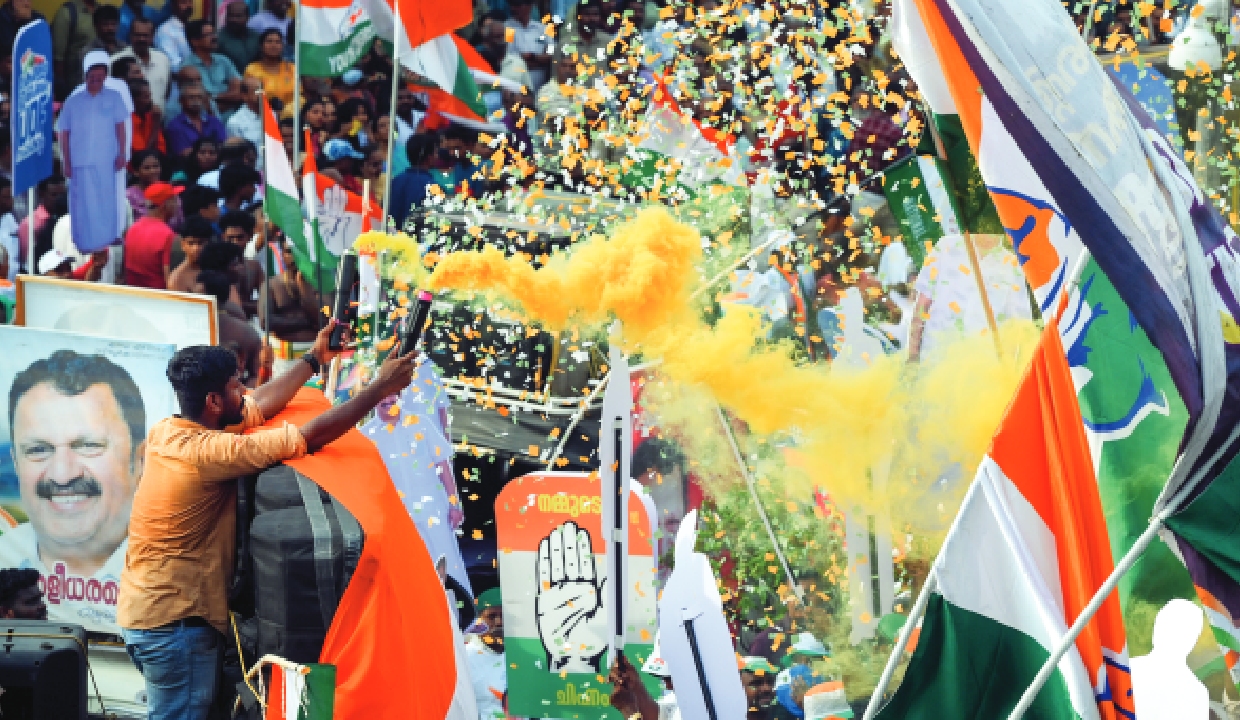
The Congress-led United Democratic Front (UDF) appears on course for a decisive victory in the upcoming Kerala Assembly elections, with a new survey projecting the alliance to secure between 88 and 92 seats in the 140-member House —well above the majority mark of 70.
According to the Poll Mantra Intelligence Report, the ruling Left Democratic Front (LDF) is expected to see a sharp decline, with projections placing it at 42–46 seats. The BJP-led National Democratic Alliance (NDA), meanwhile, is forecast to win between 0 and 2 seats, underscoring its continued struggle to translate vote share into electoral gains in the State.
The survey characterises the election as a potentially “one-sided contest,” driven by what it calls a “structured voter shift” rather than a fragmented swing. Anti-incumbency has emerged as the dominant factor influencing voter sentiment.
In terms of vote share, the UDF leads with 41.5%, followed by the LDF at 33.4%. The NDA stands at 17.2%, while other parties account for 2.3%. Only 5.6% of voters remain undecided, indicating that preferences are largely settled ahead of polling.
The UDF is projected to dominate across all regions:
Malabar (60 seats): UDF 41–43, LDF 15–17, Central Kerala (41 seats): UDF 25–26, LDF 12–13
Travancore (39 seats): UDF 22–23, LDF 15–16.
While Travancore shows a relatively closer contest, the UDF still maintains a clear edge.
The survey highlights a “desire for change” as the primary voting driver, influencing 22.8% of voters. Welfare benefits follow at 17.6%, while ideology and party values account for 16.2%. Leadership preferences (14.6%), past government performance (12.1%), and local candidates (9.4%) play smaller but notable roles.
“Kerala voters are leaning towards a performance-plus-change narrative, rather than identity politics,” the report notes, adding that welfare schemes alone are insufficient without strong leadership perception.
Among preferred Chief Ministerial candidates, VD Satheeshan leads with 21.3% support, followed by incumbent Chief Minister Pinarayi Vijayan at 18.5%. Ramesh Chennithala (17.2%) and KC Venugopal (15.1%) remain key contenders, while BJP’s Rajeev Chandrashekhar trails at 9.6%.
In terms of recent momentum, however, Venugopal leads with 19.4%, narrowly ahead of Vijayan (18.6%) and Shashi Tharoor (18.2%). Notably, four of the top five leaders shaping current electoral momentum belong to the UDF.
Economic issues have emerged as the defining theme of the election. Price rise and cost of living top voter concerns at 24.5%, followed by unemployment and youth out-migration at 20.2%. Together, these factors account for nearly 45% of voter priorities.
Corruption ranks third at 13%, followed by healthcare (10.8%) and social issues such as drugs, alcoholism, and crime (10.5%). Welfare schemes and pensions—once central to Kerala politics—have dropped sharply to just 4%.
“The election is being fought on economic survival, not ideological narratives,” the report observes, pointing to growing youth dissatisfaction as a critical factor.
The survey indicates that 44.1% of voters prioritise party over candidate, while 31.5% weigh both equally. Only 24.4% say individual candidates are their primary consideration, suggesting that broader political narratives are dominating the ????? discourse.
The report warns that the LDF’s reliance on a single central leadership figure could pose a “strategic vulnerability,” while the UDF benefits from a “collective leadership advantage” with multiple leaders shaping public perception.
“The LDF’s challenge is not just opposition, but internal fatigue and a narrative deficit,” the report concludes, adding that its chances hinge significantly on consolidating support in the Travancore region.