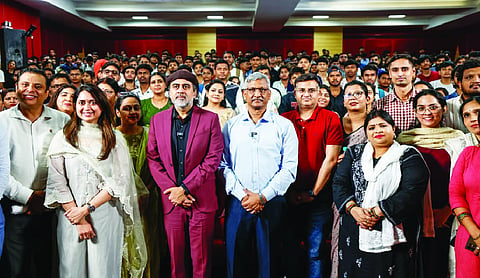

A delegation from Shyam Lal College (Evening), University of Delhi, led by its Principal, Prof Nachiketa Singh, held a public dialogue with philosopher and author Acharya Prashant on the theme “Conflict Resolution and Human Security.”
In a rare gesture, rather than host the philosopher on its own campus as is customary for such lectures, the college brought its faculty and students to a college auditorium in Greater Noida, close to Acharya Prashant’s residence. The session began with an interaction between Acharya Prashant and Prof. Singh, followed by audience questions. Prof. Singh, a senior political science faculty member with nearly three decades of teaching and research, holds a doctorate on ethnic conflict in the former Yugoslavia and works across international relations, foreign policy and security studies.
He opened by asking Acharya Prashant for a philosophical lens on a subject usually approached through diplomacy and statecraft.
Acharya Prashant located the origin of conflict not in borders or institutions but in the individual. “It is only the human species that requires peace,” he said, arguing that human conflict is largely psychological. He traced it to the ego, which he said sets human beings apart from other life forms and makes education necessary. “Only we need education because only we have the ego,” he told the audience.
Much of the discussion turned on education. Invoking the Upanishadic terms avidya and vidya, Acharya Prashant said modern schooling attends almost entirely to the external world while neglecting the self, so that students take near-irreversible decisions in their teens and twenties without knowing who is deciding for them. Self-observation, he added, requires no extra hours. “It is like the speedometer in a running car,” he said.
He was blunt about career insecurity, calling the corporate world far less fearsome than students imagine and warning that the real mistake is entering a field one has no relationship with.
“Attitude matters a little more than even aptitude,” he said, adding that mismatched work breeds lifelong conflict.
When Prof. Singh asked about the pressures families and the economy place on the young, Acharya Prashant said agency rests with parents and teachers rather than young children, since each generation passes its own conditioning to the next. That cycle, he said, breaks only where upbringing and schooling make room for mass education of the self, an effort he has taken up through his PrashantAdvait Foundation.
He then extended the argument to the environment.