
- HOME
- INDIA
- WORLD
- BUSINESS
- STATES
- LAW & JUSTICE
- ENTERTAINMENT
- SPORTS
- VIEWPOINT
- LIFESTYLE
- TECH
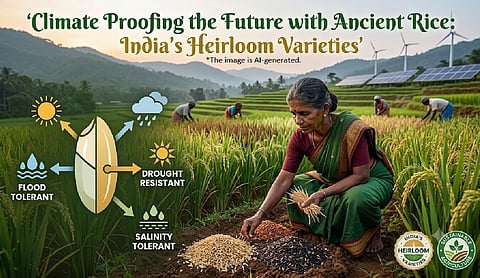
India’s heirloom rice varieties offer more than agricultural heritage; they hold genetic resilience shaped over centuries. From flood and drought tolerance to salinity resistance and nutritional richness, these ancient grains reveal how traditional farming wisdom can help climate-proof India’s food future.
As climate change tightens its grip on Indian agriculture, the search for resilient crops has become one of the defining challenges of our time. Floods are inundating fertile plains, prolonged droughts are exhausting groundwater, and rising sea levels are pushing saltwater into coastal farmlands. Scientists are investing heavily in developing climate-resilient crops, yet some of the most promising solutions may not lie in sophisticated laboratories but in the forgotten seed baskets of India’s farmers. Long before climate resilience became a scientific objective, generations of cultivators across the subcontinent had already developed rice varieties capable of surviving floods, droughts, saline soils and other environmental extremes. In an age of climatic uncertainty, these heirloom grains are emerging as living repositories of genetic resilience.
For centuries, Indian agriculture thrived not because farmers cultivated a single superior variety of rice, but because they nurtured extraordinary diversity. Every landscape shaped its own seed. River valleys favoured varieties that could withstand seasonal flooding, dry uplands required drought-tolerant grains, while coastal communities preserved rice capable of growing in saline conditions. Farmers patiently selected seeds from the healthiest plants, refined them over generations, and adapted them to local soils, rainfall patterns and cultural preferences. This continuous dialogue between nature and cultivator transformed India into one of the world’s richest centres of rice agrobiodiversity, where thousands of indigenous landraces evolved long before the emergence of formal plant breeding.
The Green Revolution fundamentally transformed Indian agriculture by dramatically increasing food production and helping the country overcome chronic grain shortages. However, its success also encouraged widespread cultivation of a relatively small number of high-yielding varieties. As traditional landraces gradually disappeared from farmers’ fields, India lost an immense reservoir of genetic diversity that had evolved over centuries. This erosion of agrobiodiversity received little attention when productivity remained the overriding concern. Today, however, as climate change exposes the vulnerability of genetically uniform cropping systems, the value of these forgotten seeds is being reassessed by agricultural scientists worldwide.
Among India’s most remarkable heirloom varieties is Pokkali, cultivated for generations in the saline coastal wetlands of Kerala. Farmers had long recognised its ability to flourish in fields periodically inundated by seawater, but only recently has molecular research revealed the sophistication of its natural adaptations. Scientists have shown that Pokkali possesses unique genetic mechanisms that regulate salt balance within plant cells and activate complex stress response pathways, enabling it to tolerate not only salinity but also several related environmental stresses. What traditional farmers conserved through experience is now recognised by modern science as one of the world’s most valuable genetic resources for breeding climate-resilient rice.
Pokkali is far from an isolated example. Across India, numerous indigenous varieties illustrate how farmers responded to different ecological challenges with remarkable precision. Samba Mosanam is known for surviving prolonged flooding, while Kullankar performs well under drought conditions. Kuzhiyadichan combines tolerance to drought and salinity, Mattaikar adapts to drought and sodic soils, and Poongar and Sorna Masuri continue to thrive in saline environments. Such diversity demonstrates that climate adaptation was deeply embedded within India’s traditional farming systems centuries before the concept entered scientific literature.
Equally significant is the nutritional wisdom preserved within these heirloom grains. Traditional farmers rarely separated productivity from human health. Rice varieties were valued not only for their ability to withstand environmental stress but also for their nutritional and medicinal qualities. Mappillai Samba, long associated with strength and endurance in Tamil Nadu, contains high levels of antioxidants, iron and dietary fibre. Kerala’s Navara (Njavara) has occupied a distinctive place in Ayurvedic practice for centuries because of its therapeutic properties, while Kavuni, an ancient black rice, is rich in anthocyanins and other bioactive compounds now recognised for their health-promoting potential. These examples reflect an agricultural tradition that viewed food, health and ecology as interconnected rather than separate domains.
Behind every surviving landrace lies an equally remarkable system of indigenous knowledge. Farmers continuously selected superior seeds, exchanged them through community networks and adapted them to changing environmental conditions. Women played a central role in conserving seed diversity within households, ensuring that valuable genetic resources were passed from one generation to the next. Every village effectively functioned as a living seed bank, conserving biodiversity through cultivation rather than storage.
The future of Indian agriculture will depend not on choosing between traditional knowledge and modern science, but on bringing the two together. Plant breeders increasingly recognise that heirloom rice varieties possess genes that can strengthen future cultivars against floods, drought, salinity and emerging climatic stresses. Conserving indigenous seeds is therefore not an exercise in nostalgia but a strategic investment in national food security. Among the many climate resilient landraces documented across India are Pokkali, Mappillai Samba, Navara, Kavuni, Samba Mosanam, Kullankar, Kuzhiyadichan, Mattaikar, Nootripathu, Norungan, Poongar, Sorna, Sorna Masuri, Karuthakar Poha, Aijong, Balijira, Kalijira, Kushal, Lal Kartika, Maloti, Moniraj, Najira, Saada Kartika, Sornomoshari, Swarnabh and Khonkosh, each preserving unique adaptations shaped by centuries of farmer innovation.
As India prepares for an increasingly uncertain climatic future, these ancient grains offer a powerful reminder that resilience is often inherited rather than invented. The farmers who patiently shaped these landraces were not merely cultivating crops; they were building a genetic insurance policy for generations they would never meet. Rediscovering and conserving this indigenous seed wisdom may prove to be one of the most important agricultural investments of the twenty-first century.
Meenakshi Lekhi, Former Minister of State for External Affairs, Govt. of India; Dr Navaneeth Krishnan S, Senior Research Fellow, Bharat Ki Soch; Views presented are personal.