China's first amphibious assault ship enters final trials
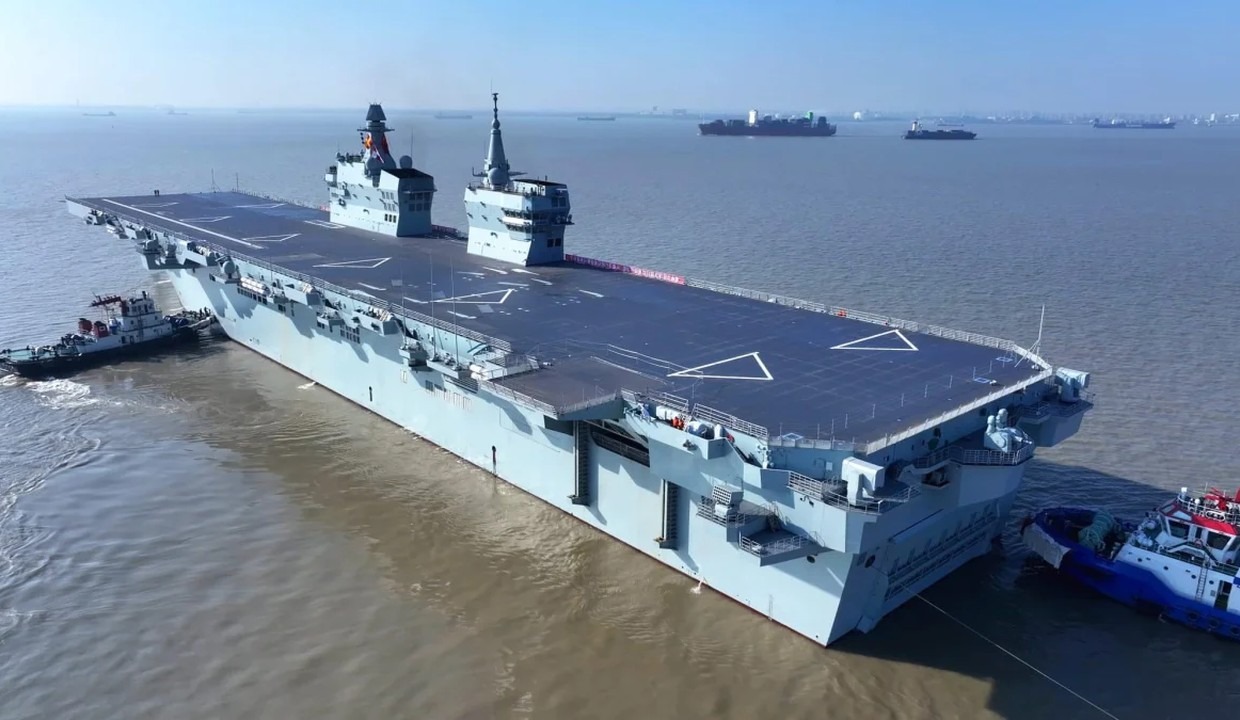
China's first amphibious assault ship, Sichuan, expected to become one of Beijing's key assets in any potential action against Taiwan, is in the final phase of sea trials, with state media airing computer-generated footage of it launching stealth combat drones.
Sichuan is the first amphibious ship in the world equipped with an Electromagnetic Aircraft Launch System (EMALS), which uses electromagnetic linear motors instead of steam catapults to launch aircraft.
An EMALS catapult system can accelerate landing and take-off of the aircraft smoothly and quickly. Besides the Sichuan, the system has been used on the US Navy's USS Gerald R Ford and China's aircraft carrier Fujian.
Computer-generated footage showing how Sichuan will launch GJ-21 stealth fighter drones was aired by the national state television broadcaster CCTV, with a military commentator saying the vessel is in the final stages of commissioning.
The 40,000-tonne Sichuan had full deck line markings, meaning it has entered the final testing phase, military expert Wei Dongxu told the state television.
The flat decked amphibious assault ship is expected to become one of Beijing’s most important assets in any potential action against Taiwan as it is designed to transport landing craft, troops, armoured vehicles and aircraft to support amphibious operations, the Hong Kong-based South China Morning Post reported.
The graphics aired on Wednesday depicted the Sichuan launching the GJ-21 stealth combat drone. Five more unmanned aerial vehicles were shown lined up along the island side of the flight deck as the sixth was catapulted into the air.
The GJ-21 is the naval carrier-based variant of China’s Hongdu GJ-11 “Sharp Sword” stealth unmanned combat aerial vehicle, developed by China’s Aviation Industry Corporation.
The Sichuan, dubbed the drone carrier, has three levels.
The upper level is the aviation hangar, while the middle and lower levels consist of a vehicle deck and a well deck, used to carry heavy ground combat equipment such as light tanks and amphibious assault vehicles, as well as multiple air-cushion landing craft.
Defence analysts say it is purpose-built for catapult launch and arrested recovery from ships without risking pilots, marking a major step in maritime unmanned aviation.
Defence analysts further say the new amphibious ship could enable the Chinese military for quick landing in the beaches in any offensive to take over Taiwan.
China claims Taiwan as part of its territory and vows to integrate it with the mainland.
Wang Yunfei, a Chinese military affairs expert, told state-run Global Times on Friday that compared with its predecessor, the other amphibious assault ships operated by the Navy Sichuan has a new aviation control system with the new dual-island design.
China, which is manufacturing a variety of battleships and submarines at a rapid speed currently, has three aircraft carriers - the Liaoning, a refit of the Soviet-era ship commissioned in 2012; Shandong, an indigenously built 2nd aircraft carrier operationalised in 2019; and the Fujian.
It is also developing new fighter aircraft like J-15T, J-35 and KongJing-600 to operate from the aircraft carriers.
Analysts say with tensions on the rise with the US, China may build more aircraft carriers to operate in various global maritime routes.
China now has what media reports describe as the world's largest operating fleet, with about 234 warships compared with the US Navy's 219.
The Indian navy, which operates two aircraft carriers INS Vikrant and INS Vikramaditya, is also catching up by commissioning more naval ships to maintain its dominance in the Indian Ocean.
India’s navy currently numbers around 150 vessels, of which some 135 are thought to be classified as frontline combatants such as frigates, destroyers and submarines. Roughly 50 more are under construction, according to a recent report by the Post.